




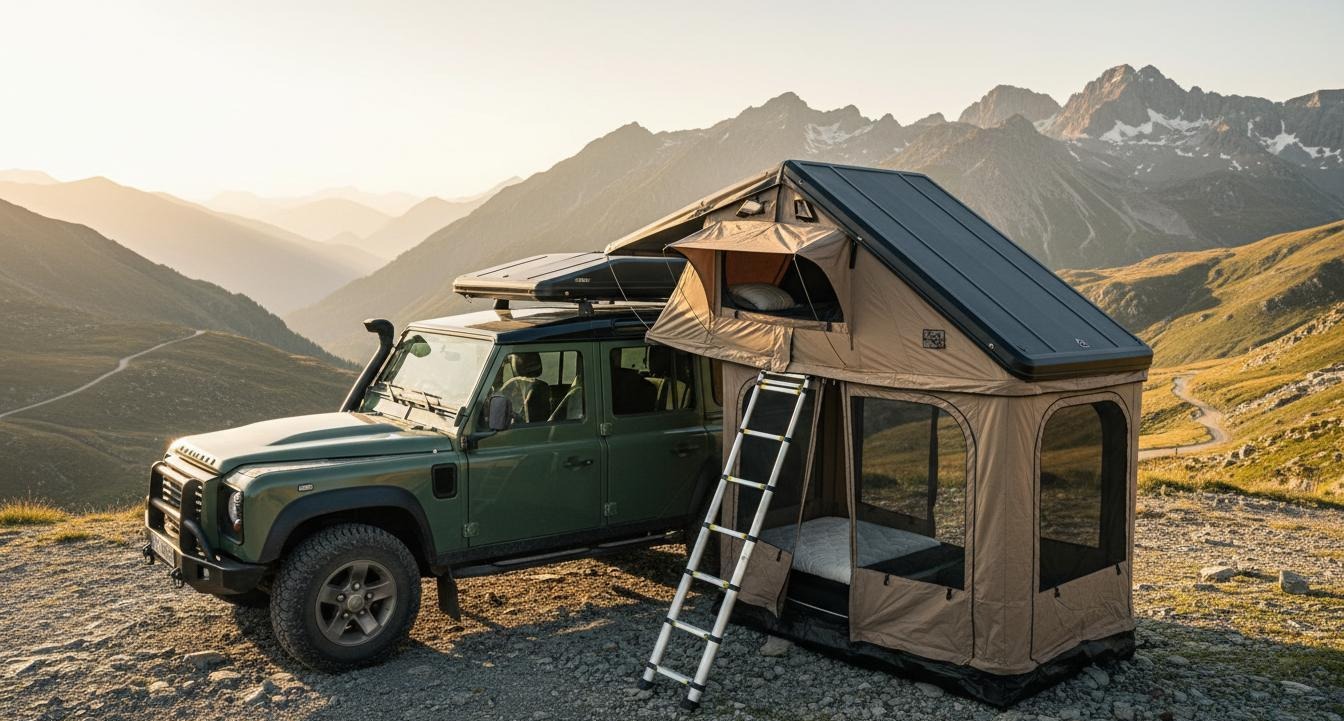
The European Overlanding Market in 2026: Why the Procurement Decision Matters Now
The European overlanding market has grown at 15–22% annually since 2020, driven by: the post-pandemic preference for self-contained outdoor travel; the expansion of overland route infrastructure (especially in Scandinavia, the Alps, and Iberia); the proliferation of 4×4 SUV platforms (Toyota Land Cruiser, Land Rover Defender, Mercedes G-Class) that support rooftop tent loads; and the Instagram and YouTube-driven cultural normalization of overland travel as a lifestyle category. The European rooftop tent market is projected to exceed €380 million by 2027, with hard shell tents representing approximately 60% of total unit sales. For retailers entering or expanding in this market, the procurement decision — material, weight class, price point — shapes the entire product category strategy.
Hard Shell Rooftop Tent Construction: ABS vs. Aluminum
ABS Thermoplastic Shell Construction
Acrylonitrile Butadiene Styrene (ABS) is a rigid thermoplastic widely used in automotive exterior panels, motorcycle helmets, and luggage. In rooftop tent applications, ABS shells are vacuum-formed or injection-molded over a structural framework, producing a one-piece or two-piece hard shell that hinges open to reveal the sleeping platform.
Key characteristics of ABS hard shell rooftop tents:
- Weight: ABS shells are significantly lighter than aluminum equivalents at equivalent dimensions — typically 15–25% lighter, which matters for vehicle roof load ratings and fuel efficiency
- Impact resistance: ABS has good impact toughness at room temperature and performs well in the ductile-brittle transition range for typical outdoor temperatures in Europe (-10C to +35C)
- UV degradation: ABS is susceptible to UV degradation over extended outdoor exposure — unpainted black ABS shells can become chalky and brittle after 3–5 years of constant UV exposure; UV-stabilized formulations and painted finishes extend service life significantly
- Thermal performance: ABS has low thermal conductivity, providing better insulation than aluminum in both hot and cold conditions — the shell does not radiate heat in summer or conduct cold in winter as aggressively as an aluminum shell
- Surface finish: ABS accepts painted finishes well and can be produced in a range of colors; textured finishes are common for scratch and fade resistance
- Repairability: Thermoplastic repair (plastic welding, body filler) is well-established; cracks can be repaired in the field with basic materials
Aluminum Alloy Shell Construction
Aluminum hard shell rooftop tents use aluminum alloy sheet (typically 1.5mm–3mm thickness, alloy 5052 or 6061) that is stamped, brake-formed, and welded into the shell panels. The result is an exceptionally rigid, durable shell with a different performance profile from ABS.
Key characteristics of aluminum hard shell rooftop tents:
- Durability: Aluminum shells are significantly more resistant to impact damage, hail, and tree branch contact than ABS. For customers who regularly overland on forest roads and mountain tracks, this damage resistance is a genuine practical advantage
- Longevity: Aluminum does not UV-degrade the way ABS does; an aluminum hard shell tent properly maintained will remain structurally sound for 15–20+ years
- Weight: Aluminum shells are heavier than equivalent ABS shells — typically 45–65kg for a two-person hard shell tent vs. 35–50kg for an equivalent ABS tent. This weight affects vehicle suitability, roof rack requirements, and fuel consumption
- Thermal conductivity: Aluminum conducts heat and cold more readily than ABS — in hot climates an aluminum tent can become uncomfortably warm, and in cold conditions the shell can radiate cold onto sleeping users. Thermal insulation liners inside the tent mitigate this
- Corrosion: Aluminum forms a natural oxide layer that provides good corrosion resistance in most environments; however, in coastal areas (salt air), the oxide layer can be compromised and galvanic corrosion can occur at joints and fasteners
- Repairability: Aluminum welding is more specialized than ABS repair; field repairs require a TIG/MIG welder or specialized adhesive systems, making field repair less accessible than for ABS
Head-to-Head: ABS vs. Aluminum for European Overlanding Applications
| Specification | ABS Hard Shell | Aluminum Hard Shell |
|---|---|---|
| Typical weight (2-person) | 38–52 kg | 48–68 kg |
| Impact resistance | Good (absorbs impact, may crack) | Excellent (bends, rarely cracks) |
| UV resistance | Moderate (requires UV-stabilized formulation) | Excellent (no UV degradation) |
| Thermal insulation | Good (low conductivity) | Moderate (high conductivity — needs liner) |
| Expected service life | 5–10 years (outdoor use, UV exposure) | 15–20+ years (outdoor use) |
| Corrosion resistance | Good (inert plastic) | Good (coastal requires care) |
| Field repairability | Easy (plastic welding) | Moderate (requires welding equipment) |
| Typical wholesale price range | $350–$650 | $550–$950 |
| Target retail positioning | Entry-to-mid premium | Mid-to-high premium |
The European Market Positioning Context
For European overlanding retailers, the material decision connects directly to target customer profile:
- ABS rooftops tents: Target the entry-to-mid premium buyer who has a daily-use SUV, values quick setup (sub-60-second deployment), and is price-sensitive. Popular with: young outdoor enthusiasts (25–40), families upgrading from canvas tents, urban customers discovering overlanding as a weekend activity
- Aluminum rooftop tents: Target the serious overlander who does extended trips, regularly drives on rough gravel and forest roads, and prioritizes durability and longevity. Popular with: experienced overlanders, professional guides, expedition vehicle builders. The aluminum tent is a long-term investment; the ABS tent is an accessible entry point
Specification Requirements for European Market Compliance
Vehicle Roof Load and Mounting Compatibility
European overlanders typically mount rooftop tents on: Toyota Land Cruiser (70 Series and 200 Series), Land Rover Defender (90 and 110), Mercedes G-Class, VW Amarok, Ford Ranger, and similar serious 4×4 platforms. These vehicles have roof load ratings of 75–100kg (dynamic) and significantly higher static ratings. However, the rooftop tent weight must be considered alongside the roof rack weight when calculating the margin.
Key Roof Load and Mounting Specifications to Verify
- Dynamic roof load rating: The vehicle manufacturer’s dynamic load rating (ISO 3870: typically 75–100kg for the vehicles listed above). The tent weight plus two occupants must not exceed this rating
- Roof rack compatibility: Confirm the tent’s mounting point spacing (typically 760–1220mm between rails) matches standard European roof rack channel dimensions (T-slot 20mm or 30mm)
- Wind load at highway speed: A hard shell tent at highway speed (130km/h) generates significant wind loads; verify the tent’s aerodynamics and mounting system are designed for highway-speed driving
- Crosswind stability: The tent’s profile when deployed creates lateral wind load; manufacturers should specify maximum safe wind speed for deployed tent
Waterproofing and Weather Performance
European overlanding conditions — especially in Scandinavia, Scotland, and Atlantic coastal routes — involve sustained rain, high winds, and temperature swings. Key specifications:
- Waterproof rating: The tent fabric (not the hard shell) should carry a hydrostatic head rating of at least 2,000mm for European weather conditions; 3,000mm+ for year-round or severe weather use
- Seam sealing: Factory-taped seams on all fabric-to-shell junctions; verify seam tape width and adhesion specification
- Condensation management: The space between the hard shell and the sleeping area fabric creates a condensation zone in cold weather; quality tents include ventilation provisions to manage this
- Operating temperature range: Confirm the tent is rated for the temperature range of your target markets — a tent rated for Mediterranean use may not perform at -5C in a Scottish highlands winter
European Regulatory and Standards Compliance
- CE marking: Required for rooftop tents sold in the EU; covers general product safety. The tent must comply with the General Product Safety Regulation (GPSR, EU 2023/988)
- REACH compliance: Chemical safety regulation for materials used in the product; relevant for tent fabrics, coatings, and adhesives
- UV stability certification: For ABS shells, the material should be UV-stabilized to a specification that matches the intended service life (typically minimum 3-year outdoor exposure rating)
The Overlanding Gear Trend Context for 2026
The top camping gear trends in 2026 directly affect rooftop tent category demand: the continued growth of “glamping” as a luxury outdoor experience format; the expansion of overland route infrastructure across Europe; the rising demand for compact, lightweight adventure equipment among urban millennial buyers; and the integration of rooftop tents into the “vanlife” and adventure vehicle ecosystem. European retailers sourcing rooftop tents in 2026 should position both ABS and aluminum options to capture the full range of this growing customer base.
Procurement Checklist: Hard Shell Rooftop Tent Wholesale
- Specify material type (ABS or aluminum) based on your target customer profile — do not assume one material suits all buyers
- Verify the tent weight against your target vehicle platform’s dynamic roof load rating; confirm 20%+ margin
- Confirm roof rack mounting point spacing matches standard European T-slot rack dimensions (20mm or 30mm T-slot)
- For ABS tents: confirm UV-stabilized formulation and request UV exposure test data or warranty terms for UV degradation
- For aluminum tents: confirm alloy grade (5052 or 6061), sheet thickness, and welding quality standard
- Verify tent fabric hydrostatic head rating (minimum 2,000mm for European conditions, 3,000mm+ for year-round use)
- Confirm CE marking and REACH compliance for EU market — request test reports from an accredited European test laboratory
- Request the manufacturer’s wind load rating for highway-speed driving and deployed tent maximum wind speed
- Clarify the tent’s operating temperature range — does it cover your target market’s seasonal conditions?
- Request samples for physical inspection: shell quality, hinge mechanism, fabric condition, zipper quality, and mattress density
- Assess the supplier’s production capacity and lead time against your seasonal inventory requirements
- Evaluate the supplier’s packaging and shipping configuration — a two-piece hard shell tent ships in two cartons; confirm these dimensions fit your import logistics
Need a Hard Shell Rooftop Tent Wholesale Supplier for Your Overlanding Retail Business?
CBNB Supplier — a Chinese cross-border supply chain platform with access to 36,000+ factory resources — connects European overlanding retailers with qualified hard shell rooftop tent manufacturers across both ABS and aluminum construction categories. CBNB’s procurement team supports specification development, factory qualification, sample evaluation, and logistics coordination for rooftop tent wholesale orders. Zhong Ji’s team has coordinated rooftop tent procurement programs for distributors across Germany, the Netherlands, Scandinavia, and the UK, with documented compliance support for CE marking and EU market requirements. View the hard shell rooftop tent product range and browse the CBNB Supplier platform for full camping and overlanding equipment sourcing.
Frequently Asked Questions
Q1: Which material — ABS or aluminum — is better for a European rooftop tent retail business?
The answer depends on your customer mix. For a retailer targeting the broader European market — including entry-level buyers, weekend overlanders, and urban customers upgrading from canvas — ABS hard shell tents provide the accessible price point (typically $350–$650 wholesale) and lighter weight that these buyers require. For a retailer focused on serious overlanders and expedition buyers who prioritize durability and longevity — willing to pay $650–$950 wholesale for an aluminum tent that will last 15–20 years — aluminum is the appropriate specification. The most successful European rooftop tent retailers carry both categories, with the ABS line capturing volume and the aluminum line capturing margin and loyalty from committed overlanders.
Q2: What is the realistic service life of an ABS hard shell rooftop tent in European outdoor conditions?
An ABS hard shell rooftop tent from a quality manufacturer, using UV-stabilized ABS formulation and protected by a painted or textured finish, will typically maintain structural integrity for 5–8 years of regular seasonal outdoor use. The primary degradation mechanism is UV exposure — which causes surface chalking and progressive embrittlement of the ABS. The tent’s effective service life can be extended significantly by: storing the tent indoors during extended periods of non-use; using a rooftop tent cover when the vehicle is parked outdoors for months; and selecting tents with factory-applied UV-resistant coatings. For buyers seeking 10+ year service life, an aluminum hard shell tent is the appropriate specification.
Q3: What CE compliance documentation should I require from a Chinese rooftop tent manufacturer for EU sales?
At minimum: (1) CE Declaration of Conformity (DoC) signed by the manufacturer, covering the General Product Safety Regulation (EU 2023/988); (2) Test reports from an EU-accredited testing laboratory covering: material safety (REACH compliance for fabrics, coatings, adhesives), structural integrity (roof load, hinge strength), and weather resistance (waterproofing, wind load); (3) Technical Construction File (TCF) maintained by the manufacturer, available for market surveillance authority review. Verify the test laboratory accreditation — the report must come from an ISO 17025 accredited lab, not just a Chinese test center.
Q4: How do I assess whether a Chinese rooftop tent manufacturer’s price is competitive or reflects quality compromises?
Price alone is not a quality indicator — but certain price signals deserve investigation. If an ABS hard shell tent is quoted below $300 wholesale for a 2-person tent, the UV stabilization formulation, mattress density, or hinge mechanism quality is likely compromised. Benchmark against the general wholesale range: 2-person ABS hard shell: $350–$650; 2-person aluminum hard shell: $550–$950. Below these ranges, request specific material specifications and test reports before proceeding. A reputable supplier will provide full material declarations and test data for a quality-conscious buyer; a supplier who resists providing this documentation is signaling that their product may not meet EU compliance standards.
Q5: How should I plan my rooftop tent wholesale order timing for the European seasonal market?
European rooftop tent retail demand peaks in Q1 (February–April) for spring/summer outdoor season purchasing. Wholesale orders should be placed by October–December of the prior year to allow for manufacturing (6–10 weeks), sea freight from China (4–6 weeks), EU port clearance, and inland distribution to your warehouse (1–2 weeks). A January delivery into your warehouse allows you to be shipping to retailers by February. For aluminum tents with custom specifications (non-standard colors, custom branding), add an additional 4–6 weeks for finishing and packaging setup.
CBNB Supplier — a Chinese cross-border supply chain platform with access to 36,000+ high-quality factory resources — specializes in outdoor recreation equipment procurement for international distributors. Zhong Ji leads product development and cross-border procurement optimization, with extensive experience coordinating rooftop tent and overlanding equipment sourcing for European retail and wholesale clients. Connect on LinkedIn | Follow on X | Follow on Facebook
Post time: May-26-2026