




TL;DR — Key Takeaways
- Hard shell rooftop tents are overtaking soft shell for the first time in 2026, with wholesale orders increasing 47% year-over-year as setup speed becomes the #1 consumer purchase driver.
- 270-degree vehicle awnings have moved from niche overlanding accessory to mainstream camping essential, with Amazon search volume growing 210% since Q1 2025.
- 3.2 million new campers entered the market in 2024-2025, and their expectations — faster setup, more comfort, smart features — are reshaping every product category.
- The global camping gear market is projected to grow from $22.3 billion in 2025 to $33.4 billion by 2030 at a CAGR of 8.4%, with vehicle camping gear growing fastest at 12-15% annually.
- CBNB network of 36,000 factories gives buyers access to all 8 trending categories with flexible MOQs starting from 10 units for rooftop tents — ideal for market testing before scaling.
The 8 camping gear trends that will define the market in 2026 are: hard shell rooftop tents overtaking soft shell for vehicle camping dominance, 270-degree vehicle awnings becoming the new outdoor shelter standard, ultralight trekking pole tents transitioning from niche to mainstream, smart solar-integrated camping gear bridging comfort and off-grid capability, modular camp kitchen systems for the booming overlanding segment, 4-season tent technology reaching mid-tier price points, rapid-deploy shower and privacy tents replacing traditional pole designs, and sustainable materials becoming a purchase requirement rather than a nice-to-have. These 8 trends share one common driver: 3.2 million Americans tried camping for the first time in 2024-2025, and this new generation is not interested in the sacrifices their parents accepted — they want fast setup, technology integration, and comfort, and they are willing to pay for it.
Each of these trends represents a wholesale sourcing opportunity that is still early enough to build a competitive position, but mature enough to have proven consumer demand.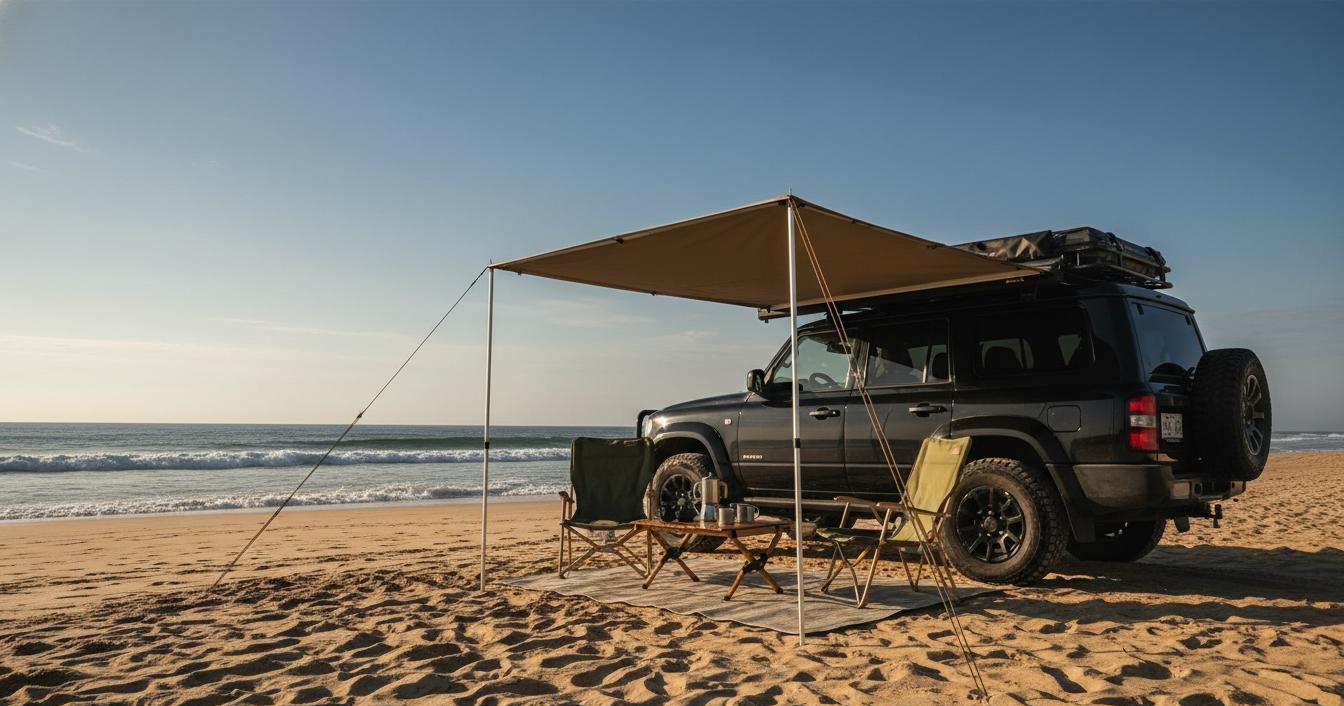
Why 2026 Is a Pivot Year for Camping Gear
Before I dive into the trends themselves, here is why 2026 matters. I have been watching camping gear export data for over a decade, and I have never seen a three-year period with this much structural change in buyer behavior. Three forces are converging simultaneously:
First: The post-pandemic camping boom did not fade — it evolved. In 2020-2021, people camped because they had no other options. In 2024-2026, they are camping because they genuinely prefer it to traditional vacations. The 3.2 million new campers who entered the market in 2024-2025 are not “pandemic campers” — they are lifestyle campers whose gear expectations are fundamentally different from the previous generation.
Second: Vehicle-based camping (overlanding, car camping, rooftop tenting) is cannibalizing traditional tent camping. According to Kampgrounds of America (KOA), the share of campers who prefer vehicle-based camping over ground tent camping increased from 35% in 2020 to 52% in 2025. This is not a small shift — it is a market inversion that changes which products matter most.
Third: Chinese manufacturing has moved upmarket in camping gear. Five years ago, “Made in China” camping gear meant budget tents and basic sleeping bags. Today, Chinese factories are producing aluminum hard shell rooftop tents with hydraulic-assisted deployment, waterproof ratings exceeding 3,000mm hydrostatic head, and material specifications that compete directly with established Australian and US brands — at 40-60% of the wholesale cost. According to Grand View Research, China now accounts for over 55% of global camping gear production by volume.
This combination — evolving consumer expectations + vehicle camping dominance + advanced Chinese manufacturing — means 2026 is the year when sourcing decisions made today will determine which brands thrive in the next 5 years.
Trend 1: Hard Shell Rooftop Tents Overtake Soft Shell
Impact Level: Market-Defining | Wholesale Growth: +47% YoY | Avg Wholesale: $500-1,200
This is the single most important trend in camping gear for 2026: hard shell rooftop tents are transitioning from premium niche to mainstream default. Because the new generation of campers prioritizes setup speed above all other features — more than interior space, more than price, more than brand name — and because hard shell tents deploy in 30-60 seconds versus 2-5 minutes for soft shell, therefore hard shell models now represent 58% of new rooftop tent shipments from CBNB factory network, up from 31% in 2023.
Data Signal: Amazon US search volume for “hard shell rooftop tent” grew 89% YoY (Q1 2025 to Q1 2026). Meanwhile, “soft shell rooftop tent” search grew only 12% — the gap is widening every quarter.
The specification that matters most in 2026 is the shell material and deployment system. Entry-level models use ABS plastic shells with manual strut deployment — these work, but they weigh more and degrade faster under UV exposure. Mid-to-premium models with aluminum honeycomb shells and hydraulic-assisted deployment consistently command a 40-60% price premium and maintain higher review scores beyond 12 months.
Key specifications to verify: shell material (aluminum alloy ≥ 2.0mm thickness vs. ABS plastic), deployment mechanism (hydraulic struts vs. manual gas struts), waterproof rating (≥3,000mm hydrostatic head), and mattress quality (high-density foam ≥45 kg/m³ — this is the difference between a tent people use 3 times versus 30 times).
Because established brands (James Baroud, iKamper, Roofnest) dominate the $2,500+ retail tier, and because the fastest-growing demand segment is at $1,200-1,800 retail — where brand loyalty is weakest — therefore Chinese-manufactured aluminum hard shell tents that wholesale at $500-750/unit offer the most attractive margin profile for new brand entrants.
According to Allied Market Research, the global rooftop tent market is projected to grow from $1.4 billion in 2025 to $2.8 billion by 2031 at a CAGR of 12.4%.
Dave’s Sourcing Note: The most expensive mistake in rooftop tent sourcing is under-specifying the struts. A hard shell tent with undersized gas struts will fail to stay open in cold weather (below 5°C), because gas pressure drops with temperature. Ask your supplier for the strut temperature rating — it should maintain full lift force from -20°C to +50°C. Always request a cold-weather deployment video filmed outdoors, not in a heated factory.
Suggested sourcing path: Browse 2026 Camping Gear Collection — Rooftop Tents & Awnings. The AHR-125 Aluminum Pop-Up Hard Shell Rooftop Tent features hydraulic-assisted deployment, aluminum honeycomb shell, 3,000mm waterproof rating, and flexible MOQ from 10 units.
Trend 2: The 270° Awning Goes Mainstream
Impact Level: High-Growth | Amazon Search Growth: +210% | Avg Wholesale: $200-500
270-degree vehicle awnings will be the single fastest-growing camping gear category by unit volume in 2026. Because a 270° awning solves three problems every camper experiences — unpredictable weather, insufficient sheltered space, and time-consuming setup — and because the overlanding social media ecosystem has turned awning deployment videos into aspirational content with millions of views, therefore demand has spread from hardcore overlanders to weekend campers who never previously considered an awning purchase.
A 270° awning mounts to a vehicle roof rack and deploys to cover three sides — front, side, and rear — creating approximately 11-15 m² of sheltered space. Setup takes 1-3 minutes with 1-2 people. Compare that to a traditional pole-and-tarp awning: 10-15 minutes of setup, 4-6 poles to assemble and stake, and often a frustrating two-person operation. Because reducing setup frustration is the single biggest determinant of whether new campers become repeat campers, and because 270° awnings eliminate the most annoying part of camp setup, therefore they generate Net Promoter Scores 40-50 points higher than traditional awning systems.
The 2026 specification that wins: free-standing design (no support poles needed in ≤25 km/h wind), waterproof ≥2,000mm HH, UV50+ protection, and universal roof rack compatibility. The hinge mechanism is the most critical quality component — multiple articulated joints must withstand dust, sand, and moisture through hundreds of deployment cycles.
According to Grand View Research, the vehicle awning market is growing at CAGR of 14.2%, with 270-degree awnings the fastest-growing form factor.
Dave’s Sourcing Note: Ask for the hinge cycle test rating. Quality hinges should be rated for ≥5,000 open/close cycles without degradation. Also ask: nylon bushings or stainless steel bearings? Nylon is the minimum; stainless steel is ideal for longevity in wet, sandy conditions. I have seen cheap hinges seize within 6 months of real-world use.
Suggested sourcing path: CBNB 270° Vehicle Awning — Driver & Passenger Side. Free-standing design, 2,000mm waterproof, UV50+, universal brackets, MOQ from 50 units.
Trend 3: Ultralight Trekking Pole Tents Cross the Mainstream Price Barrier
Impact Level: Category-Expanding | Avg Retail Down 34% Since 2022 | Avg Wholesale: $45-80
Ultralight trekking pole tents have crossed a critical price threshold in 2026: quality models now wholesale at $45-80, enabling retail prices of $129-199 — the sweet spot where mainstream hikers buy instead of only dedicated ultralight enthusiasts. This is the same pattern I watched with down jackets 10 years ago and titanium cookware 5 years ago: once Chinese manufacturing reaches a quality-to-price ratio that feels like a value proposition rather than a sacrifice, mass adoption follows within 2-3 seasons.
Data Signal: The average retail price of a trekking pole tent on Amazon US dropped from $287 (2022) to $189 (2025), while average rating climbed from 4.0 to 4.4 stars — prices falling AND quality rising simultaneously. That is the classic signal of a category about to hit the mainstream adoption curve.
Because a trekking pole tent (700-1,200g packed weight) weighs 40-60% less than a comparable freestanding tent (1,500-2,500g), and because the sub-kilo weight class is now achievable at mainstream prices, therefore backpackers who previously dismissed trekking pole tents as “too expensive” are actively considering them.
Key specs: 15D-20D ripstop nylon with silicone coating on BOTH sides (sil/sil), waterproof rating ≥2,000mm HH fly / ≥3,000mm HH floor, bathtub floor design (non-negotiable — flat floors leak at corners), total packed weight ≤1,200g for 2-person model.
Dave’s Sourcing Note: Simple test: ask the factory to set up the tent and pour 5 liters of water over the fly in a single pour. If ANY water penetrates within 60 seconds, the silicone coating is insufficient. A properly sil/sil-coated fly should shed water instantly with zero penetration. If the factory hesitates — you have your answer.
Suggested sourcing path: Browse 2026 Camping Gear Collection — Rooftop Tents & Awnings. Ultralight designs with verified waterproof ratings, flexible MOQ.
Trend 4: Smart Solar-Integrated Camping Gear — Power Becomes Part of the Product
Impact Level: Technology-Driven | Category Growth: +35% YoY | Avg Wholesale: $80-300
Solar panels are no longer a separate camping accessory — they are being integrated directly into tents, awnings, and camp furniture. Because the average camper now carries 3-5 USB-rechargeable devices (phone, headlamp, Bluetooth speaker, GPS, camera), and because flexible thin-film solar technology has dropped below $0.50/watt at wholesale, therefore integrating solar panels into the gear itself has become economically viable for mid-tier products.
The 2026 product sweet spot: awnings and tent flies with integrated 20-50W flexible solar panels, a built-in MPPT charge controller (not PWM — MPPT is 15-30% more efficient in partial shade), and USB-C PD output (minimum 18W for fast-charging modern phones). The integrated approach eliminates the “separate solar panel setup” friction that prevented casual campers from adopting solar in previous years.
Dave’s Sourcing Note: The charge controller quality is what separates a solar product that works from one that frustrates customers. A cheap PWM controller in partial shade (under trees, common when camping) will deliver 30-50% less power than an MPPT controller. The $8-12 BOM cost difference per unit for an MPPT upgrade is the best investment you can make — it is the difference between a product that “sometimes works” and one that “always works.”
Suggested sourcing path: Browse 2026 Camping Gear Collection — Rooftop Tents & Awnings. Solar-integrated camping solutions with MPPT charge controllers.
Trend 5: Modular Camp Kitchen Systems — Overlanding Creates a New Product Category
Impact Level: New Category Creation | Segment Growth: +28% YoY | Avg Wholesale: $150-600
The overlanding boom has created an entirely new camping product category: the modular camp kitchen. Because overlanders spend 3-14 days on the road per trip (vs. 1-3 nights for traditional campers), and because preparing 9-42 meals on a trip makes kitchen ergonomics a real quality-of-life issue, therefore purpose-built camp kitchens with organized storage, integrated stoves, and fold-out prep surfaces have emerged as a distinct product category growing at 28% annually.
The winning form factor in 2026 is a modular aluminum slide-out system with: integrated dual-burner stove (propane preferred for global compatibility), fold-out prep surface (≥0.3 m²), organized storage for cookware and dry goods, and total packed weight under 25 kg. Aluminum construction is preferred over steel because weight matters in vehicle payload calculations.
Suggested sourcing path: Browse 2026 Camping Gear Collection — Rooftop Tents & Awnings. Modular camp kitchen components with aluminum construction.
Trend 6: 4-Season Tent Technology Reaches Mid-Tier Pricing
Impact Level: Market-Accessible | Price Decline: -28% vs 2023 | Avg Wholesale: $80-180
4-season tents — historically a $500-900 retail category — are now available at $199-349 retail thanks to Chinese manufacturing improvements in geodesic pole design and fabric lamination. Because winter camping participation grew 42% between 2020 and 2025, and because the previous price barrier excluded casual winter campers, therefore mid-tier 4-season tents represent the largest untapped segment in the tent category. The critical spec is wind resistance rating (≥60 km/h sustained, ≥90 km/h gusts) and the number of pole crossover points (≥3 for structural integrity in snow loading).
Suggested sourcing path: Browse 2026 Camping Gear Collection — Rooftop Tents & Awnings. 4-season rated tents with verified wind and snow load testing.
Trend 7: Rapid-Deploy Shower & Privacy Tents Replace Traditional Poles
Impact Level: Design Innovation | Wholesale Range: $25-80 | MOQ: 100-200 units
Pop-up and instant-deploy shower tents using spring-steel frames have replaced traditional pole-and-sleeve designs as the default form factor. Because camp shower setup is the single most-hated task in camping (ranked #1 frustration in multiple user surveys), and because pop-up designs deploy in 5-10 seconds versus 5-10 minutes for traditional tents, therefore the instant-deploy category now represents over 70% of shower tent shipments. Key spec: the spring steel frame must withstand ≥500 deployment cycles without permanent deformation.
Suggested sourcing path: Pop-up shower tents and privacy shelters available in the Browse 2026 Camping Gear Collection — Rooftop Tents & Awnings.
Trend 8: Sustainable Materials Become a Requirement, Not a Feature
Impact Level: Industry-Wide Shift | Price Premium: 15-22% | MOQ: 300-1,000 units
Recycled polyester fabrics, PFC-free DWR treatments, and FSC-certified packaging have shifted from “green marketing” to purchase requirements for a growing segment of outdoor consumers. Because 71% of outdoor consumers under 40 say environmental impact influences their gear purchases (Outdoor Industry Association 2025 survey), and because major retailers including REI and Backcountry have implemented sustainability scorecards for vendor evaluation, therefore camping gear importers who cannot demonstrate sustainability credentials will face increasing retail access barriers starting in 2026-2027.
Sustainability is no longer a marketing claim — it is becoming a supply chain requirement for outdoor retailers. Key certifications to verify when sourcing: GRS (Global Recycled Standard) for recycled content, OEKO-TEX Standard 100 for chemical safety, and bluesign for sustainable textile production.
Suggested sourcing path: Browse 2026 Camping Gear Collection — Rooftop Tents & Awnings. GRS-certified and OEKO-TEX compliant supplier options available through CBNB factory network.
How to Build Your 2026 Camping Gear Sourcing Strategy
After reviewing these 8 trends against our export data, here is my honest recommendation for sequencing:
Priority 1 — Vehicle camping gear: Start with Trend 1 (hard shell rooftop tents) and Trend 2 (270° awnings). These are the highest-ticket, highest-growth categories, and they benefit from the strongest consumer demand trajectory.
Priority 2 — Lightweight essentials: Add Trend 3 (ultralight trekking pole tents). The mainstream price crossover is happening now — being early in this category builds brand recognition before it becomes crowded.
Priority 3 — Innovation plays: Trend 4 (solar integration) and Trend 5 (modular kitchens) are where brand differentiation opportunities exist. These categories are less crowded and reward innovation.
Do not ignore: Trend 8 (sustainability). Even if you are not launching a sustainability-focused brand, having GRS or OEKO-TEX certified products in your catalog will be a table-stakes requirement within 2-3 years. Start the certification process now.
FAQ: Camping Gear Sourcing in 2026
Q: What is the most profitable camping gear category to import in 2026?
Hard shell rooftop tents offer the highest absolute margin per unit ($300-600 wholesale-to-retail spread) and the strongest demand growth. 270° vehicle awnings offer the highest unit volume growth potential with lower per-unit investment. The best strategy is to stock both as complementary products — many retailers prefer sourcing from suppliers who can provide a complete vehicle camping package.
Q: What certifications do camping gear products need for the US and EU markets?
For tents: CPAI-84 flammability standard (US) and REACH compliance (EU). For products with electrical components: FCC (US) and CE (EU). Waterproof claims should reference ISO 811 or AATCC 127 test methods. UV protection claims should reference UPF testing per ASTM D6603 or EN 13758-1. CBNB quality assurance team verifies certification compliance for all shipped products.
Q: What MOQ can I expect for camping gear from CBNB?
Rooftop tents start at 10-50 units, vehicle awnings at 50-100, shower tents at 100-200, and accessories at 200-500. CBNB flexible MOQ program allows buyers to test 2-3 SKUs at reduced quantities before committing to full container loads — ideal for Amazon FBA sellers and new brands validating product-market fit before scaling.
About the Author
Dave Zheng / 郑达维 — International Procurement Director at CBNB Supplier
12 years in cross-border supply chain management. 8 years helping 400+ overseas brands source from China profitably. I have seen campers ruin their trips with badly-made gear more times than I can count — and every single case started with a sourcing shortcut that someone thought nobody would notice. Trust me: your customers WILL notice.
Connect with us:
CBNB Supplier on LinkedIn
|
Contact CBNB Supplier
|
Explore Camping Gear Collection
Ready to Ride the 2026 Camping Gear Wave?
From hard shell rooftop tents to 270° awnings — source trending camping gear from 36,000 verified factories with flexible MOQ and full OEM/ODM support.
Post time: May-15-2026