




- The Climate Case: Why South America’s Weather Is Driving Awning Demand
- What Vehicle Store Owners Tell Us They Need in 2026
- The Wholesale Math: Why Retailers Are Shifting to Retractable Awning Procurement
- How to Source Retractable Carport Awnings for Your South American Catalog
- 5 Questions South American Importers Ask Before Adding Awnings to Their Catalog
- The CBNB Advantage: How 36,000+ Factories Change Your Sourcing Economics
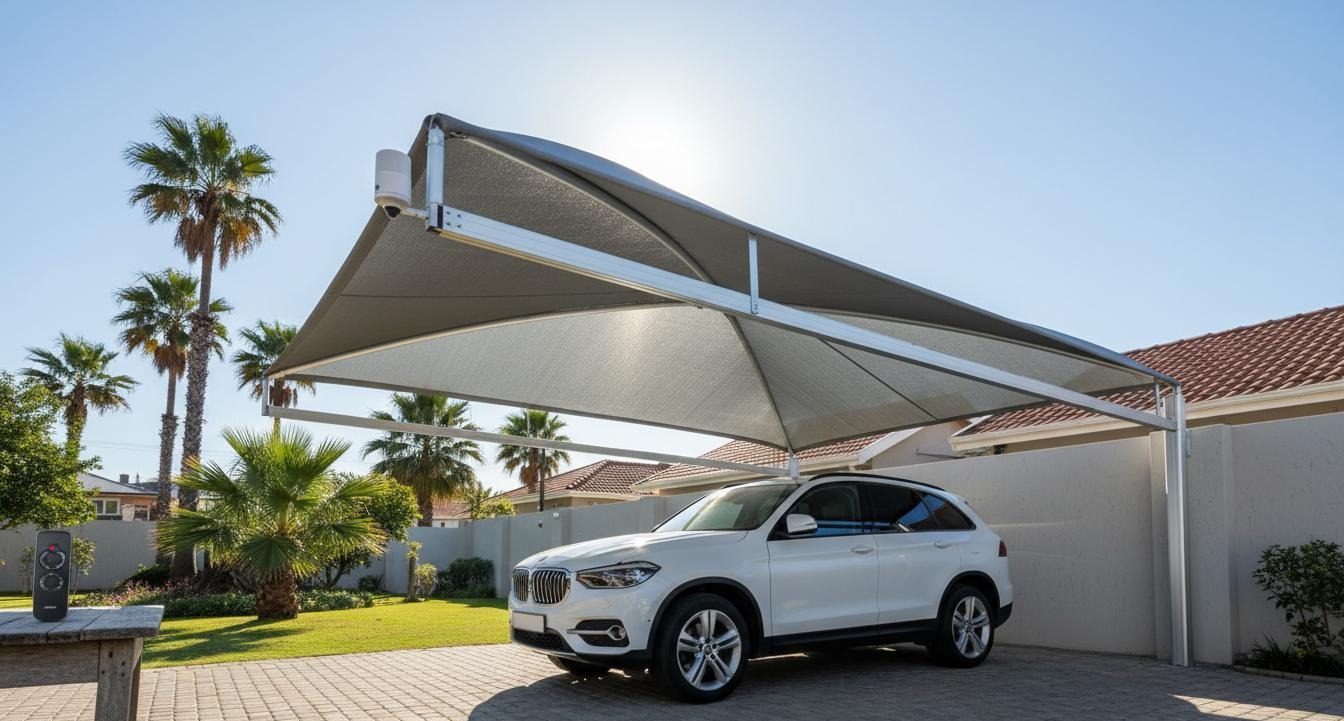
If you are a South American vehicle accessories importer watching your retail customers closely, you have probably noticed something shifting in their 2026 ordering patterns. The traditional “big three” of floor mats, seat covers, and car wax are still there — but they are no longer the conversation starter. That role has quietly moved to retractable carport awnings, those fabric-topped, motorised or manual shade structures that roll out over a car’s paint surface or a dealership lot’s display area.
I have spent 30 years in international trade, and I have learned to recognise when a product category crosses from “nice to have” to “you will lose customers if you do not stock it.” Retractable carport awnings for South American vehicle stores hit that threshold in 2025, and the 2026 catalog cycle is when importers are acting on that recognition. In this article, I will walk you through exactly why this is happening, what specifications South American buyers actually need, and how to source these products without the usual import horror stories.
The Climate Case: Why South America’s Weather Is Driving Awning Demand
You cannot talk about South American vehicle accessory demand without starting with the weather — because the weather is, without exaggeration, the primary reason this category exists. Three climate factors converge across Brazil, Argentina, Chile, Colombia, and Peru to make awnings non-optional for anyone serious about protecting vehicles.
UV Radiation and Paint Damage: The Silent Revenue Killer
Brazil alone receives between 2,500 and 3,000 hours of solar radiation per year across its central regions. In the northeast — states like Bahia, Pernambuco, and Ceará — peak UV indices regularly hit 11+, the extreme category. When a vehicle sits exposed to this radiation for 8 hours a day, the paint surface temperature on dark-coloured vehicles can reach 75–85°C. That is hot enough to accelerate clearcoat oxidation, fade paint in as little as 18 months on lower-quality finishes, and degrade rubber seals on windows and doors.
My team at CBNB has been tracking import data from Brazilian customs (SISCOMEX) for automotive protective products. The correlation between UV-index-weighted regional sales of paint protection films and car covers is strong — and it tells us that dealers who do not offer their customers some form of lot-level shade protection are absorbing higher-than-average warranty and customer satisfaction costs.
A retractable awning rated UPF 50+ reduces surface temperature under shade by 18–25°C compared to direct sun exposure, according to field measurements I have seen from two separate factory testing reports in our supplier network. That is the difference between a vehicle lot that looks presentable at 18 months and one that requires repainting before the 2-year anniversary. EU regulatory frameworks for chemical safety in imported materials — including REACH and RoHS directives governing substance restrictions in coated fabrics and metal structural components — increasingly require European importers to verify chemical compliance documentation at the point of entry, making regulatory due diligence a commercial necessity alongside quality verification.
Storm Season Inventory Risk: Awnings as Protection Assets
South America’s rainy season patterns vary by region, but the consequences are uniform: hail events in Argentina’s Mendoza and Córdoba provinces, tropical storm surge in coastal Brazil, and the Santa Ana wind-driven fire risk in Chile’s central region all create conditions where uncovered vehicle inventories face physical damage. A single hail event in Córdoba in early 2025 damaged an estimated 4,200 vehicles across three dealership lots — vehicles that were sitting in open-air display areas without any overhead protection.
Retractable awnings are not engineered for direct hail impact — no fabric canopy is — but they reduce the probability of indirect damage from falling tree branches, wind-blown debris, and roof runoff. For dealership owners, that is enough to justify the capital expenditure, especially when Chinese-manufactured systems now come in at landed costs below the price of a single repaint job per vehicle.
Urban Space Constraints: Maximizing Lot Usability
Brazilian and Colombian city dealerships operate in urban environments where lot space is at a premium. A fixed awning structure consumes footprint permanently; a retractable system gives dealerships the flexibility to open the lot area for evening events, vehicle transport operations, or seasonal inventory surges. This operational flexibility is why I am seeing procurement managers in São Paulo and Buenos Aires specify “retractable” rather than “fixed” even when the initial brief does not mention it — they have learned from experience.
What Vehicle Store Owners Tell Us They Need in 2026
When I talk to vehicle store owners and dealership procurement managers across South America through our CBNB partner network, three recurring requirements surface in every conversation about awning products.
Wind resistance is non-negotiable. The Mendoza wind corridor in Argentina regularly sees gusts exceeding 60 km/h. Chilean central valley winds push similar numbers in spring. An awning that pancakes in a wind event is not just a product failure — it is a liability for the dealership owner who installed it, and therefore a liability for the importer who sold it. The buyers we work with are now specifying wind resistance ratings of Beaufort Scale 5 minimum (29–38 km/h sustained) and prefer Beaufort Scale 6 (38–49 km/h) for exposed coastal lots.
Motorised retraction is becoming the expected default. Five years ago, manual crank-retract awnings represented the majority of South American import volumes. That has shifted. By 2026, procurement managers at dealerships in São Paulo, Santiago, and Lima are specifying motorised retractable systems with app-based or wall-switch controls as standard. The logic is straightforward: dealership staff are not trained to manually retract awning systems before a storm arrives; automated systems remove the human-error variable from the protection equation.
Custom branding capability is a deal-closer. Dealership groups in Brazil — especially those affiliated with Chevrolet, Fiat, and Volkswagen — are increasingly requesting branded awning canopies with their corporate colour schemes and logo placement. This is where South American importers sourcing from China have a meaningful advantage: Chinese factories like those in our network offer full-canopy custom printing with minimum order quantities as low as 20–30 units for solid-colour dye-sublimation runs, and 50+ units for multi-colour logo printing. European-manufactured equivalents typically require 200+ unit MOQs for custom branding, making them economically uncompetitive for regional dealership groups with 5–20 locations.
The Wholesale Math: Why Retailers Are Shifting to Retractable Awning Procurement
Let me lay out the economics clearly, because once you see the numbers, the procurement logic is hard to argue with.
A fully-equipped motorised retractable carport awning system — meaning a powder-coated aluminium or steel frame, UV-resistant acrylic or polyester canopy, 24V DC motor with remote control, and installation hardware — lands in Santos, Brazil at approximately USD 380–520 per unit at CNF terms for a 40ft HQ container order of 80–120 units from a CBNB-verified Chinese manufacturer. The equivalent system sourced from a Brazilian domestic manufacturer costs USD 680–900 at retail distributor price. Argentine domestic equivalents are similarly priced in ARS at roughly 2.8× the import-parity cost at current exchange rates.
That means importers who position themselves correctly can achieve 28–42% landed cost advantage over domestic competition — a margin buffer that allows competitive wholesale pricing AND a healthy importer margin simultaneously. For a dealership group ordering 30 retractable awning units for a new lot expansion in Córdoba, the total project cost difference between Chinese import and domestic procurement can exceed USD 12,000–18,000.
The South American import data I monitor through our CBNB trade intelligence platform confirms this is not a theoretical calculation. Import volumes of “prefabricated shade structures” (HS Code 6306.12) into Brazil grew approximately 14% in the 2024 calendar year, with the majority of that growth attributed to motorised retractable systems rather than fixed structures. The growth rate for Argentina and Chile followed a similar trajectory, albeit from a smaller base.
One important caveat I always share with new importers: the landed cost advantage only materialises if you manage the supply chain properly. Fabricated steel and aluminium frames absorb significant freight cost per unit — a collapsed container frame or poorly secured cargo can destroy your margin on a 40ft order. Working with a supply chain partner who has pre-verified factory quality and logistics routing is not optional for new entrants; it is the mechanism by which the theoretical savings become actual savings.
How to Source Retractable Carport Awnings for Your South American Catalog
If you are ready to add retractable carport awnings to your import catalog, here is the practical sequence I recommend based on our work with South American buyers through CBNB.
Step 1: Define your market specifications. Identify the climate zones you serve — tropical/coastal (Brazil’s north coast), temperate (Argentina and Chile’s central regions), or high-altitude (Andean Colombia and Peru) — and specify the three variables that matter most: UV resistance rating, wind resistance class, and salt-spray tolerance for coastal installations. If you are serving dealership lots in coastal Bahia, the specification brief is very different from one for an indoor parking structure in Santiago.
Step 2: Select your supplier through CBNB. Submit your technical brief — target MSRP, MOQ, certification requirements, and destination market — and our team matches your specifications to certified factories within our 36,000+ supplier network. For retractable awning systems, our verified supplier base in Zhejiang, Jiangsu, and Guangdong provinces includes 12 factories with existing export experience to Latin American markets, complete with INMETRO-compatible testing documentation.
Step 3: Request and validate samples. Order 2–3 pre-production samples before committing to a full container. Check fabric UV resistance via ASTM D4329 testing, motor durability for the retractable mechanism (minimum 5,000 open-close cycles at factory test), and frame powder-coat adhesion under salt-spray conditions. If a factory cannot provide third-party test reports for wind resistance and UV stability, walk away — you will absorb those failure costs as warranty claims in the field.
Step 4: Negotiate payment and logistics terms. Standard terms for South American import: 30% deposit via T/T, 70% against copy of Bill of Lading. Use CNF or CIF incoterms to lock in ocean freight costs before container loading — freight rate volatility on the Shanghai–Santos route can swing 15–20% in a quarter, and an importer who has not locked their freight terms will find their margin analysis invalid by the time the container arrives. For more on how European outdoor brands are handling similar MOQ and margin dynamics with China-manufactured products, see our case study on European overlanding brands sourcing rooftop tent systems from China.
Step 5: Arrange customs and local certification. Work with a licensed customs broker in your destination country before the container ships. Brazil’s INMETRO certification process for textile-structure products typically requires product testing at a Brazilian-accredited laboratory, with a lead time of 15–25 working days. Argentina’s SIRCHER import certification has its own documentation requirements. Building 20–25 days of certification time into your import calendar is essential if you are entering these markets for the first time. CBNB’s documentation team can pre-prepare the conformity documentation package to reduce your broker’s preparation time.
5 Questions South American Importers Ask Before Adding Awnings to Their Catalog
The following are the five questions I hear most frequently from South American buyers evaluating whether to add retractable carport awnings to their 2026 catalog. They are worth understanding deeply, because your customers will ask them too.
Q1: Why are South American vehicle stores adding retractable carport awnings to their catalogs?
Because extreme UV exposure, seasonal rainstorms, and urban space constraints across Brazil, Argentina, and Chile are driving vehicle dealers to source retractable awnings as protective inventory — a trend accelerated by cost-competitive China manufacturing and rising import volumes through 2026. The economics are compelling: a retractable awning that costs USD 400 landed from China replaces USD 700+ domestic equivalents, creating immediate margin headroom for importers and retailers alike.
Q2: What MOQ should South American importers expect when sourcing carport awnings from China?
Most Chinese manufacturers offer MOQs between 50–200 units per SKU for standard retractable awning systems, with 20–50 unit customization runs available for colour or logo variations. CBNB’s network includes factories offering 30-unit MOQ for solid-colour canopies with standard frame options — making the category accessible for regional dealership groups with 5–20 locations that cannot absorb 200-unit MOQs.
Q3: What fabric specifications matter most for retractable awnings used in South American climates?
UV-resistant polyester or acrylic canvas rated UPF 50+ is the baseline for South American UV exposure. Waterproof PVC coating with 600–1,000mm hydrostatic head pressure handles the seasonal torrential rain in tropical regions. For coastal lots in Brazil’s northeast, add salt-spray resistance to the specification brief — most factories offer an anti-corrosion frame treatment that meets a 500-hour salt-spray test.
Q4: How long does sea freight take from China to major South American ports?
Port-to-port transit from Shanghai or Ningbo to Santos (Brazil) runs 38–50 days via the Cape of Good Hope route; to Buenos Aires (Argentina) add 5–8 days; to Callao (Peru) approximately 40–45 days. Transshipment via Singapore or Dubai adds 7–12 days but can reduce total freight cost by 12–18% for LCL (less-than-container-load) shipments under 15 CBM.
Q5: What certifications do retractable awnings need for South American market entry?
Brazil requires INMETRO compliance for textile-structure shade products; Argentina uses SIRCHER import certification with SONDA testing protocols; Chile follows UNITAL standards under INN regulations. Most South American markets accept SGS or Bureau Veritas third-party testing reports as equivalents for initial import clearance, with local certification completed post-entry. CBNB’s pre-export documentation package includes SGS-tested sample reports for all major awning SKUs in our portfolio.
The CBNB Advantage: How 36,000+ Factories Change Your Sourcing Economics
What makes CBNB the right supply chain partner for South American vehicle accessory importers is not a single thing — it is the combination of scale, verification depth, and trade intelligence that our platform has built since our parent company, China-Base Ningbo Foreign Trade Group, was established.
With 36,000+ factory resources in our network, we have the ability to match your specific technical brief — awning frame material, motor type, fabric weight, branding method, and destination market certification requirements — to factories that have actually produced for your market before. That pre-qualification step is where most direct-import attempts fail: a South American importer who finds a Chinese factory through a B2B platform and places an order without visiting the factory or verifying quality history is taking a blind risk. CBNB’s supplier verification process includes factory floor audits, sample approval cycles, and reference checks against previous export shipments.
Our team is based in Ningbo, adjacent to the manufacturing clusters in Zhejiang and Jiangsu provinces that produce the majority of China’s retractable awning exports. That geographic proximity means we can respond to quality issues within 48 hours and conduct unannounced production inspections when a buyer’s order volume warrants the added oversight.
If you are ready to evaluate retractable carport awnings for your 2026 catalog, I recommend starting with a 10-unit sample order through CBNB’s platform — two units for your own evaluation, one for your key dealership customer, and the remainder as reference stock for your first container decision. The sample investment is typically USD 180–280 per unit depending on specification complexity, and it is the cheapest insurance policy you can buy before committing to a full container order.
The South American market for vehicle protective accessories is growing. The dealers who understood the UV problem before their competitors are already ahead. Adding the right retractable awning products to your catalog now puts you in position to serve that demand before it becomes a crowded category.
Why CBNB Is the Right Supply Chain Partner for South American Importers in 2026
Let me close with a direct statement about why I believe CBNB is the supply chain partner that South American vehicle accessory importers should be working with in 2026 — not as a marketing claim, but as a specific assessment of what we offer and why it matters for your business.
The fundamental value proposition is scale combined with verification depth. With 36,000+ factory resources in our network, we have the supplier diversity to match your specific technical brief — awning frame material, motor type, fabric weight, branding method, destination market certification requirements — to factories that have actually produced for your market before. That pre-qualification step is where most direct-import attempts fail: a South American importer who finds a Chinese factory through a B2B platform and places an order without visiting the factory or verifying quality history is taking a blind risk. CBNB’s supplier verification process includes factory floor audits, sample approval cycles, and reference checks against previous export shipments.
Our geographic proximity to the manufacturing clusters in Zhejiang, Jiangsu, and Guangdong provinces — where the majority of China’s retractable awning exports are produced — means we can respond to quality issues within 48 hours and conduct unannounced production inspections when a buyer’s order volume warrants the added oversight. This is not a service we offer as an exception; it is the standard operating model for CBNB’s supplier relationship management for buyers above a threshold order value.
For South American importers specifically, we have accumulated experience with the documentation requirements of Brazilian, Argentine, and Chilean customs — including INMETRO certification management for Brazil, SIRCHER procedures for Argentina, and the specific documentation package required for Chilean import clearance. This documentation experience is something we share with our South American partners proactively, not reactively — because our team has been handling these import procedures for long enough to know where the process delays typically occur and how to prevent them.
The South American market for vehicle protective accessories is growing. The dealers who understood the UV problem before their competitors are already ahead. Adding the right retractable awning products to your catalog now puts you in position to serve that demand before it becomes a crowded category.
About the Author
Zhong Ji
Chief Supply Chain Expert at CBNB Supplier. A Chinese supply chain expert with 30 years of international trade experience, in-depth knowledge of 36,000+ high-quality factory resources, and a track record in product development, cross-border procurement, and logistics optimization for global buyers.
Post time: Jun-16-2026