




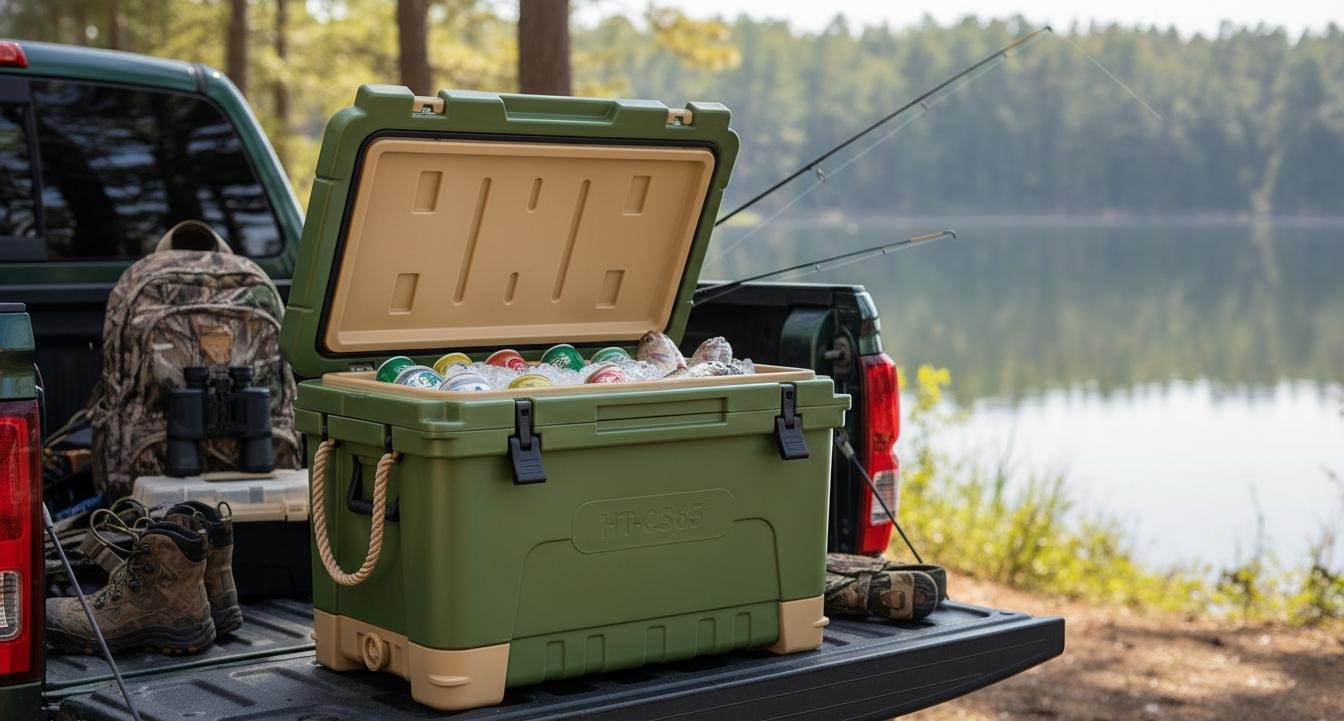
CBNB Supplier — a Chinese cross-border supply chain platform with access to 36,000+ factory resources and specialized expertise in outdoor recreation equipment procurement — supports hunting and fishing equipment distributors with rotomolded cooler box sourcing, specification verification, and quality inspection programs. Zhong Ji’s team at CBNB Supplier has coordinated cooler box procurement for distributors across North America, Europe, and Australasia.
The Ice Retention Claim: Why “5-Day Ice Retention” Is a Marketing Statement, Not a Specification
The phrase “5-day ice retention” appears on dozens of cooler box listings — but it is not a standardized specification. The actual ice retention performance of a rotomolded cooler depends on: the initial ice temperature and form (crushed vs. block ice); the ambient temperature and airflow around the cooler; the cooler wall thickness and foam density; the gasket quality and lid sealing pressure; the number of lid openings and duration of each opening; and whether the cooler is in shade or direct sunlight. A cooler tested in a 20C air-conditioned room with block ice in a static shaded position will outperform the same cooler in direct summer sun at 35C ambient. Before specifying a “5-day ice retention” cooler, confirm: the test protocol used (typically ASTM F2381 or equivalent), the test conditions (ambient temperature, ice type, test duration, and the temperature endpoint — typically when the internal temperature exceeds 4C or 5C), and whether the test was conducted by the manufacturer or by an independent accredited laboratory.
Rotomolded Cooler Manufacturing: How the Process Determines Quality
The Rotomolding Process
Rotational molding (rotomolding) is a manufacturing process where powdered polyethylene plastic is placed in a closed mold, which is then heated and rotated on two perpendicular axes. The melting powder coats the interior of the mold cavity, forming a seamless, stress-free wall. This process produces cooler boxes with distinct quality characteristics compared to injection molding or blow molding:
- Seamless construction: Unlike injection-molded coolers (which have a parting line seam) or blow-molded coolers (which have a pinch-off seam), rotomolded coolers are genuinely seamless — which eliminates the most common failure point in lesser cooler designs
- Uniform wall thickness: Properly controlled rotomolding produces consistent wall thickness throughout the cooler body — critical for consistent thermal performance and structural strength
- Thick wall sections: Rotomolded coolers typically have 35–60mm wall thickness (vs. 15–25mm for blow-molded coolers), which directly contributes to their thermal mass and ice retention capability
- Design flexibility: Rotomolding accommodates complex internal geometries, molded-in features (cup holders, cutting board channels, cargo grid systems), and non-uniform wall thickness profiles — useful for hunting-specific cooler designs
HDPE Material Specifications for Rotomolded Coolers
High-Density Polyethylene (HDPE) is the standard material for rotomolded cooler boxes. The grade and formulation of HDPE directly affects the cooler’s impact strength, UV resistance, and food safety compliance:
| HDPE Property | Specification Requirement | Why It Matters |
|---|---|---|
| Melt index (MI) | 2.0–5.0 g/10min (190C/2.16kg) | Balance of flow during molding and final impact strength |
| Density | 0.945–0.960 g/cm3 | Higher density = better stiffness and lower permeability |
| ESCR (environmental stress crack resistance) | >500 hours, ASTM D1693 | Resistance to cracking under stress (important for hinge area) |
| UV stabilizer | Carbon black 2–3% or HALS-based | Prevents UV degradation during outdoor use |
| Food contact compliance | FDA 21 CFR 177.1520 or EU 10/2011 | Required for coolers used with food and game |
Foam Insulation: The Core of Ice Retention Performance
The ice retention performance of a rotomolded cooler comes from the polyurethane (PU) foam fill between the inner and outer HDPE shells. The foam’s thermal resistance is the dominant factor in ice retention — more important than wall thickness alone. Key foam specifications:
- Foam density: Higher density foam (typically 30–45 kg/m3 for cooler applications) provides better thermal resistance than lower density foam. However, excessively high density can make the cooler heavier and does not improve thermal performance proportionally
- Closed-cell content: Higher closed-cell content (90%+ is target) prevents moisture absorption and maintains thermal resistance over the cooler’s service life
- Foam fill uniformity: The foam must fill the cavity completely with no voids — voids create thermal short circuits that dramatically reduce ice retention. Manufacturers should x-ray or ultrasound inspect samples from each production batch for void content
- Blowing agent: Cyclopentane is the environmentally preferred blowing agent (replacing CFC and HCFC agents); verify the foam system used meets current environmental regulations for your target market
5-Day Ice Retention: What It Actually Requires
The “5-day ice retention” performance standard — if genuinely achieved and independently verified — requires:
| Component | Specification Required for 5-Day Performance |
|---|---|
| Wall thickness | Minimum 45mm total (inner + outer shell + foam core) |
| Foam density | 35–45 kg/m3, minimum 92% closed-cell content |
| Foam void-free fill | 100% void-free, verified by non-destructive inspection |
| Lid gasket | Molded silicone or EPDM gasket, minimum 8mm diameter seal contact width |
| Lid hinge design | Molded-in hinge pins with corrosion-resistant coating |
| Drain plug | Large-diameter (minimum 50mm) threaded or quick-release drain with gasket seal |
| Test protocol | ANSI/NEBIC 5-day ice retention test (or equivalent, 32C ambient, 50% relative humidity) |
The cooler box product range on CBNB Supplier’s platform includes rotomolded coolers with specifications meeting these requirements — including HD65, HD75, and HD100 capacity configurations tested for hunting and fishing use conditions.
Durability Standards for Hunting and Fishing Applications
Impact Resistance
Hunting and fishing coolers are subject to impacts that consumer coolers are not: being loaded into truck beds, dropped on rocks, knocked against game poles, and in some cases bitten by large animals. Key durability specifications:
- Drop test: The filled cooler (with representative load) should survive a drop from 1 meter onto a hard surface without structural failure — specify this as a production test or request test data
- Impact indentation resistance: The HDPE outer shell should resist impact indentation from point loads (e.g., a rifle butt or game hook) without cracking or deformation that compromises the foam seal
- UV exposure durability: HDPE formulated with carbon black (2–3%) or HALS UV stabilizers maintains structural integrity after 3–5 years of outdoor UV exposure. Unprotected HDPE will become brittle and crack within 1–2 years of outdoor UV exposure
Leak and Seal Testing
For hunting and fishing use, the cooler must be genuinely waterproof, not just water-resistant:
- Lid seal integrity: The gasket must seal under compression across the full lid perimeter with no gaps at corners or hinge areas
- Drain plug sealing: The drain plug must seal under pressure (the cooler may be submerged in water, driven through streams) without leaking
- Rotomolded integrity: The seamless rotomolded shell has no seams to leak — confirm the manufacturing process is genuinely rotomolding (not a hybrid construction with glued or mechanically fastened panels)
Food Safety for Game and Fish Transport
When coolers are used to transport wild game and fish, food safety compliance is essential:
- Inner surface food contact: The inner HDPE surface must be formulated for food contact — HDPE with FDA food contact compliance or EU food contact regulation 10/2011
- Antimicrobial additive (optional): Some cooler manufacturers offer antimicrobial inner surface additives that inhibit bacterial growth on the cooler walls — relevant for extended game transport in warm conditions
- Cleaning and drainage: The cooler must drain completely through the drain plug and be cleanable without damage to gasket or foam
Supplier Qualification for Rotomolded Cooler Wholesale
Rotomolded Cooler Supplier Qualification Checklist
- Confirm rotomolding process — genuine rotational molding, not injection or blow molding
- Request HDPE material data sheet (MDS) confirming food contact compliance for your target market
- Request foam system data sheet confirming blowing agent and density
- Request independent ice retention test report (from accredited laboratory, not manufacturer internal test)
- Verify UV stabilizer inclusion in HDPE formulation — request material test report or include in purchase specification
- Request non-destructive foam fill inspection (X-ray or ultrasound) report for production samples
- Assess production facility: rotomolding machines (number and size), mold construction quality, QC procedures
- Request production sample for physical inspection: wall thickness (use ultrasonic gauge), gasket compression, hinge action, drain plug sealing, drop test
Procurement Checklist: Rotomolded Cooler Box Wholesale for Hunting and Fishing
- Specify genuine rotomolded construction — not injection or blow molded — and verify this during sample inspection
- Request independent ice retention test data from an accredited laboratory; confirm the test protocol, conditions, and temperature endpoint
- Specify HDPE material grade with food contact compliance (FDA 21 CFR 177.1520 or EU 10/2011) for hunting/fishing market
- Specify foam density (35–45 kg/m3), closed-cell content (92%+), and cyclopentane blowing agent in the purchase specification
- Include non-destructive void inspection (X-ray or ultrasound) as a production quality requirement
- Specify UV stabilizer in HDPE formulation — minimum 2% carbon black or equivalent HALS stabilizer — and verify with material test report
- Verify gasket material (silicone or EPDM), cross-section diameter (minimum 8mm), and compression characteristics
- Confirm drain plug diameter (minimum 50mm), threading, and gasket seal specification
- Request production samples and conduct physical inspection: wall thickness, drop test, lid seal test, drain plug test
- Assess the supplier’s packaging for shipping — rotomolded coolers are bulky; confirm carton dimensions, palletization, and container load efficiency
- Clarify warranty terms: what constitutes a defect, whether manufacturer covers return shipping, and typical resolution time
Need a Rotomolded Cooler Box Wholesale Supplier for Your Hunting and Fishing Distribution Business?
CBNB Supplier — a Chinese cross-border supply chain platform with access to 36,000+ factory resources — connects hunting and fishing equipment distributors with qualified rotomolded cooler manufacturers. CBNB’s procurement team supports specification development, factory qualification, independent ice retention testing coordination, and quality inspection programs for rotomolded cooler wholesale orders. Zhong Ji’s team has coordinated cooler box procurement programs for distributors across North America, Europe, and Australasia, with documented quality verification for ice retention, food contact compliance, and durability performance. View the rotomolded cooler box product range including HD65, HD75, and HD100 configurations, and browse the full cooler box category for hunting, fishing, and outdoor applications.
Frequently Asked Questions
Q1: How can I verify that a Chinese cooler box manufacturer’s “5-day ice retention” claim is accurate?
Request the actual test report — not a marketing document, but a physical test report from an accredited third-party laboratory (ISO 17025 accredited). The report should specify: the test protocol used (e.g., a variant of ASTM F2381 or a recognized 5-day protocol), the exact test conditions (ambient temperature, humidity, ice type and initial temperature, cooler load, lid opening protocol), and the temperature measurement methodology. If the supplier cannot or will not provide this report, treat the “5-day” claim as unverified and adjust your specification accordingly. A practical alternative: purchase sample coolers and conduct your own ice retention test under conditions that approximate your target customers’ use conditions — this is standard practice for serious distributors before committing to volume orders.
Q2: What is the difference between rotomolded, injection-molded, and blow-molded cooler boxes?
Rotomolded coolers are seamless, have thick walls (35–60mm), and offer superior ice retention and durability — they are the premium category. Injection-molded coolers use two molded halves that are joined at a parting line seam — which is a potential leak point and a stress concentration area. Blow-molded coolers are formed by inflating molten plastic into a mold cavity — they have thinner walls (15–25mm) and are significantly lighter but offer lower ice retention and impact resistance. For hunting and fishing applications where ice retention and durability are paramount, rotomolded construction is the appropriate specification. Budget and consumer-use coolers are commonly injection-molded or blow-molded.
Q3: How does rotomolded cooler weight affect logistics and shipping costs?
Rotomolded coolers are heavy relative to their volume — a 65-liter rotomolded cooler (HD65) typically weighs 7–10 kg depending on wall thickness and accessories. This affects shipping: a 20-foot container loads approximately 400–500 units of 65L rotomolded coolers (depending on carton configuration), vs. 1,000+ units of equivalent-volume injection-molded coolers. The higher per-unit freight cost should be factored into the landed cost calculation. When comparing rotomolded cooler quotations from different suppliers, confirm whether the quoted price includes packaging for sea freight ( carton + pallet configuration that maximizes container utilization) — poor packaging can reduce container loading by 20–30% and significantly increase the per-unit freight cost.
Q4: What UV stabilizer specification is needed for rotomolded coolers used in outdoor fishing and hunting applications?
For coolers that will spend significant time in direct sunlight (fishing kayaks, open truck beds, rooftop cargo), specify HDPE with minimum 2–3% carbon black UV stabilizer — this provides the most effective and cost-efficient UV protection for polyethylene. Alternative HALS (Hindered Amine Light Stabilizer) packages are available for cases where black coloration is not desired, but they are more expensive and less proven in HDPE outdoor applications than carbon black. Without UV stabilizer, unpainted white or natural HDPE will degrade (surface cracking, chalking, embrittlement) within 12–24 months of outdoor UV exposure in strong sunlight conditions. Confirm the material data sheet includes UV exposure test data or stabilizer inclusion verification.
Q5: What warranty terms should I negotiate for rotomolded cooler wholesale orders?
Standard warranty terms for rotomolded cooler wholesale orders from Chinese manufacturers: 12 months from date of shipment, covering manufacturing defects in materials and workmanship. Key negotiation points: (1) whether “defect” includes gasket seal failure, drain plug failure, and hinge failure — or only shell cracking; (2) whether defective units are replaced or credited — and who pays return shipping; (3) whether the warranty covers consequential damages (the cost of spoiled contents) or only the cooler itself; (4) whether warranty claims can be supported with photographic evidence and no physical return required — which is critical for international claims where return shipping costs exceed the cooler value. Establish the warranty terms in writing before the first order and include them in the purchase agreement.
CBNB Supplier — a Chinese cross-border supply chain platform with access to 36,000+ high-quality factory resources — specializes in outdoor recreation equipment procurement for international distributors. Zhong Ji leads product development and cross-border procurement optimization, with extensive experience coordinating rotomolded cooler box and outdoor equipment sourcing for hunting, fishing, and overlanding distributors worldwide. Connect on LinkedIn | Follow on X | Follow on Facebook
Post time: May-26-2026