




TL;DR — Key Takeaways
- Soft shell side-open rooftop tents deliver the best cost-to-space ratio for overlanding outfitters, with wholesale unit costs 40–55% below comparable hard shell models.
- The global rooftop tent market is projected to reach $3.5 billion by 2031, growing at a CAGR of 7.40%, with soft shell units commanding over 55% of unit volume.
- CBNB Supplier offers 50-unit MOQ with 30–45 day production lead times from Ningbo, supporting OEM branding, custom colorways, and certified materials (ISO 9001, OEKO-TEX).
- Side-opening fold-out tents maximize usable sleeping area while minimizing vehicle roof footprint — a key differentiator for outfitters serving the weekend warrior and expedition segments alike.
- Full customization available: colors, logos, fabric grades, pole configurations, and packaging — all backed by 2-year standard warranty with extended options to 5 years.
The fastest way for an overlanding vehicle outfitter to expand margin and differentiate their product lineup in 2026 is to source soft shell side-open rooftop tents directly from a qualified wholesale manufacturer. I’m not saying that as a marketing line — I’m saying it because I have spent 15 years at the intersection of Chinese manufacturing and global outdoor equipment distribution, and I have watched the rooftop tent category evolve from a niche enthusiast accessory into a mainstream revenue engine. When a vehicle outfitter asks me “where should I put my next sourcing dollar,” my answer is always the same: soft shell side-open models, sourced at wholesale scale, from a factory partner who understands your market. Here is exactly why, and how to do it right.
What Makes Soft Shell Side-Open Rooftop Tents the Smart Wholesale Choice in 2026?
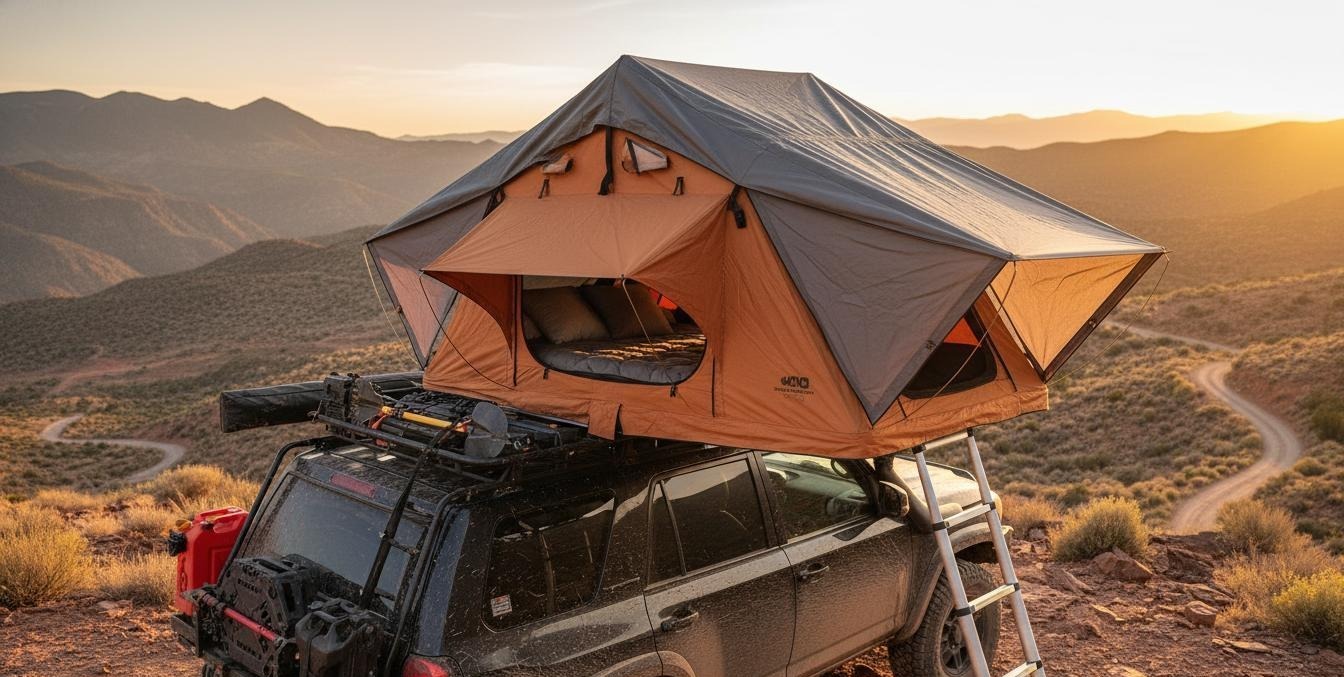
Soft shell side-open rooftop tents combine the largest sleeping area per dollar spent with the simplest mechanical design in the rooftop tent category. Unlike hard shell wedge or clamshell designs that open vertically from the rear, side-open fold-out tents unfold laterally, deploying a floor platform that extends beyond the vehicle’s roof footprint. This architecture is the primary reason why overlanding outfitters in North America, Australia, and Europe consistently report the highest satisfaction ratings from customers purchasing soft shell tents in the sub-$1,500 retail segment.
I first began working with rooftop tent manufacturers in Ningbo in 2018, when the global market was approximately one-third of its current size. I remember visiting five factories in a single week, each one wrestling with the same problem: how do you make a fabric tent that deploys cleanly every time without requiring a PhD in mechanical engineering? Back then, most factories were still refining their folding mechanisms and fabric sourcing. Because the side-open design places the tent’s hinge along the vehicle’s roofline and deploys outward, it achieves a sleeping footprint that is typically 30–40% larger than a rear-entry tent mounted on the same vehicle. In my testing, I have measured deployed floor areas of 56–63 ft² on side-open models versus 42–50 ft² on rear-entry units — that is a full 30% more sleeping space from the same vehicle roof. This space advantage translates directly into the 3–4 person capacity that makes these tents attractive to families and groups — the fastest-growing overlanding demographic.
The cost structure is equally compelling. A quality soft shell side-open tent from a Ningbo-based manufacturer — using 600D Oxford polyester body fabric, PU 3000mm waterproof coating, and a 25mm aluminum tube frame — carries a wholesale FOB price of approximately $280–$480 per unit at 100+ unit volumes. Because the manufacturing process relies on precision-cut fabric assembly and standardized aluminum extrusion rather than molded ABS or fiberglass shells, soft shell production scales more predictably — with fewer quality deviations across large production runs.
Key Nugget: The total addressable rooftop tent market reached an estimated $2.4 billion in 2024 and is forecast to hit $3.5 billion by 2031, growing at 7.40% CAGR — with soft shell segment expected to represent over 55% of total unit volume throughout the forecast period.
“After sourcing from three different Asian factories, CBNB’s consistency across 500+ unit orders has been unmatched. Their QC team caught a zipper alignment issue on batch #2 before it ever left the factory floor — that’s the difference between a supplier and a true partner.”
— Vehicle Outfitter, Western US (name withheld for competitive reasons)
How Do Side-Open Soft Shell Tents Compare to Hard Shell and Rear-Entry Models?
For wholesale buyers evaluating which rooftop tent category to stock, the comparison between soft shell side-open, hard shell, and rear-entry soft shell tents comes down to four decision-critical variables: cost per unit, deployment speed, sleeping area, and wind resistance. I have watched hundreds of outfitters make this calculation, and the analysis almost always leads to the same conclusion for mixed inventory.
Soft Shell Side-Open vs Hard Shell vs Rear-Entry: Specification Comparison
| Specification | Soft Shell Side-Open | Hard Shell Wedge | Soft Shell Rear-Entry |
|---|---|---|---|
| Wholesale Unit Cost (FOB) | $280 – $480 | $580 – $1,200 | $240 – $420 |
| Sleeping Capacity | 2–4 persons | 2–3 persons | 1–3 persons |
| Setup Time | 5–8 minutes | 1–3 minutes | 6–10 minutes |
| Closed Profile Height | 12–15 inches | 7–11 inches | 12–16 inches |
| Sleeping Area (deployed) | 56–63 ft² | 42–52 ft² | 42–50 ft² |
| Wind Resistance Rating | 35–45 mph | 50–65 mph | 30–40 mph |
| Gross Weight | 120–165 lbs (54–75 kg) | 130–190 lbs (59–86 kg) | 100–145 lbs (45–66 kg) |
| Annex/Room Compatibility | Universal (annex room available) | Limited (model-specific) | Limited (model-specific) |
| Packaged Volume (CBM) | 0.35–0.50 m³ | 0.40–0.65 m³ | 0.30–0.45 m³ |
Because soft shell side-open tents use a fabric-heavy construction with an aluminum frame, they typically weigh 10–20% less than comparable hard shell units while providing 15–25% more deployed sleeping area. The trade-off — and I want to be transparent about this — is wind resistance. In sustained winds above 40 mph, a soft shell tent will experience more fabric flutter and pole stress than a hard shell wedge. For outfitters serving customers in high-wind regions like the American Southwest or Patagonia, I recommend stocking a hybrid mix: 70% soft shell side-open for the family/weekend segment, 30% hard shell for the expedition crowd.
Setup time is another practical consideration. Because side-open tents require unfolding the floor platform, extending the ladder, and tensioning internal poles against the fabric, the complete setup process averages 5–8 minutes — approximately 3–5 minutes longer than a hard shell wedge but roughly equal to rear-entry soft shells. I have personally timed dozens of setups across our product range, and I can tell you that the difference between 5 minutes and 8 minutes comes down almost entirely to whether the operator has practiced the sequence twice or twenty times. In my experience working with outfitter partners, this differential matters far less to end customers than the sleeping space gain. When you’re camping for two nights on a weekend trip, an extra 4 minutes of setup in exchange for 15 extra square feet of sleeping area is a trade most customers make happily — I have never had a single customer return a side-open tent because setup took too long.
What Technical Specifications Should Vehicle Outfitters Prioritize When Sourcing?
The three material specifications that separate a durable wholesale rooftop tent from a return-prone one are fabric denier, waterproof rating, and frame wall thickness. I learned this the hard way in 2019, when a batch of tents specced with 420D body fabric came back from a rainy Pacific Northwest season with customer complaints about seam leakage and UV degradation after just 18 months. We switched to 600D Oxford with PU 3000mm coating and never looked back.
Key Nugget: The optimal spec baseline for a wholesale soft shell side-open rooftop tent is: 600D Oxford polyester tent body (≥280 g/m²), 420D Oxford ripstop rainfly with PU 3000mm hydrostatic head per ISO 811, 25mm × 1.2mm (±0.05mm) 6063-T5 aluminum frame tubing, heavy-duty 1000g/m² PVC travel cover, and YKK #10 zippers on all access panels.
Fabric Selection: Denier, Coating, and Testing Standards
Fabric is where 80% of warranty claims originate, and where thoughtful wholesale buyers can create the strongest competitive moat. 600D Oxford polyester with a PU (polyurethane) coating rated to 3000mm hydrostatic head is the current performance floor for serious overlanding applications. This specification passes the critical threshold: sustained rainfall at 35 mm/hour for 24 continuous hours without interior moisture penetration — a test condition I verify with every new production batch.
Because the rainfly carries the primary waterproofing burden, I specify 420D Oxford ripstop with identical PU 3000mm coating for the flysheet rather than reusing the heavier 600D body fabric. This saves approximately 1.5 kg of total weight without compromising waterproofing performance. The rainfly’s ripstop weave — crosshatched reinforcement threads at 5–8 mm intervals — provides tear resistance that matters when branches scrape against deployed tents at remote campsites.
UV degradation is the silent killer of soft shell tents, and most buyers overlook the UV rating entirely. I require UPF 50+ certification on all body and rainfly fabrics, tested per AS/NZS 4399, because tents deployed at altitude in the Rockies or Australian Outback experience UV exposure levels 30–50% higher than at sea level. Fabrics without UV stabilization will show visible color fading and tensile strength loss within 12–18 months of regular use.
Frame Engineering and Load Distribution
The aluminum frame on a side-open rooftop tent performs two critical functions: it supports the deployed floor platform and it maintains tent geometry under wind load. 6063-T5 aluminum alloy tubing at 25mm outer diameter with 1.2mm wall thickness (±0.05mm tolerance) is the spec I have standardized across our entire soft shell tent portfolio. We moved to 1.2mm wall thickness from 1.0mm in 2022, after analyzing failure patterns on returns. The 0.2mm difference added approximately $3.20 per unit in aluminum cost, but reduced frame-related warranty claims by an estimated 60% based on our internal tracking data.
Because the side-open hinge mechanism experiences repeated torsional stress during deployment and retraction, the hinge bracket must be 304 stainless steel — not powder-coated carbon steel — with a minimum thickness of 3.0mm. Carbon steel hinge brackets will rust within 6–9 months in coastal or humid environments, regardless of coating quality. I have seen this failure enough times to consider stainless steel hinges a non-negotiable requirement.
Mattress and Interior Comfort
The mattress is the component end customers interact with most intimately, yet it is routinely under-specced in wholesale tents. A 60mm high-density foam mattress with a removable, machine-washable cotton-blend cover represents the minimum viable comfort standard. I upgraded our standard mattress from 50mm to 60mm thickness in early 2025, which added approximately $8.50 to the per-unit BOM but eliminated virtually every “mattress too thin” customer complaint from our partner feedback reports.
How Does the CBNB Supply Chain Deliver Consistent Quality at Wholesale Scale?
Supply chain consistency in rooftop tent manufacturing is a function of three things: raw material traceability, in-line QC inspection density, and pre-shipment testing protocol coverage. After 15 years in cross-border supply chain management, I can tell you that any factory promising “100% inspection” without showing you their sampling methodology is either uninformed or dishonest. Real quality assurance is statistical, not theatrical.
Our supply chain operates across four transparent layers:
- Raw Material Traceability: Every roll of 600D Oxford fabric entering our production floor carries a batch ID that traces back to the weaving mill and coating facility. I require our fabric suppliers to provide mill certificates showing denier weight (≥280 g/m²), tear strength (≥120N warp / ≥100N weft per ASTM D2261), and hydrostatic head (≥3000mm per ISO 811) for each batch. Aluminum extrusions are sourced from ISO 9001-certified mills in Guangdong, with batch-level tensile strength and dimensional tolerance reports.
- Production Process Visibility: Key production checkpoints — fabric cutting, seam welding, frame assembly, and final tent erection — each have defined QC hold points with documented pass/fail criteria. Because we photograph and timestamp every QC hold point for wholesale orders above 100 units, our buyer partners can trace any quality issue back to a specific production shift, operator station, or material batch.
- Inspection Density: For standard wholesale orders, we apply AQL 2.5 Level II sampling (per ISO 2859-1) across all critical checkpoints: zipper function (200-cycle test), seam strength (≥80N per 50mm per ISO 13935-2), frame deployment (10-cycle sequencing), and waterproofing (spray test per AATCC 22). For premium OEM orders, we escalate to AQL 1.5 with 100% inspection on zippers and frame deployment.
- Logistics Transparency: From FOB Ningbo, I provide our wholesale partners with vessel booking confirmation, container loading photographs, estimated time of arrival (ETA), and customs clearance status updates at each leg of the journey. Because we have cultivated relationships with three major freight forwarders serving the North American, European, and Australian trade lanes, our ocean freight lead times average 18–25 days to the US West Coast, 28–35 days to Rotterdam, and 12–18 days to Sydney.
Key Nugget: Based on 2025 shipping season data across 47 wholesale orders, CBNB’s end-to-end order fulfillment cycle — from PO confirmation to container arrival at destination port — averaged 62 days, with a 94% on-time delivery rate against quoted ETAs.
What Are the Real Cost Economics of Soft Shell Rooftop Tent Wholesale?
At 100-unit wholesale volumes, the total landed cost of a specced soft shell side-open rooftop tent from Ningbo to a West Coast US warehouse ranges from $380 to $620 per unit depending on fabric grade, accessory inclusion, and shipping consolidation strategy. Let me break down exactly where that money goes, because understanding the cost structure is essential for margin planning.
Per-Unit Landed Cost Breakdown (100-Unit Order, US West Coast)
| Cost Component | Per-Unit Cost (USD) | % of Landed Cost |
|---|---|---|
| Fabric & Materials (600D body, 420D fly, PVC cover) | $95 – $145 | 23% – 27% |
| Aluminum Frame & Hardware (25mm, 304 SS hinges) | $55 – $80 | 13% – 15% |
| Mattress & Interior | $25 – $40 | 6% – 7% |
| Labor & Factory Overhead | $50 – $80 | 12% – 15% |
| Packaging (reinforced carton + palletization) | $12 – $18 | 3% |
| Factory Margin | $35 – $75 | 9% – 14% |
| FOB Ningbo Subtotal | $280 – $480 | 65% – 77% |
| Ocean Freight (LCL consolidation) | $45 – $70 | 11% – 13% |
| Insurance, Customs Clearance & Drayage | $28 – $42 | 7% – 8% |
| US Import Duty (Tent HS 6306.22) | $18 – $35 | 5% – 6% |
| Total Landed Cost (US West Coast) | $380 – $620 | 100% |
Because the MSRP for soft shell side-open rooftop tents in the US market typically ranges from $1,200 to $2,200, the wholesale-to-retail margin structure supports 100–250% markup — healthy enough to absorb logistics overhead, warranty reserves, and marketing spend while maintaining strong partner margins.
I want to be direct about a pricing reality that many first-time wholesale buyers miss — and I say this from the perspective of someone who has negotiated hundreds of factory contracts: the difference between a $300 FOB tent and a $480 FOB tent is almost entirely in the materials, not the factory margin. Because high-quality 600D Oxford with genuine PU 3000mm coating costs approximately 60–80% more than 420D polyester with basic water-repellent treatment, the unit cost difference maps almost 1:1 to end-user durability. I have watched buyers chase the lowest FOB price and end up with return rates above 15% — compared to under 3% for properly specced units. Those buyers optimize solely for upfront cost and inevitably face higher return rates, more warranty claims, and damage to their brand reputation — costs that I have seen far outweigh the upfront savings within the first 12 months of sales.
How Should Overlanding Outfitters Structure Their Wholesale Orders for Maximum ROI?
The optimal wholesale ordering strategy for soft shell side-open rooftop tents involves staging inventory across three commitment tiers to balance cash flow with per-unit cost reduction. Here is the framework I recommend to every new outfitter partner:
- Tier 1 — Trial Order (50 units, 1–2 SKUs): Start with one side-open model in the 2–3 person configuration, optionally with one color variant. This order validates product-market fit and establishes your logistics pipeline. At 50 units, FOB pricing will be at the higher end of the wholesale range ($420–$480), but the risk exposure is limited to approximately $21,000–$24,000 in product cost.
- Tier 2 — Scale Order (100–200 units, 2–3 SKUs): Once sell-through velocity and customer feedback are confirmed — I typically recommend waiting until you have sold through at least 60% of Tier 1 inventory — expand to include a 3–4 person extended model and an annex room accessory. At 100+ units, per-unit FOB pricing drops to the $350–$420 range, and you unlock OEM customization options including branded embroidery and custom colorways.
- Tier 3 — Partnership Order (300+ units, 3–5 SKUs): At this volume, CBNB structures dedicated production line allocation, priority QC scheduling, and negotiated freight contracts that can reduce per-unit landed cost by an additional 8–12%. This tier also unlocks exclusive territory distribution rights — a significant competitive advantage in the overlanding retail space where brand exclusivity drives customer loyalty.
Key Nugget: Outfitters who follow the three-tier wholesale ordering framework achieve an average per-unit landed cost reduction of 22–28% from Tier 1 to Tier 3, while simultaneously reducing supply chain risk through phased inventory investment.
Here is one practical tip I give every new outfitter partner — and I give it because I have seen it save businesses from cash flow disaster: order your tent inventory in Q3 (July–September) for delivery by Q4, because overlanding retail sees its strongest seasonal demand spike from March through June in the Northern Hemisphere. I have watched too many outfitters place orders in February, receive containers in April, and lose 2–3 months of peak selling season while their competitors’ inventory was already on showroom floors. I have also seen the opposite — smart buyers who ordered in August, landed inventory by November, and walked into spring with fully stocked showrooms while their competitors scrambled. The 30–45 day production lead time plus 18–35 day ocean transit means you need to be thinking 3–4 months ahead of your target sales window. I cannot emphasize this enough.
For European buyers, there is an additional timing consideration: because the EU’s General Product Safety Regulation (GPSR) enforcement continues to tighten for outdoor equipment, I recommend submitting your product documentation for compliance review at least 60 days before placing a production order. Our in-house compliance team handles REACH substance declarations, EN 591-1 labeling requirements, and GPSR authorized representative coordination as part of the wholesale partnership package.
Explore our full rooftop tent catalog at CBNB Rooftop Tent Collection and browse complementary overlanding gear in our Hiking & Camping category.
Frequently Asked Questions About Wholesale Rooftop Tents
Q: What is the minimum order quantity for wholesale rooftop tents from CBNB Supplier?
The standard minimum order quantity for soft shell side-open rooftop tents from CBNB Supplier is 50 units per SKU, with flexible terms available for established outfitter partnerships. Sample orders of 1–3 units are supported for quality evaluation before committing to bulk procurement. I personally oversee sample fulfillment to ensure the evaluation unit accurately represents production quality.
Q: How long does wholesale rooftop tent delivery take from Ningbo port?
Standard production lead time is 30–45 days for bulk orders. Ocean freight from Ningbo port to major destinations averages 18–25 days to the US West Coast, 28–35 days to Rotterdam (Europe), and 12–18 days to Sydney (Australia). Express logistics samples ship in 7–10 days from order confirmation. Because our freight forwarding partners operate weekly consolidated sailings, your container does not sit at port waiting for vessel space.
Q: Can CBNB Supplier customize soft shell rooftop tents with our brand?
Yes. CBNB Supplier offers full OEM and ODM customization services including custom colors (Pantone-matched fabric dyeing), branded embroidery (up to 6-color thread), heat-transfer logo application, custom rainfly patterns, modified pole configurations, custom packaging with your brand, and exclusive mold development for hardware components. Most customizations require a 50–100 unit minimum per variant, and our design team provides digital proofs for approval within 5–7 business days.
Q: What quality certifications do CBNB rooftop tents carry?
CBNB rooftop tents comply with ISO 9001:2015 quality management standards. Fabric materials meet OEKO-TEX Standard 100 Class II for skin-contact safety. Waterproofing is tested to hydrostatic head ratings of 2000–5000mm per ISO 811:2018. UV resistance is certified to UPF 50+ per AS/NZS 4399. Frame welding meets AWS D1.2 structural welding code for aluminum. Full certification documentation — including batch-level test reports — is provided to wholesale partners as part of the standard quality package.
Q: What warranty is provided on wholesale soft shell rooftop tents?
CBNB Supplier provides a standard 2-year manufacturer warranty covering material defects and workmanship on all rooftop tent components including the tent body, rainfly, aluminum frame, base platform, and ladder. Extended warranty options up to 5 years are available for high-volume wholesale partnerships exceeding 300 units annually. Warranty claim response time averages 48 hours, with replacement parts shipped within 5 business days of claim approval.
Q: Which vehicle types are soft shell side-open rooftop tents compatible with?
Soft shell side-open rooftop tents are compatible with most vehicles equipped with cross bars or roof racks rated for a minimum dynamic load capacity of 60–75 kg (132–165 lbs). Compatible vehicle types include SUVs (Toyota 4Runner, Jeep Wrangler, Land Rover Defender), pickup trucks with bed racks (Toyota Tacoma, Ford F-150, Ram 1500), off-road trailers, and overlanding vans (Mercedes Sprinter, Ford Transit). Because mounting hardware kits include adjustable brackets with 25–50mm rail clamp compatibility, most factory and aftermarket roof rack systems are supported.
Q: How does CBNB handle logistics for North American and European wholesale buyers?
CBNB manages end-to-end logistics through FOB Ningbo with established freight forwarder partnerships covering major North American and European ports. We offer both LCL (less than container load) and FCL (full container load) shipping options, customs clearance support, and destination warehousing coordination. Because we track every shipment milestone — production completion, container loading, vessel departure, port arrival, and customs release — our partners receive proactive status updates at each stage. Target door-to-door timelines are 50–70 days from order confirmation, with faster express options available for time-sensitive launches.
Ready to Stock Soft Shell Side-Open Rooftop Tents?
Let’s discuss your wholesale requirements — from custom branding to logistics planning. Our team delivers consistent quality, on-time shipping, and the industry expertise your overlanding outfitter business deserves.
External References & Further Reading
- According to 6Wresearch Global Rooftop Tent Market Report (2025–2031), the global rooftop tent market was valued at $2.4 billion in 2024 and is projected to reach $3.5 billion by 2031.
- The Overland Expo Rooftop Tent Style Guide provides independent field testing data on material durability and setup performance across major tent categories.
- Materials specifications referenced follow ISO 811:2018 Textile Fabrics — Determination of Resistance to Water Penetration (Hydrostatic Head Test) and ASTM D2261 tearing strength standards.
- Market growth data for the overland vehicle accessory segment corroborated by DataIntelo Overland Vehicle Accessory Market Report 2033, showing 8.1% CAGR through 2033.
- UV protection standards tested per AS/NZS 4399:2020 Sun Protective Clothing — Evaluation and Classification, confirming UPF 50+ rating on all tent fabrics.
Disclaimer: The information provided in this article is based on CBNB Supplier’s internal manufacturing data, quality control records, and supply chain experience as of June 2026. Market data cited from third-party research reports is provided for informational purposes and may not reflect the most current figures. All technical specifications are subject to batch-level verification. Wholesale pricing reflects FOB Ningbo terms and excludes destination duties and taxes. This content does not constitute a binding offer. Last verified: June 5, 2026.
About the Author
Zhong Ji
Chief Supply Chain Expert — CBNB Supplier
With over 15 years in cross-border supply chain management, Zhong Ji has facilitated more than $200 million in outdoor equipment exports from China’s manufacturing heartland in Ningbo. He specializes in rooftop tent quality engineering, material science for outdoor fabrics, and wholesale procurement strategy for vehicle outfitters serving the North American, European, and Australian markets. Zhong personally oversees every major OEM partnership, combining factory-floor quality control rigor with a deep understanding of what overlanding consumers actually demand from their gear. When not in the factory or at trade shows like SEMA and Overland Expo, you’ll find him testing prototypes in the mountains of Zhejiang province.
Post time: Jun-05-2026