




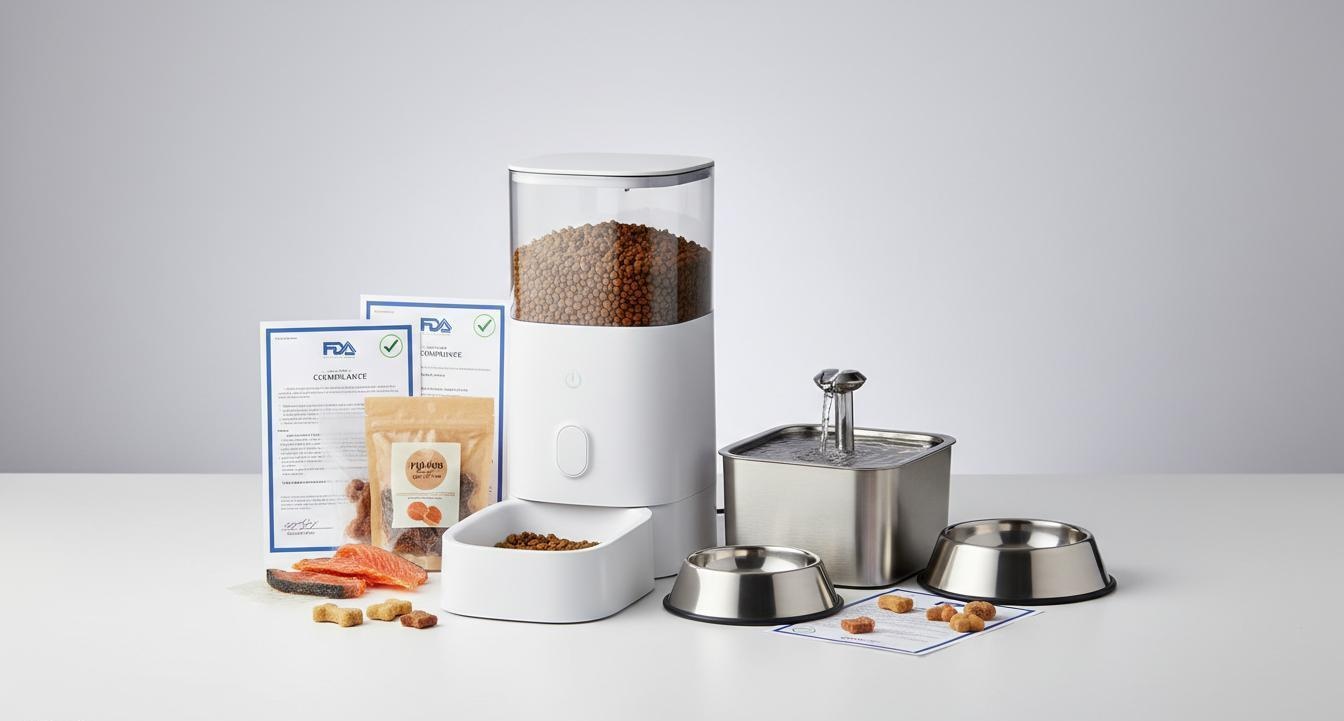
Why US Pet Retail Distributors Are Sourcing Pet Supplies Wholesale from China — and Why Compliance Is Non-Negotiable
The numbers tell a compelling story. The US pet industry surpassed $150 billion in revenue in 2024, with pet food and supplies representing the single largest spending category at over $50 billion annually, according to the American Pet Products Association (APPA). For US pet store distributors seeking competitive pricing on high-volume SKUs — automatic feeders, water fountains, crates, chew toys, and travel gear — sourcing pet supplies wholesale from China has become the dominant procurement strategy.
But here is what separates the distributors who scale profitably from those who face costly recalls, customs holds, or lawsuits: compliance is not optional. Importing non-compliant pet products into the United States exposes distributors to enforcement actions from the FDA, the Consumer Product Safety Commission (CPSC), and state authorities — particularly in California. Each year, containers are seized at US ports because documentation was missing, test reports were fabricated, or the supplier simply did not understand the regulatory requirements.
As someone who has spent 30 years vetting factories across Zhejiang and Guangdong for CBNB Supplier’s network of 36,000+ cooperative manufacturers, I have seen what separates a legitimate compliance program from a paperwork exercise. This guide gives you the complete checklist — no fluff, no lawyerspeak — so you can import with confidence.
FDA Compliance: Food-Grade Materials and Food Contact Regulations
How the FDA Classifies Pet Feeders
The US Food and Drug Administration regulates pet food bowls, feeders, and waterers under its food contact article framework. FDA requires ABS material to be food-grade certified because the feeder is classified as a food contact article. Therefore, importers must ensure that the ABS plastic used in the product body, food chamber, and any component that contacts pet food has been evaluated for food safety under the Federal Food, Drug, and Cosmetic Act.
What Distributors Must Demand from Their Supplier
When evaluating a Chinese supplier for smart pet feeders or any product that contacts food, you need the following documentation:
- FDA food-grade material declaration — the resin supplier’s own FDA acknowledgment letter for the specific ABS grade used
- 21 CFR compliance statement — confirming no restricted use of colorants, plasticizers, or monomers above FDA limits
- GMP documentation — evidence that the factory follows Good Manufacturing Practice during production, including batch traceability records
- Extractives/leachables test report — from an accredited lab, simulating food contact conditions with food simulants (water, acid, alcohol)
FDA does not pre-approve pet products. However, if FDA inspectors examine your shipment at the port and find non-compliant ABS materials, they can issue an Import Alert (Red Flag) that applies to all future shipments from that supplier — not just yours. In 2023, FDA issued Import Alerts affecting over 340 product lines from Southeast Asian and Chinese manufacturers for food contact violations. One bad shipment can blacklist a supplier for years and leave you liable for all costs of disposal or re-export.
CPSIA Compliance: Lead, Phthalates, Tracking Labels, and Third-Party Testing
The Consumer Product Safety Improvement Act (CPSIA) of 2008 — administered by the CPSC — applies to virtually all consumer products intended for household use, including pet supplies. CPSIA mandates lead content limits of 100 ppm for surface coatings and 300 ppm for substrates because lead exposure in pets and humans occurs through skin contact, mouthing, and ingestion. Therefore, any plastic component in a pet feeder — even if it does not directly contact food — must meet these stringent thresholds.
Lead and Phthalate Limits: The Numbers That Matter
| Hazardous Substance | CPSIA Limit | California Prop 65 | Testing Required |
|---|---|---|---|
| Lead – surface coatings | 100 ppm | 0.5 ug/day (oral) | Third-party lab (CPSC-accepted) |
| Lead – substrates | 300 ppm | 0.5 ug/day (oral) | Third-party lab (CPSC-accepted) |
| DEHP, BBP, DBP, DnHP | 0.1% each (1000 ppm) | No Safe Harbor | Third-party lab (CPSC-accepted) |
| DINP, DIDP | 0.1% (intentionally added) | Prop 65 listed | Third-party lab recommended |
Six phthalates (DEHP, BBP, DBP, DnHP, DINP, DIDP) are each limited to 0.1% or 1000 ppm under CPSIA Section 108 because these compounds are known endocrine disruptors. The risk for pet products is compounded because pets — especially puppies and kittens — frequently chew on plastic components. A soft ABS compound used in a pet feeder’s housing that exceeds phthalate limits can expose a pet to significant chemical risk over time.
Tracking Labels and Traceability
Every consumer product imported into the US must carry a tracking label under CPSIA Section 103. This is not optional, and it is one of the most commonly overlooked requirements by new importers. Your tracking label must include:
- Name of the manufacturer (or private labeler) — including city and country of manufacture
- Manufacturing date (at minimum month and year; day preferred)
- Batch or lot number sufficient to identify the production run
- Country of origin: “Made in China”
Tracking labels must appear on the product AND its packaging because the CPSC uses these labels during recall investigations to identify affected lots. Without them, a recall cannot be executed precisely — exposing distributors to full liability for all units in the field, not just the specific batch.
Third-Party Laboratory Testing
Third-party laboratory testing by a CPSC-accepted lab is mandatory for children’s products and strongly recommended for pet supplies to demonstrate due diligence because it provides an independent, verifiable compliance record that the CPSC, FDA, and plaintiffs’ attorneys will scrutinize during any investigation. For smart pet feeders, plan for the following tests:
- 16 CFR Part 1303 — lead in paint/surface coatings (ASTM F963 method)
- 16 CFR Part 1307 / CPSIA Section 108 — phthalates in plastic components
- ASTM F963 — physical and mechanical hazards (small parts, sharp edges, projected parts) — especially relevant for feeders with removable components that pets could ingest
- FCC Part 15B — electromagnetic emissions (for WiFi/Bluetooth smart feeders; see Section 4)
FCC Compliance: Why Your Smart Pet Feeder Needs More Than a CE Mark
Smart pet feeders with WiFi (802.11b/g/n) or Bluetooth modules are classified as intentional radiators under FCC rules. FCC Part 15B under 47 CFR limits electromagnetic radiation to prevent interference with other devices because the FCC has a mandate to manage the radio frequency spectrum and prevent harmful interference across all devices operating within US jurisdiction. Therefore, every WiFi or Bluetooth-enabled pet feeder imported into the US must be tested for radiated and conducted emissions before it can legally be sold.
The two pathways for FCC compliance are:
- FCC Certification (for intentional radiators like WiFi/Bluetooth) — requires testing by an FCC-recognized Television Equipment Testing Laboratory (TCT) and issuance of an FCC ID
- Supplier’s Declaration of Conformity (SDoC) — for some unintentional radiators; the supplier attests to compliance but testing by an accredited lab is still required
One critical warning: many Chinese suppliers show a CE mark as proof of electromagnetic compliance. This is insufficient for the US market. The CE mark is a European conformity marking — it is not recognized by the FCC and does not indicate compliance with American electromagnetic compatibility standards. Always request the actual FCC test report and FCC ID number, and verify the FCC ID on the official FCC Equipment Authorization database at fcc.gov/oet/ea/fccid.
California Prop 65: The State Regulation That Bites Distributors Nationwide
California’s Proposition 65 (Safe Drinking Water and Toxic Enforcement Act of 1986) operates differently from federal regulations — it is a state “right-to-know” law with teeth. California Prop 65 applies to any pet product sold in California because the law requires businesses to provide clear and reasonable warnings before exposing consumers — or their pets — to listed chemicals. Distributors who sell to CA customers are responsible for Prop 65 compliance regardless of where the product was manufactured.
Penalties are $2,500 per violation per day, making compliance essential for distributors of any size. A single product line sold for 90 days in California without required Prop 65 warnings could generate $225,000 in penalties — before attorneys’ fees. Critically, private citizens and competitor law firms frequently bring Prop 65 enforcement actions, making it one of the most litigated consumer protection statutes in the US.
The most practical approach for wholesale importers is to build Prop 65 compliance into the product specification from the outset. Since CBNB Supplier’s full product catalog includes compliant documentation packages, working with a supplier that has pre-tested against Prop 65 chemical thresholds is far more cost-effective than retro-labeling or defending a violation.
CBNB Supplier’s Compliance Advantage: 36,000+ Factories with Pre-Verified Documentation
When I started building CBNB Supplier’s factory network 30 years ago, the biggest complaint from American buyers was not price — it was documentation reliability. They had test reports that turned out to be forged, certificates that did not match the actual product, and no recourse when a shipment was held at customs. That experience shaped how we built our compliance verification system.
CBNB Supplier pre-verifies all compliance documentation before it reaches the buyer because we believe compliance documentation is a product feature, not an afterthought. Every factory in our network that supplies pet products undergoes a multi-step verification process before we recommend them to distributors. We do not just collect certificates — we audit the underlying test data, verify lab accreditation, and cross-reference batch numbers against production records.
Our compliance package for pet product orders includes:
- Factory GMP audit report — third-party verified, renewed annually
- Full CPSIA test reports from CPSC-accepted third-party laboratories (not just certificates)
- FDA food-grade material declarations traceable to the specific ABS resin lot used in production
- FCC test reports and FCC ID for all smart electronics, verified against the FCC database
- Prop 65 screening reports covering all listed chemicals — so you know exactly which warning language applies
- Batch-level traceability from raw material to finished product, supporting precise recall management if ever needed
Our 36,000+ factory network spans Zhejiang, Guangdong, Jiangsu, and Fujian provinces, giving us the flexibility to match you with manufacturers that have already invested in compliance infrastructure. Many of these factories supply major US pet retail brands — they have the documentation track record, the lab relationships, and the production quality systems in place. You benefit from their compliance investment without having to build it from scratch for every order.
Product Spotlight: CB-PAF9L Smart Pet Feeder — A Compliance Case Study
Let me walk through a real product from CBNB Supplier’s catalog to illustrate how compliance documentation works in practice. The smart pet feeder CB-PAF9L is a dual-capacity (7L and 9L) automatic feeder designed for dogs and cats, with APP control via the Tuya/Smart Life platform.
CB-PAF9L Smart Pet Feeder — Key Specifications
2.4 GHz)
The CB-PAF9L comes with CE certification and FDA-compliant ABS material declarations as standard. The WiFi version (Tuya/Smart Life app) carries FCC Part 15B certification with a verified FCC ID — importers can confirm the ID directly against the FCC database before placing orders. This is the kind of transparent, verifiable documentation that separates a credible supplier from one that hands you a folder of unverifiable certificates.
The camera version of the CB-PAF9L includes video interaction, which adds an additional compliance dimension: the camera module must also be FCC-certified, and the product must comply with any applicable requirements under the Federal Trade Commission’s FTC guidelines on endorsements and testimonials if marketing materials depict real-time pet monitoring. Plan accordingly if you are importing the camera SKU.
How to Read a Chinese Supplier’s Compliance Documentation: Red Flags to Watch
After three decades working with Chinese manufacturers, I have compiled a list of the most common documentation red flags that should immediately raise your suspicion. These are the patterns that, in my experience, most often precede compliance failures at the port or in the market.
The Fabricated Test Report Warning Signs
Test reports older than two years are unreliable because factory production processes, raw material suppliers, and compound formulations change frequently in the manufacturing industry. A report from 2023 does not certify a product manufactured in 2026. Always request test reports dated within six months of your production order.
Test report numbers that cannot be verified directly with the issuing laboratory are the single most common sign of fabrication because legitimate laboratories maintain public databases of issued reports. Therefore, before accepting any compliance documentation, call or email the lab using contact information from the lab’s own website — not from the test report header. Confirm the report number, the product tested, and the test dates. If the lab cannot verify it, the report is fake.
Other red flags include:
- Generic certificates without product-specific data — a certificate that says “pet feeder” without specifying the SKU, material grade, or batch number is useless. Demand the actual test data, not a one-page summary.
- Missing lab accreditation logos — legitimate test reports from CPSC-accepted labs will carry logos from A2LA, IAS, or other ILAC-recognized accreditation bodies. If these are absent or look pixelated/incorrect, that is a warning sign.
- Inconsistent batch numbers — if the batch number on your product’s tracking label does not match the batch referenced in the test report, your documentation trail is broken.
- Vague material descriptions — “food-grade ABS” is not specific enough. You need the exact ABS grade (e.g., ABS 121H from LG Chem or equivalent), the resin supplier’s FDA documentation number, and the extractives test results for that specific grade.
- Certificates that do not match your product — I have seen factories submit test reports for a different product size, different material, or different electronic configuration than the SKU being ordered. Always cross-check the product specifications in the test report against your purchase order.
Frequently Asked Questions
Ready to Source Compliant Pet Supplies from China?
CBNB Supplier connects US pet store distributors with 36,000+ verified factories across China, all backed by pre-verified FDA, CPSIA, FCC, and Prop 65 compliance documentation. From our 7L/9L smart pet feeder CB-PAF9L to full CBNB Supplier’s full product catalog, we handle the documentation so you can focus on selling.