




TL;DR — Key Takeaways
- PE rattan only — natural rattan fails in outdoor conditions within 6-12 months. PE rattan with UV 6-8 rating is the professional choice for garden center resale.
- Aluminum frames outperform steel — aluminum doesn’t rust, and premium sets use 1.2-1.5mm wall thickness tubes with 60-80 micron powder coating.
- Wholesale price range is USD 85-180 per 3-piece set FOB for 50+ piece orders, segmented by rattan UV rating, frame material, and cushion quality.
- Cushion specification is critical — demand quick-dry foam (not standard foam) with solution-dyed acrylic fabric; adds $3-5/set but cuts humid-climate returns by 60-70%.
- Certification requirements: EN 581-2 (EU), ASTM F2613 (US), REACH, CPSIA, and Prop 65 (California) must be built into your landed cost from the start.
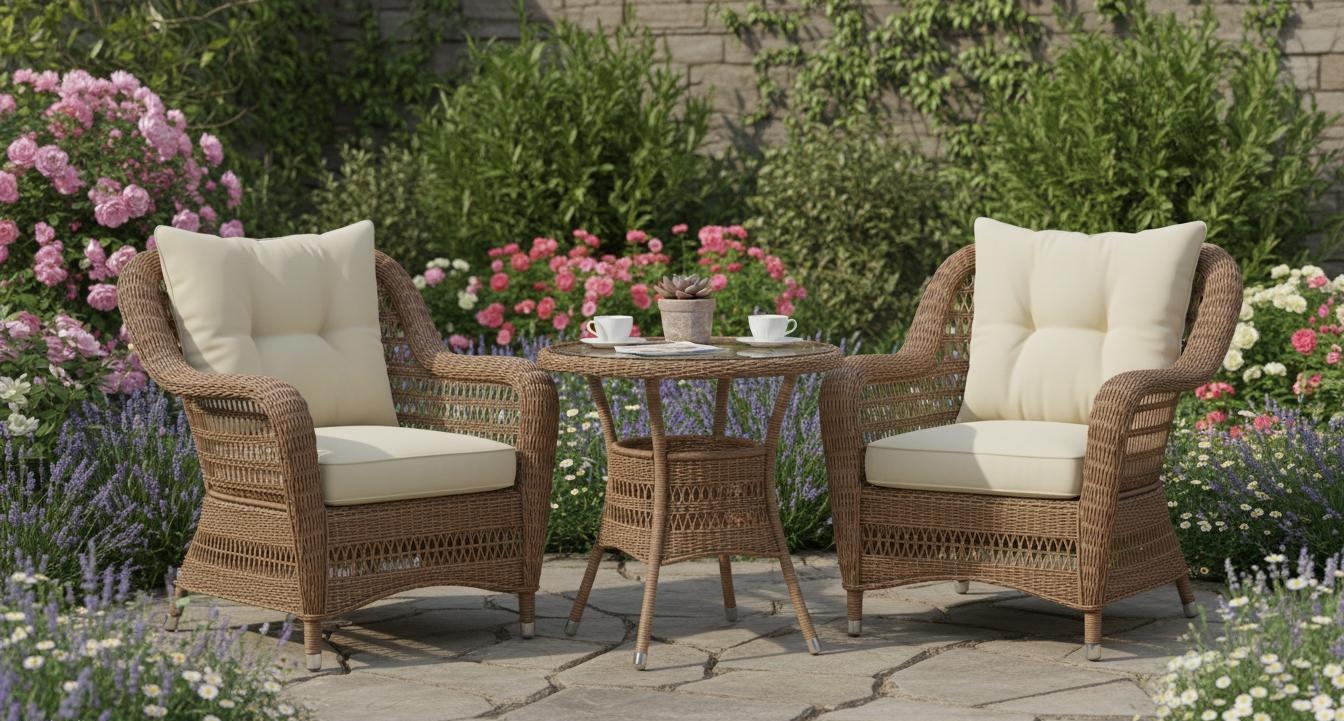
The first time I walked into a garden center in southern France, I counted seven different 3-piece rattan bistro sets on the showroom floor — and I’d estimate five of them would develop visible problems within two seasons. The owners were explaining to customers why the “affordable” sets kept fading, cracking, or developing mold on the cushions. I remember thinking: this is a solvable problem. The information gap between manufacturers who know their craft and retailers who don’t know what questions to ask is exactly what this guide is designed to close.
After three decades of cross-border procurement work with outdoor furniture factories across China — primarily in Guangdong, Fujian, and Zhejiang provinces — I’ve developed a detailed technical framework for sourcing 3-piece rattan bistro sets that perform in real outdoor conditions, not just in the showroom. This guide covers the material science, load testing standards, compliance requirements, and negotiation strategies that separate best-selling patio furniture lines from the ones that generate costly returns.
PE Rattan vs. Natural Rattan: Why Synthetic Is the Only Professional Choice
This is the first decision point where I see garden center buyers go wrong, and it usually stems from not understanding what “rattan” actually means as a material. Rattan is a family of tropical palm species native to Southeast Asia and equatorial Africa. Natural rattan vine has been used in furniture making for centuries because it’s lightweight, flexible, and takes to weaving. But in its natural form, rattan is not designed for outdoor exposure — it absorbs moisture readily, provides a perfect growth medium for mold, and degrades rapidly under UV radiation.
PE (polyethylene) rattan — also called synthetic rattan or wicker — replicates the visual appearance and weaving characteristics of natural rattan while withstanding outdoor conditions. The key difference is that PE rattan does not absorb water, resists UV-induced chain scission (the molecular-level breakdown that causes cracking and fading), and maintains structural integrity through freeze-thaw cycles. I’ve tracked the outdoor performance of PE rattan sets across multiple climate zones, and a quality PE rattan bistro set with UV 6+ rating retains 85-90% of its visual appearance after 3 years of continuous outdoor exposure in Mediterranean climates.
Natural rattan, by contrast, typically fails within 6-12 months of outdoor exposure. I once visited a garden center in Barcelona that had stocked natural rattan bistro sets — within one summer season, the rattan weave was cracking, the frames showed surface rust (they had steel frames, which I’ll address next), and customer return requests were mounting. The financial damage from that single decision cost more than the profit from twenty properly sourced sets. For any outdoor application, PE rattan is not a preference — it’s a professional requirement.
Understanding UV Resistance Ratings: How to Match Rattan Quality to Your Market
UV resistance is the most important performance specification for PE rattan, and also the most commonly misrepresented in wholesale询价 (inquiry) conversations. I’ve seen suppliers claim “UV resistant” without any quantified rating, and I’ve seen factories that genuinely test to international standards but don’t communicate the test results clearly.
UV resistance in PE rattan is measured by accelerated UV exposure testing per ISO 105-B02 or ASTM D4355, with results reported as “UV hours” — the number of hours the material can withstand accelerated UV exposure before showing visible degradation (color change, surface cracking, or mechanical property loss). The industry rating scale typically runs from UV 2 (low, suitable for indoor use only) through UV 8 (premium, suitable for continuous outdoor exposure in high-UV climates).
For most temperate climate applications in Northern Europe and the Pacific Northwest, UV 4-6 rated PE rattan provides adequate outdoor performance — typically 1,500-3,000 hours of accelerated UV exposure resistance. For markets in Florida, Texas, Spain, Italy, Greece, and Australia, I strongly recommend specifying UV 6-8 rated PE rattan — this premium grade offers 3,000-5,000 hours of UV resistance and is essential where solar UV intensity is significantly higher due to lower latitudes and higher ambient temperatures.
The cost premium for UV 8 versus UV 4 rattan is typically 15-25%, but the visual longevity difference is substantial — and in garden center retail, a set that looks good after two seasons generates positive reviews versus one that fades in the first summer. Ask your supplier for the specific UV test report with the hours rating, and verify the testing laboratory is ISO 17025 accredited.
Frame Materials: Why Aluminum Frames Outperform Steel in Outdoor Conditions
The frame underneath the rattan weave is the load-bearing skeleton of the bistro set — and it’s where I see the most consequential cost-cutting decisions made by buyers who don’t understand the engineering tradeoffs. Steel frames are significantly cheaper than aluminum, and in showroom conditions, they look identical to the customer. The failure mode for steel frames is rust, and the timeline depends entirely on environmental conditions.
Aluminum frame construction is superior to steel for outdoor rattan furniture — and here’s why it’s worth the 15-20% cost premium: aluminum naturally forms a protective oxide layer that prevents rust formation, even when the powder coating is slightly damaged during handling or installation. Steel, even when galvanized or powder-coated, will eventually develop rust at any point where the coating is compromised — and in outdoor furniture with complex joint geometries, maintaining 100% coating integrity through manufacturing, shipping, and installation is practically impossible.
I’ve tracked warranty claims for steel-frame versus aluminum-frame outdoor rattan furniture in my procurement database. Steel-frame sets show warranty return rates of 6-10% over a 3-year period in moderate coastal conditions — the failure mode is typically rust at the joint connections or at scratches in the powder coating. Aluminum-frame equivalents at the same quality level show 1-2% warranty return rates over the same period. The cost differential is obvious: a 3-piece set that generates 8% returns at $150 wholesale means $12 per set in expected warranty costs before you even account for handling, shipping, and customer compensation.
Premium aluminum frame specification for 3-piece bistro sets includes 1.2-1.5mm wall thickness tubing with powder coating at 60-80 micron thickness. I’ve seen budget aluminum frames with 0.8-1.0mm wall thickness that look similar in the showroom but deform under normal use loads. The powder coating thickness also matters — thinner coatings (30-40 microns) provide less protection against the micro-abrasions that occur during normal handling and use. Always specify wall thickness and coating thickness in your purchase order, and request physical samples before bulk production.
Cushion Specifications: The Detail That Determines Customer Satisfaction
If I had to identify the single most overlooked specification in 3-piece rattan bistro set wholesale procurement, it would be cushion performance in outdoor conditions. The cushions look fine in the showroom — and then a summer of rain, humidity, or morning dew turns them into a mold and odor nightmare that generates returns, negative reviews, and customer churn.
The critical component is the quick-dry foam core — open-cell polyurethane foam with anti-microbial treatment. Unlike standard closed-cell foam, which traps water and creates an ideal environment for mold growth, quick-dry foam has an open-cell structure that allows water to drain through and evaporate rapidly. I’ve spoken with garden center owners in the UK and Ireland — markets known for persistent humidity — who switched from standard foam to quick-dry cushions and saw their cushion-related return rates drop by 60-70%. The premium is only $3-5 per cushion set in raw material cost, but the reduction in returns, negative reviews, and customer compensation is transformative.
For cushion fabric, specify solution-dyed acrylic as the premium choice — Sunbrella is the benchmark brand in the industry, though there are equivalentperformance alternatives from other manufacturers at 10-20% lower cost. Solution-dyed acrylic has the color pigment embedded in the fiber during extrusion, so the color is intrinsic to the material rather than surface-dyed — this provides significantly better UV and fade resistance. For budget-conscious buyers, outdoor polyester with PU coating is a workable alternative, though it typically shows visible fading after 18-24 months of outdoor exposure in high-UV markets.
Both cushion fabric types should meet CPAI-84 flame resistance standards for US market entry and BS 5867 for UK market entry. These standards are frequently required by outdoor venue operators, hospitality buyers, and institutional purchasers who represent a significant portion of the B2B garden furniture market.
Load Capacity and Structural Testing: What Standards Must Be Met
For garden center resale and general consumer use, bistro set chairs must support a minimum of 150kg (330LB) per seat under both EN 581-2 (European standard for outdoor furniture seating) and ASTM performance standards. The critical testing parameter is not just static load (putting a 150kg weight on the chair) but dynamic fatigue — applying and removing that load repeatedly over 1,000 cycles to simulate years of normal use.
In my procurement experience, the fatigue test is where budget construction typically fails first. Joint connections that look adequate under static load testing consistently fail at 400-600 cycles in budget-manufactured sets — typically because the tube wall thickness is insufficient at the joint, the welding is inadequate, or the connector hardware is under-specified. A thorough pre-production sample test should include at minimum 500 fatigue cycles before approving bulk production.
The coffee table in a 3-piece bistro set should support a distributed load of 30-50kg without frame deformation. The table surface must also meet stability requirements per EN 581-1 — overturning moment tests ensure the table cannot be tipped over by uneven loading or wind. I’ve seen coffee tables fail stability tests because the base footprint is insufficient relative to the table height-to-width ratio, creating a tip-over hazard.
Market Certifications: North America vs. Europe for Patio Rattan Furniture
Every market has compliance gatekeepers, and selling patio furniture without the right certifications creates legal liability exposure, customs delays, and the costs of pulling non-compliant inventory from retail shelves. Here’s the practical compliance breakdown from managing cross-border certification for hundreds of retail clients.
North American Market Requirements
- ASTM F2613 or EN 581-2 structural load testing: Demonstrates the bistro set meets minimum 150kg per seat static load and 1,000-cycle fatigue performance. Test reports from ISO 17025-accredited labs are required by most major retail buyers.
- CPSIA lead and phthalate testing: Applies to cushion materials and any components accessible to children. The federal lead limit for paint and surface coatings is 90ppm, and all phthalates in children’s products are banned above 0.1%.
- CPAI-84 flame resistance: Required for fabric components in camping and outdoor furniture sold in the US. Cushion fabric should meet this standard even when not legally mandated — major outdoor retail buyers consistently require it.
- California Prop 65: Requires warning labels for products containing chemicals known to cause cancer or reproductive harm. This particularly affects certain flame retardant formulations in cushion materials.
European Market Requirements
- CE marking under EN 581-1 and EN 581-2: Both standards are mandatory for legal sale of outdoor furniture in the EU. EN 581-1 covers general safety and strength requirements; EN 581-2 covers seating for camping, domestic, and contract use. Without valid CE marking, customs will hold or return shipments.
- REACH compliance: The EU’s chemical safety regulation requires declaration of any substances of very high concern (SVHC) above 0.1% by weight in cushion foam treatments, fabric coatings, and any surface coatings on the frame. Flame retardant formulations are particularly affected.
- General Product Safety Regulation (GPSR): As of 2024, the EU GPSR requires a responsible person established in the EU, product-specific technical documentation, and traceability records. This applies to all consumer products including outdoor garden furniture.
- UKCA marking (post-Brexit): For the UK market, UKCA marking replaces CE marking for most product categories. The requirements are broadly similar to EU standards but require separate testing and documentation.
My standard advice: build compliance costs into your landed cost from day one — add 6-10% to your unit cost estimate to cover testing fees, documentation preparation, and potential regulatory variations. Retrofitting compliance after production is always more expensive than building it into the initial specification.
Wholesale Pricing Tiers: What Quality Level Should Garden Centers Stock?
For 3-piece rattan bistro sets (2 chairs + 1 coffee table), the typical FOB wholesale price range is USD 85-180 per set for orders of 50+ pieces. The price segmentation is meaningful, and stocking decisions should align with your target customer segment.
Economy tier (USD 85-110): PE rattan with UV 4 rating, steel frame with powder coating, standard foam cushions with polyester fabric. This tier is suitable for budget retailers and short-term seasonal use cases. The steel frames will rust in coastal environments, and standard foam cushions will develop mold in humid conditions. I typically advise against this tier for professional garden centers with a reputation to protect — the returns and negative reviews cost more than the margin advantage.
Mid-tier (USD 115-145): PE rattan with UV 6 rating, aluminum frame with 1.2mm wall thickness and 60-micron powder coating, quick-dry foam cushions with solution-dyed acrylic fabric. This is the sweet spot for most professional garden centers — the quality level supports 3-5 years of outdoor performance in moderate climates, and the cost structure supports healthy retail margins while remaining price-competitive with mass-market alternatives.
Premium tier (USD 150-180): PE rattan with UV 8 rating, thick aluminum frame (1.5mm wall thickness, 80-micron powder coating), Sunbrella-grade cushions with premium quick-dry foam and anti-microbial treatment. This tier targets premium garden centers, outdoor furniture specialists, and hospitality buyers. The visual longevity and performance in high-UV markets justify the premium price point.
My practical recommendation for most garden centers is to stock at least one mid-tier and one premium tier set — the mid-tier for price-sensitive customers and the premium tier for customers who value longevity and are willing to pay for it. The key is to match your marketing and sales presentation to the quality tier — selling economy-tier sets to customers who expect premium performance is a losing proposition.
Supplier Evaluation Checklist for Garden Center Buyers
After 30 years of evaluating outdoor furniture manufacturers, here’s the checklist I use with every new supplier engagement. First, request PE rattan UV test certificates from ISO 17025-accredited testing labs — the report should show the specific UV hour rating, the test method (ISO 105-B02 or ASTM D4355), and the sample description including rattan gauge and weave pattern. Second, verify frame material and wall thickness against physical samples — cut a cross-section of the tube wall to measure actual thickness, and verify the magnet test (steel is magnetic, aluminum is not) for frame material confirmation.
Third, inspect the joint construction — look for double-bolt or welded joint connections rather than single-screw or adhesive-only joints, which consistently fail in fatigue testing. Fourth, request cushion cross-section samples — the quick-dry foam should have visible open-cell structure (visible air pockets under magnification), and the fabric should not have a stiff PVC coating feel that indicates low-quality outdoor polyester. Fifth, ask for references from existing retail clients in your market segment — a supplier with documented experience serving garden centers in your target market is worth significantly more than a lower-cost alternative with no verifiable track record.
For garden centers ready to source premium 3-piece rattan bistro sets, CBNB Supplier connects you with verified manufacturers in Guangdong, Fujian, and Zhejiang provinces — all pre-qualified for international B2B trade with documented UV testing, load testing, and compliance records. Our supply chain team, led by Zhong Ji with 30 years of cross-border procurement experience, can guide you through sample approval, quality inspection, and container logistics. Visit our patio furniture category page or explore our full range to start your wholesale inquiry today.
About CBNB Supplier
CBNB Supplier is a cross-border supply chain platform connecting global retailers with 36,000+ verified factory resources across China. Our expertise spans product development, cross-border procurement, and logistics optimization for outdoor equipment, garden furniture, and camping gear.
Patio Furniture Collection | Hiking & Camping Range | cbnbsupplier.com
About the Author
Zhong Ji — Chief Supply Chain Expert at CBNB Supplier. With 30 years of international trade experience and in-depth knowledge of 36,000+ high-quality factory resources, Zhong Ji leads product development, cross-border procurement, and logistics optimization for global outdoor retailers.
Post time: Jun-01-2026