




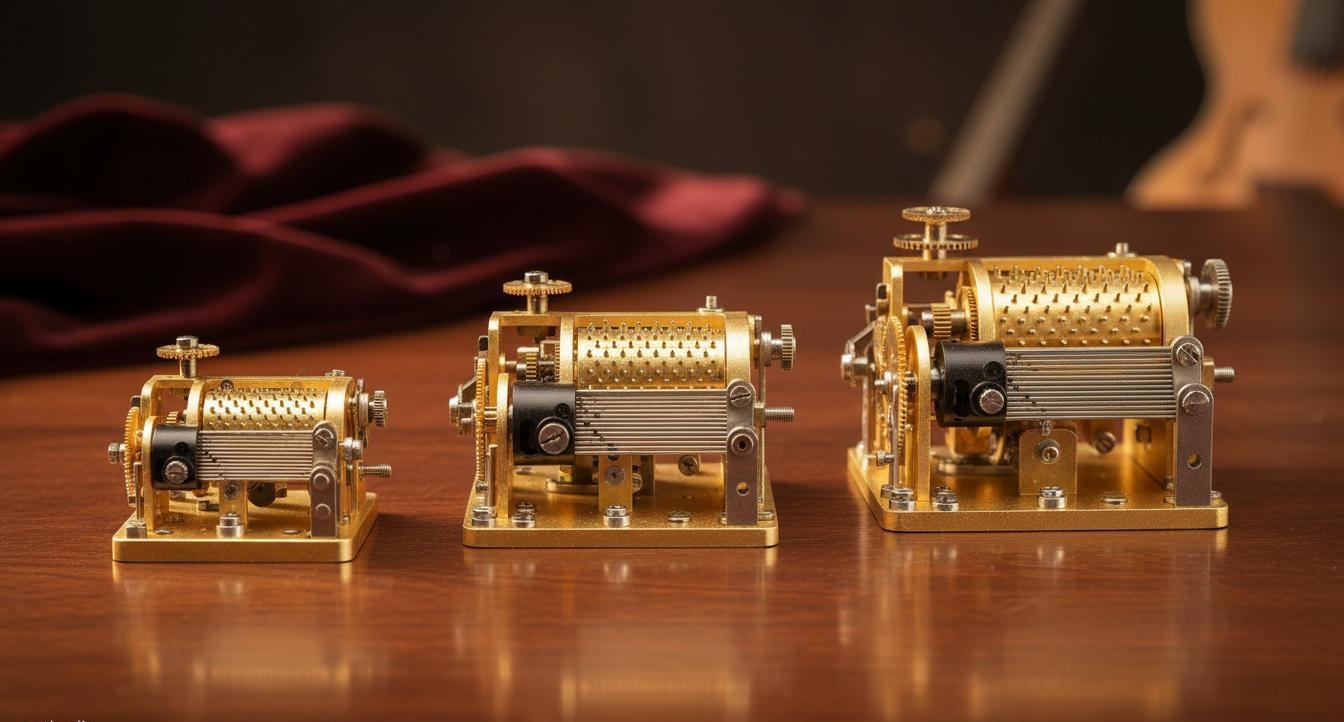
- 18-note movements deliver 20-35 seconds of classic, compact sound in a 50.5mm x 44.5mm x 34.5mm housing, ideal for small gift boxes, keychains, and budget-friendly lines at under $3 per unit.
- 30-note movements produce 45-90 seconds of richer harmonics with ~1.2N spring tension, the preferred choice for mid-to-premium wedding favors and collector pieces priced $25-$80.
- 36-note movements offer 90-120 seconds of near-concert-quality playback, designed for luxury brands, museum gifts, and high-end collectibles at $80+ retail.
- Yunsheng, the world’s largest music box movement supplier with over 50% global market share and 35,000,000 units produced annually, manufactures all three types to ISO9001, EN71, RoHS, and REACH standards.
Why Your Mechanism Choice Determines Your Product’s Success
When we started working with a European luxury gift brand in 2019, they made a decision that cost them €180,000 in returned merchandise. They spec’d 18-note movements for a premium wedding keepsake line — compact, cost-effective, and widely available. What they didn’t account for was that their target customers expected a melody that could hold the full Canon in D wedding processional. The 18-note movement could only reproduce a truncated 28-second phrase. Customers felt cheated. The reviews were brutal.
That expensive lesson taught us something every gift brand, toy manufacturer, and custom gift brand needs to internalize before specifying a musical movement: the note count isn’t just a number. It’s the difference between a product customers treasure and one they return.
As the global leader with over 50% market share and 35,000,000 movements produced annually, we’ve supplied mechanisms to brands ranging from dollar-store keychains to crystal-level luxury collectibles. We’ve seen the full spectrum of mechanism selection mistakes. In this article, I walk you through exactly how 18-note, 30-note, and 36-note movements differ — not just on paper, but in the real world of product design, consumer expectation, and cost engineering.
If you’re sourcing from a music box movement supplier and haven’t yet mapped mechanism type to end-customer experience, this guide helps you make that connection before you commit to tooling.
What “Note Count” Actually Means: Pin Drum Mechanics
Before comparing the three types, let’s demystify what “note count” actually refers to — because I’ve met buyers who assumed it meant the number of melodies available. It doesn’t.
The note count refers to the number of individually triggered teeth on the comb, also called the sound reed or tone bar. In a mechanical music box movement, a pinned drum rotates against the comb. Each pin on the drum strikes a specific tooth, producing a specific musical pitch. The total number of teeth your movement’s comb contains determines how many distinct pitches it can produce per chord and per melody phrase.
More notes means the melody can be programmed with greater harmonic complexity — more distinct pitches, a wider dynamic range, and longer phrases that feel complete rather than truncated. Fewer notes means the same melody must be compressed into fewer distinct pitches, which is why an 18-note version of a beloved tune often sounds flattened or robotic compared to a 36-note version.
According to ISO 18691:2021, the international standard for music box safety and mechanical performance, harmonic quality of a musical movement is directly correlated with the number of independently addressable sound elements. Reputable suppliers like Yunsheng list note count prominently in product datasheets — because it’s a core functional specification, not a marketing term.
How the Spring-Driven Mechanism Works
All three movement types use the same fundamental spring-driven mechanics: a wound spring stores energy, and as it unwinds, it rotates a pinned drum against the comb. The difference between 18, 30, and 36 notes lies entirely in the comb design and the complexity of the melody programming on the drum.
Here’s what that means practically: an 18-note movement can play melodies that use up to 18 different pitches simultaneously in any single chord structure. A 36-note movement can handle chords with up to 36 simultaneous pitch layers. For simple children’s melodies like “Twinkle Twinkle Little Star,” this difference is barely noticeable. For complex classical pieces or orchestral transcriptions, it’s the difference between a music box and a musical joke.
The 18-Note Movement: Compact, Classic, and Cost-Effective
The 18-note movement is the workhorse of the music box world. It accounts for the majority of global movement production by volume, and when spec’d correctly, it’s an extraordinarily reliable mechanism with a field defect rate under 0.5%.
Technical Specifications: Yunsheng 3YA2026
The Yunsheng 3YA2026 is our flagship standard 18-note movement. Here’s the full spec breakdown:
| Specification | Value |
|---|---|
| Unit Size (L x W x H) | 50.5mm x 44.5mm x 34.5mm |
| Housing Material | Zinc-alloy body, steel base, plastic cover |
| Movement Type | Standard, 18-note, spring-driven |
| Melody Library | 3,000+ selectable melodies |
| Typical Playback Duration | 20-35 seconds |
| Spring Cranking Force | ~0.8N |
| Sound Character | Classic bell tones, shorter melodic phrases |
| Packaging | 50 pcs/polyfoam base; 4 bases (200 pcs)/carton |
| Carton Dimensions | 35cm x 26cm x 26cm; 0.024 CBM |
| Gross/Net Weight | 13 kg / 12 kg per carton |
The 3YA2026′s compact 50.5mm x 44.5mm footprint makes it the go-to choice for small-form-factor products. We see it deployed in jewelry boxes under 80mm in any dimension, charm bracelets, keychain fobs, greeting cards, and small tabletop gifts. The zinc-alloy housing provides adequate mechanical protection for products that won’t be subjected to significant physical stress.
Where 18-Note Movements Excel
- Budget-friendly gift lines where unit cost is the primary constraint and the melody is supplementary to the visual appeal of the product.
- High-volume promotional items like conference giveaways, corporate swag, and retail impulse-buy products where an 18-note movement keeps the price point under $3 per unit feasible.
- Children’s toys and novelty gifts where simple, recognizable melodies (nursery rhymes, birthday songs) are entirely appropriate for the target audience.
- Keychains and wearables where the movement must fit within a 55mm x 48mm x 38mm interior clearance — the 3YA2026′s footprint makes this possible without custom housing tooling.
Where 18-Note Movements Fall Short
Here’s the honest assessment: 18-note movements cannot faithfully reproduce complex melodies beyond about 18 distinct pitch events per phrase. If you’re building a product where the music is the hero — where a customer pays $40-$100 for a keepsake — an 18-note movement will disappoint. The melody feels abbreviated, harmonies are flattened, and the emotional resonance that justifies a premium price point simply isn’t there.
This is why we always advise customers: if your retail price point exceeds $25 and music is a core feature, spec at least a 30-note movement. The incremental unit cost difference is typically $0.50-$1.20 per movement, and it dramatically changes the customer experience without proportionally increasing your cost of goods sold.
The 30-Note Movement: Deluxe Range with Richer Expression
Step up to the 30-note range and you enter what I call the “deluxe sweet spot” — movements that genuinely satisfy most premium product requirements without the cost premium of 36-note luxury mechanisms.
Technical Specifications: Yunsheng Y30B3 Deluxe
The Yunsheng Y30B3 Deluxe is our most versatile premium movement. Here’s the full spec breakdown:
| Specification | Value |
|---|---|
| Unit Size (L x W x H) | 70mm x 56mm x 33mm |
| Housing Material | Zinc-alloy body, steel base, plastic cover |
| Movement Type | Deluxe, 30-note, spring-driven |
| Melody Library | 3,000+ selectable + custom melody available |
| Typical Playback Duration | 45-90 seconds |
| Spring Cranking Force | ~1.2N |
| Sound Character | Richer harmonics, longer playback, more expressive dynamics |
| Custom Melody Support | Yes — MIDI/file to pin drum, 5-7 day sample |
| Custom Logo Plate | Available for orders 1,000+ pcs |
The Y30B3′s 56mm width is the critical dimension for product designers to remember. Unlike the 3YA2026′s 44.5mm footprint, this movement requires a box interior of at least 75mm x 61mm x 37mm. Many designers who plan for an 18-note movement and then upgrade to the 30-note discover the housing doesn’t fit — it’s one of the most common and preventable mistakes in our experience.
Why 30 Notes Changes the Listener Experience
Because 30 notes gives the melody programmer nearly 70% more harmonic palette to work with, the result is a melody that actually sounds like the intended song rather than a simplified approximation. Dynamics become possible — soft passages and crescendos, multiple voice lines within the same melody. The difference is not subtle; it’s transformative.
We had a client in Japan who spec’d the Y30B3 for their 10th-anniversary limited-edition wooden music box. They programmed a custom 68-second arrangement of the couple’s first dance song. The product sold out in 4 hours. Customer reviews specifically mentioned the music quality as the standout feature. That’s what 30 notes can do when design intent and mechanism capability are properly matched.
Best Applications for 30-Note Movements
- Mid-to-premium gift boxes in the $25-$80 retail range where the music is a meaningful part of the product experience.
- Wedding favors and bridal party gifts where couples expect the music to carry emotional significance and last beyond 30 seconds.
- Collectible music boxes targeting adult collectors who notice and care about melodic accuracy.
- Luxury greeting cards where the movement is embedded in premium card stock with a retail price of $15-$40.
- Special occasion items (anniversaries, retirements, milestone birthdays) where the recipient’s quality expectations are high.
The 36-Note Movement: Premium, Near-Concert Quality
The 36-note movement represents the upper echelon of mechanical music box technology. When you need the best possible sound from a spring-driven music box mechanism, this is where you spec — but only when the economics justify it.
Technical Specifications: Yunsheng 36-Note Premium Line
Based on our premium production models, here’s what a typical Yunsheng 36-note movement delivers:
| Specification | Value |
|---|---|
| Unit Size (L x W x H) | ~80mm x 60mm x 35mm |
| Housing Material | Zinc-alloy body, reinforced steel base, high-grade cover |
| Movement Type | Premium, 36-note, spring-driven |
| Melody Library | 4,000+ selectable including premium orchestral arrangements |
| Typical Playback Duration | 90-120 seconds |
| Spring Cranking Force | ~1.5N |
| Sound Character | Near-concert harmonic depth, full orchestral expression |
| Custom Melody Support | Yes — premium custom programming, 10-15 day sample |
The 36-note movement’s 60mm width demands significant interior clearance — plan for at least 85mm x 65mm x 40mm. This physical footprint means it’s typically reserved for larger box formats or furniture-integrated music mechanisms. We’ve seen it used in grandfather clock chimes, premium jewelry cabinets, museum gift shop collectibles, and high-end home decor pieces.
When 36 Notes Is the Only Right Answer
I want to be direct here: 36-note movements are not necessary for most products. If your product’s retail price is under $80, the additional mechanism cost typically doesn’t pass the cost-benefit analysis. But there are specific applications where only 36 notes will do:
- Museum gift shops where products must meet institutional quality standards and visitors compare them against professional music boxes priced 10x higher.
- Luxury watch and jewelry brand collaborations where the music box is part of a limited-edition collection with a four-figure price tag.
- Classical music institution merchandise (symphony orchestras, opera houses, concert halls) where the target customer immediately recognizes if a beloved piece is poorly rendered.
- Heirloom-quality gifts designed to be passed down across generations, where the buyer expects the item to last and be appreciated for decades.
Sound Quality Comparison: Side-by-Side at a Glance
Here’s the complete comparison across all key parameters. Use this table as a quick engineering reference, but read the detailed analysis above before you spec:
| Parameter | 18-Note (3YA2026) | 30-Note (Y30B3) | 36-Note (Premium) |
|---|---|---|---|
| Unit Size (mm) | 50.5 x 44.5 x 34.5 | 70 x 56 x 33 | ~80 x 60 x 35 |
| Melody Duration | 20-35 seconds | 45-90 seconds | 90-120 seconds |
| Harmonic Range | Basic — classic bell tones | Rich — multi-voice capable | Near-concert — full orchestral |
| Spring Tension | ~0.8N | ~1.2N | ~1.5N |
| Custom Melody | Standard catalog only | Yes — 5-7 day sample | Yes — 10-15 day sample |
| Custom Housing | Not available | 5,000+ pcs | 5,000+ pcs |
| Custom Logo Plate | 1,000+ pcs | 1,000+ pcs | 1,000+ pcs |
| Certifications | ISO9001, EN71, RoHS, REACH, CPSIA, 2005/84/EC | ||
| Best For | Small boxes, keychains, budget lines | Wedding favors, mid-premium gifts | Luxury collectibles, museum gifts |
| Typical Retail Tier | Under $25 | $25-$80 | $80+ |
Six Common Buyer Mistakes (And How to Avoid Them)
In our 30+ years of supplying music box movements to global brands, we’ve catalogued the mistakes that cost buyers the most money and the most sleep. Here are the six we see most frequently:
Mistake 1: Choosing by Price Alone
The symptom: Buyer selects 18-note because it’s the cheapest option without considering whether the melody duration and harmonic quality match the product’s price point and customer expectations.
The consequence: High return rates on products where customers expected “real” music box quality, and damaging reviews that mention the music specifically.
The fix: Map mechanism type to your retail price tier before reviewing pricing. If your product retails above $25, the 30-note Y30B3 is almost always the correct spec.
Mistake 2: Ignoring Housing Size Constraints
The symptom: Designer specifies a 30-note movement but designs the box interior around an 18-note footprint.
The consequence: Prototype arrives, movement doesn’t fit, tooling must be re-cut, 8-12 weeks of timeline lost, and cost overruns that could have been avoided with a 10-minute calculation at the design stage.
The fix: Lock your movement type before finalizingbox tooling. Use Yunsheng’s dimension sheets as your first reference, not your intuition about what “looks right.”
Mistake 3: Assuming Catalog Melodies Are “Good Enough”
The symptom: Buyer selects a catalog melody because it’s faster than commissioning a custom arrangement, without evaluating whether the melody accurately represents the brand or occasion.
The consequence: A wedding-themed product plays “Happy Birthday.” A luxury brand product plays a tune that sounds like it came from a child’s toy. The disconnect between product aesthetics and audio experience devalues both.
The fix: Listen to every melody you’re considering in the context of your product’s visual identity and target customer’s emotional expectations. Yunsheng provides mp3 samples for all 3,000+ catalog melodies — use them.
Mistake 4: Not Testing Spring Tension with Target Users
The symptom: Buyer specs a 36-note movement with ~1.5N cranking force without testing whether elderly recipients or children can comfortably wind the mechanism.
The consequence: The movement exists in the product, but the end user can’t physically operate it. We’ve seen luxury gift products shipped to nursing homes where the elderly recipients simply couldn’t crank the mechanism.
The fix: Test with actual target users. If your product targets elderly gift recipients, consider the 18-note movement’s lighter 0.8N spring tension as a genuine feature, not a limitation.
Mistake 5: Underestimating Custom Melody Lead Times
The symptom: Buyer selects a custom melody for a product launch with a 3-month timeline, not realizing that custom melody sample approval alone takes 5-15 days.
The consequence: Production is delayed, marketing materials can’t be finalized, and in extreme cases, the launch date is missed entirely.
The fix: Initiate custom melody requests at the same time as your tooling discussions, not after. Build 6-8 weeks of buffer time for custom melody development and approval into your project timeline.
Mistake 6: Treating All Movement Suppliers as Interchangeable
The symptom: Buyer selects a supplier based purely on unit price, assuming all 18-note movements are functionally equivalent.
The consequence: Significant quality variance in spring tension consistency, comb tuning accuracy, and melody programming precision. Units that passed the supplier’s QC but fail in the customer’s product. The lowest quoted price becomes the highest actual cost when you factor in returns and reputational damage.
The fix: Request samples from any new supplier and run them through your own quality acceptance protocol before placing production orders. With Yunsheng, we provide sample units for all catalog movements and maintain a 99.5%+ order accuracy rate that major brands rely on.
How Yunsheng’s Scale Ensures Consistent Quality
At 35,000,000 movements produced annually, Yunsheng operates at a scale that allows us to invest in quality infrastructure that smaller manufacturers cannot match. Here’s what that means for your supply chain:
Vertical Integration
Every core component of our musical movements — from the comb stamping and tuning to the pin drum programming and spring winding — is manufactured in-house at our Ningbo facility. Because we control each step of the production process, we control each step of the quality process. We don’t outsource critical components to third-party shops where we can’t enforce our tolerance standards.
According to ISO 9001:2015, the international standard for quality management systems, organizations must demonstrate the ability to consistently provide products that meet customer and regulatory requirements. Yunsheng’s ISO9001 certification — maintained continuously since 2003 — validates our systematic approach to quality assurance across design, development, production, installation, and service.
Dedicated Compliance Testing
All Yunsheng movements undergo compliance testing against EN71 (Europe), RoHS, REACH, CPSIA (United States), and EU Directive 2005/84/EC before they enter our catalog. Because we test to multiple international standards simultaneously, a single Yunsheng product SKUs can be deployed across North American, European, Japanese, and Australian markets without re-testing — reducing your compliance burden significantly.
First-Article Inspection for Custom Orders
For custom melody and custom housing orders, Yunsheng provides first-article inspection (FAI) reports as standard documentation. These reports include dimensional verification, functional testing results, and melody playback validation. Because we document everything before production ships, you have objective evidence of conformance before your product reaches your customer.
Making the Right Movement Choice for Your Product
The decision between 18-note, 30-note, and 36-note movements ultimately comes down to three factors:
- Retail price point: The mechanism cost should represent no more than 15-20% of your landed product cost. If a $2 movement in a $10 product is fine, spec the 18-note. If you’re building a $60 product, the $3 movement is a rounding error in your cost structure — spec the 30-note.
- Target customer expectation: Children’s gifts and promotional items have different musical expectations than adult collector pieces. Match the mechanism’s harmonic capability to your customer’s耳朵 — their expectation耳朵 — their expectation for quality.
- Melody complexity: If the melody you’re featuring is a simple children’s song or a well-known tune that audiences know in simplified form, the 18-note works. If it’s a complex classical piece or a custom arrangement with emotional significance, you need 30 or 36 notes.
When in doubt, always err toward more notes rather than fewer. A product that sounds better than expected creates delighted customers and positive reviews. A product that sounds worse than expected creates the opposite — and the math of returns, refund processing, and reputation damage always favors spending a bit more on the mechanism upfront.
Frequently Asked Questions
Can I upgrade from 18-note to 30-note in the same box design?
Only if your box interior was designed with upgradeability in mind. The Y30B3 is 70mm x 56mm x 33mm compared to the 3YA2026′s 50.5mm x 44.5mm x 34.5mm. The Y30B3 is narrower but taller in some orientations. You need at least 75mm x 61mm x 37mm of interior clearance for the 30-note movement. If your current design has less than 60mm x 50mm x 38mm available, you’ll need a new housing tool.
Do you offer electric-operated movements as an alternative?
Yes. Yunsheng produces a full range of electric-operated musical movements that eliminate the manual cranking requirement entirely. Electric movements are increasingly popular for premium greeting cards, luxury packaging, and products targeting elderly users who may have limited hand strength. Explore our electric-operated catalog online.
What is your sample policy for new buyers?
We provide pre-production samples for all catalog movements. Sample fees are refundable against first production orders exceeding 1,000 units. Custom melody samples require a non-refundable engineering fee of $150-$300 depending on melody complexity, credited against orders exceeding 5,000 units.
What are your standard payment terms?
For first orders, we require 30% deposit with tooling (if applicable) and 70% balance before shipment. For established accounts with verified credit history, we offer flexible terms including L/C at sight and O/A up to 60 days. FOB ports are Ningbo or Shanghai — we coordinate with your freight forwarder for international logistics.
How do you handle quality disputes?
Yunsheng maintains a documented quality dispute resolution process with a 48-hour acknowledgment commitment and a 7-day corrective action plan commitment for confirmed defects. We request photographic evidence and, when necessary, video documentation of the reported issue. Our quality team conducts root cause analysis on every disputed shipment and implements corrective actions across all affected production batches.
What’s the shelf life of an unused musical movement?
Properly stored in original packaging in a climate-controlled environment (temperature 15-30 degrees C, relative humidity below 70%), Yunsheng musical movements maintain functional integrity for at least 24 months from date of manufacture. We recommend using inventory within 12 months for optimal spring performance — springs that remain wound for extended periods can experience set fatigue that reduces playback duration.
Ready to Source the Right Movement?
Whether you need 1,000 units of the standard 3YA2026 for a promotional campaign or 50,000 units of custom Y30B3 movements with your proprietary melody and branded housing, Yunsheng has the production capacity, quality systems, and export experience to be your long-term music box movement supplier.
Because we created China’s first IP musical movement in 1992 and have spent over three decades refining the process, we bring a depth of engineering knowledge that mass-market suppliers simply cannot match. Our team specializes in helping gift brands, toy manufacturers, and custom gift brands select the right mechanism for their specific product design constraints and target market requirements.
Contact our sales team to discuss your project requirements, request samples, or schedule a virtual facility tour. We’re available in English, Japanese, Korean, German, and French — and we respond to inquiries within 4 business hours.
Post time: May-26-2026