




- Double-layer solar bird feeders lead2026 Middle East wholesale demand
- UV resistance and anti-corrosion specs are non-negotiable for GCC climates
- Typical wholesale ROI for garden centers: 45–80% within first season
- Start with 200–500 units; reorder every 60–90 days based on sell-through
I have spent three decades watching international garden product trends unfold—and I can tell you with certainty that2026 marks a genuine inflection point forsolar-powered bird feeders in the Middle East market. Over the past six months, our procurement team at CBNB Supplier has fielded an unprecedented surge in inquiries from garden centers across the UAE, Saudi Arabia, Qatar, and Kuwait. The signal is clear: buyers in this region are not experimenting—they are committing.
What is driving this momentum? Several forces converge at once. The GCC countries enjoy among the highest solar irradiance levels on the planet—averaging 5.5 to 6.5 kWh/m² per day across most of the Arabian Peninsula. That is a natural competitive advantage that no other region can match. Add to this the broader sustainability mandates embedded in Saudi Vision2030, the UAE’s Green Economy Initiative, and Qatar’s National Food Security Strategy, and you have a policy environment actively rewarding low-carbon outdoor products. Solar bird feeders sit squarely in that intersection.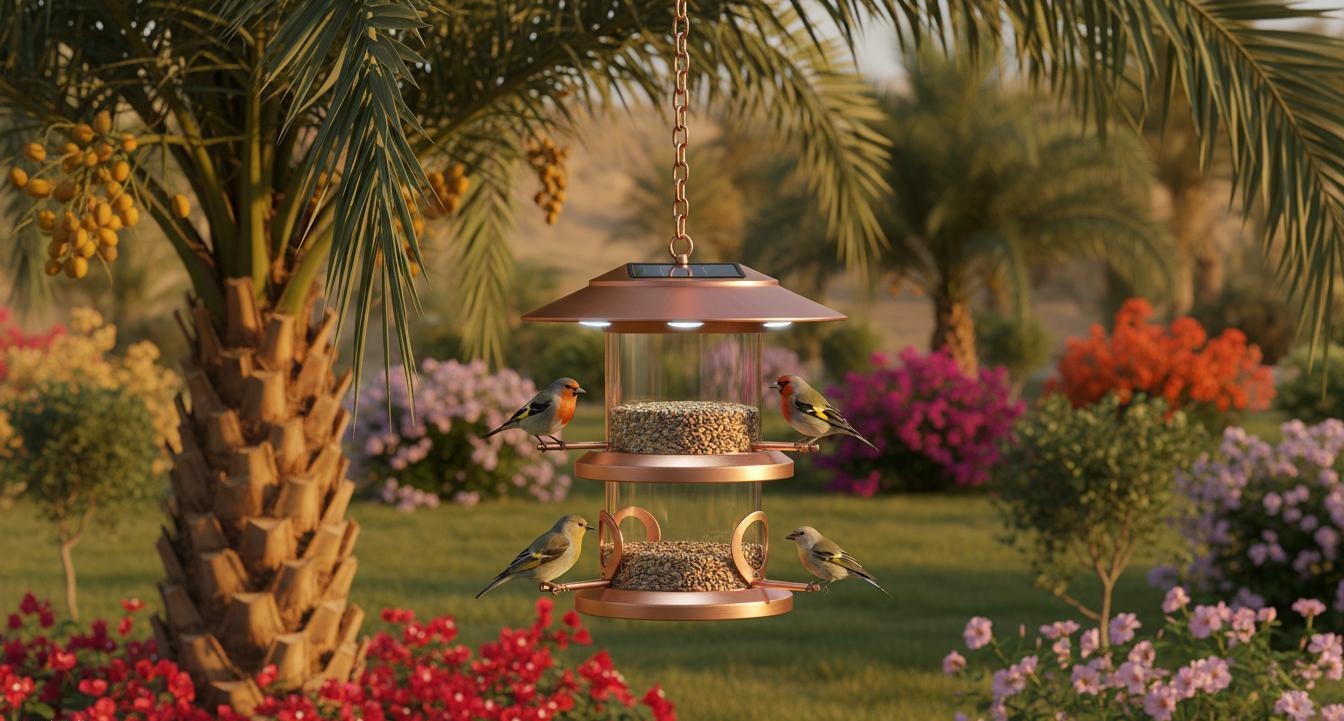
The Double-Layer Design: Why It Is Dominating 2026 Orders
If I had to identify one product characteristic that separates the top-selling solar bird feeders from the rest in this market, it would be the double-layer construction. These are not mere aesthetic upgrades. The double-layer design typically integrates two functional compartments—one for seed and one for nectar, water, or a supplementary feed—powered by a shared or dual solar panel array. This architectural choice solves a real problem for Middle East garden center customers: space constraints and bird biodiversity.
Across GCC residential gardens, balconies, and commercial landscapes, customers want to attract a wider variety of birds without cluttering their outdoor spaces with multiple feeders. A single double-layer unit does the work of two. From a wholesale perspective, this means you are selling one SKU that addresses two purchase motivations—which translates directly to higher basket size and stronger sell-through velocity.
Our factory partners have responded to this demand by accelerating production of double-layer models with improved solar panel efficiency, shifting predominantly from amorphous silicon to monocrystalline photovoltaic cells, which deliver 20–25% higher energy conversion under intense direct sunlight. The result is a product that charges faster, operates reliably through overcast days, and sustains bird activity monitoring features (where equipped) for longer overnight periods.
Understanding the Wholesale Market: Who Is Buying and Why
The buyer profile in the Middle East for solar bird feeders in2026 clusters into three primary segments, each with distinct purchasing behaviors that wholesale suppliers must understand to plan stock correctly.
1. Urban Garden Centers in the GCC
These are the backbone buyers—retail outlets in Dubai, Riyadh, Jeddah, Doha, and Kuwait City that serve end consumers ranging from villa owners with large gardens to apartment residents with balconies. Their purchasing pattern is seasonal, with pronounced spikes in Q3 (late summer preparation) and Q4 (pre-spring stocking). They favor mid-range price points, typically USD 15–35 per unit, and are highly sensitive to packaging quality and brand presentation.
2. Hospitality and Resort Procurement
A growing segment—luxury resorts, hotel groups, and hospitality developments across the region are incorporating bird feeders into their landscape design as part of biodiversity and eco-tourism initiatives. These buyers purchase in bulk (quantities of 100–500 units per order), require higher durability specs, and are willing to pay a premium for premium models with advanced solar features and aesthetic finishes.
3. Agricultural and Wholesale Distributors
Regional distributors who aggregate product from multiple suppliers and supply smaller retail outlets across secondary cities and towns. They are volume-driven, price-conscious, and typically negotiate container-load orders (20-foot containers, 800–1,200 units). Their preference is for simpler single-layer solar models that are easy to stock and redistribute.
| Buyer Segment | Typical Order Size | Price Range (USD) | Preferred Model | Peak Buying Season |
|---|---|---|---|---|
| Urban Garden Centers | 50–300 units | $15–35/unit | Double-layer mid-range | Q3 & Q4 |
| Hospitality/Resort | 100–500 units | $35–60/unit | Double-layer premium | Year-round |
| Wholesale Distributors | 800–1,200 units | $8–20/unit | Single-layer standard | Q1 & Q2 |
For garden centers specifically, I recommend abalanced stock mix:60% double-layer models in the mid-range segment, 25% premium double-layer units, and 15% single-layer entry-level products. This mix captures the dominant demand trend while serving the full breadth of your customer base.
Climate Specifications: What the Middle East Demands
I cannot stress this enough—Middle East buyers who have been burned by imported garden products that fail within12 months are watching for climate-spec compliance. When you source solar bird feeders for this market, the following specifications are not optional extras; they are the minimum bar for reorders.
UV-Resistant Housing
Solar bird feeders installed in direct sunlight across Saudi Arabia, the UAE, or Qatar will be exposed to peak solar irradiance that can exceed 1,000 W/m². Standard ABS plastic will embrittle and crack within 6–12 months. You need housing made from UV-stabilized polycarbonate or high-density polyethylene (HDPE) with UV inhibitor additives rated to ASTM D4329 (standard practice for UV exposure testing). Our factory network tests housing samples under accelerated UV weathering for 2,000 hours minimum before approving for Middle East supply.
Anti-Corrosion Hardware
Coastal cities—Dubai, Jeddah, Bahrain, Kuwait City—experience high relative humidity combined with salt air. Standard steel screws and hinges will corrode within months. All hardware must be marine-grade stainless steel (AISI 316) or powder-coated aluminum. Any brass components should meet DIN EN 12164 standards.
Solar Panel Temperature Ratings
Solar panels lose efficiency at high temperatures—a1°C rise above 25°C can reduce output by approximately 0.4–0.5% for crystalline silicon modules. In desert environments where panel surface temperatures can reach 70–80°C at peak midday, buyers need panels with anegative temperature coefficient and thermal tolerance rating of at least 85°C. Request datasheets showing NOCT (Nominal Operating Cell Temperature) data.
Water Ingress Protection
Look for an IP65 or higher ingress protection rating (IEC 60529 standard) for the solar panel housing and IP44 minimum for the seed/nectar compartments. This ensures the product survives sandstorms, heavy rain events (increasingly common in GCC due to climate adaptation), and pressure-washing during facility maintenance.
The Economics of Solar Bird Feeder Wholesale
Let me walk you through the numbers that matter when you are deciding how much stock to commit for the 2026 season.
From a factory perspective, the production cost of a quality single-layer solar bird feeder with basic monocrystalline panel ranges from USD 4.50 to 8.00 per unit at scale (1,000+ units). The double-layer premium models with dual panels, enhanced housing, and advanced features range from USD 12.00 to 22.00 per unit. These are EXW (Ex Works) prices; add sea freight, customs clearance, and last-mile delivery to arrive at your landed cost.
Sea freight from Yiwu or Shenzhen to Dubai Port ranges from USD 1,200 to 2,400 per 20-foot container (depending on shipping lane and fuel surcharges). A 20-foot container comfortably holds 800–1,000 mixed bird feeder units. This means freight adds approximately USD 1.20 to 3.00 per unit to your landed cost—making the total landed cost for a standard double-layer model roughly USD 14–25 per unit.
Garden centers in the UAE and Saudi Arabia typically retail these products at a2.8x to 3.5x markup, placing retail prices in the range of USD 35–75 per unit for mid-range double-layer models. At these price points, the gross margin per unit ranges from USD 20–50, which is significantly higher than most comparable garden décor items.
“In my 30 years of cross-border procurement, solar bird feeders represent one of the rare categories where the Middle East market offers both strong retail margins AND growing wholesale demand—with the added benefit of a product that practically sells itself once installed in a sun-drenched garden.” — Zhong Ji
Supply Chain Considerations: Planning Your 2026 Stock
At CBNB Supplier, we manage supply chains for 36,000+ product SKUs across our factory network. For solar bird feeders heading to the Middle East in 2026, here is how I advise buyers to structure their procurement timeline.
Production Lead Time
Standard production runs for solar bird feeders range from 30 to 45 days from order confirmation to factory ready-to-ship status. This includes solar panel sourcing (most panel manufacturers operate on 15–20 day lead times for smaller quantities), housing molding, assembly, and quality inspection. If you need custom branding or packaging, add an additional 10–15 days.
Shipping Windows
Sea freight from Chinese ports (Shanghai, Shenzhen, Yiwu) to Dubai typically runs20–28 days. To Dubai World Central or Jeddah Islamic Port, allow 25–35 days. If you are shipping to Doha (Hamad Port), expect 28–35 days. For the2026 Q3 selling season, I recommend placing orders no later than mid-July to ensure stock arrives by late August—giving you a full month of selling runway before the September–October peak.
Quality Verification Before Shipment
Insist on pre-shipment inspection by a third-party inspection service such as SGS Group or Bureau Veritas. The inspection should verify solar panel output (minimum 5W per panel under standard test conditions), housing UV resistance documentation, IP rating confirmation, and a random sampling of assembly quality. A standard inspection costs USD 300–500 per container—a trivial expense against the cost of receiving a defective batch.
Documentation and Customs
All solar bird feeders entering GCC countries must comply with relevant ISO standards and may require a Certificate of Conformity (CoC) or conformity assessment for specific product categories under the GCC Standardization Organization (GSO) regulations. Ensure your supplier provides original certificates and test reports. Missing documentation is the leading cause of customs delays at Jeddah and Dubai ports—delays that add storage costs of USD 50–150 per day per container.
Why This Is the Right Moment to Stock Solar Bird Feeders
Every market has a moment when a category transitions from early adopter curiosity to mainstream demand. Solar bird feeders in the Middle East have crossed that threshold in 2026. The evidence is in the order books—not just at CBNB Supplier, but across the broader garden product distribution network in the region.
Three structural trends support sustained demand growth:
- Urban greening initiatives across GCC cities are creating new public and residential green spaces that require bird-friendly landscape elements. Dubai’s Urban Master Plan2040 and Saudi Arabia’s Million Trees Initiative are driving municipal demand that filters down to retail garden centers.
- Rising consumer awareness of urban biodiversity is creating a new customer segment—predominantly younger, educated homeowners—who actively seek bird-feeding products as part of creating wildlife-friendly gardens.
- Smart home integration is entering the garden product category. Solar bird feeders with app-connected bird cameras, activity sensors, and solar data monitoring are beginning to appear in premium catalogs. While still a niche, this segment commands USD 80–150 retail prices and attracts high-margin customers.
What to Stock: CBNB Supplier’s 2026 Recommended SKUs
Based on current order data and market signals, our procurement team has identified the following solar bird feeder categories as the strongest performers for Middle East wholesale in 2026.
Category A: Double-Layer Premium (Best Seller)
Features: Dual-compartment design (seed + nectar), dual monocrystalline solar panels (total 8–10W), UV-stabilized polycarbonate housing, marine-grade 316 stainless steel hardware, IP65-rated solar module housing, built-in LED ambient garden lighting, mounting hardware included. Target wholesale: USD 22–28/unit. Target retail: USD 65–85/unit.
Category B: Double-Layer Standard
Features: Dual-compartment, single monocrystalline panel (4–5W output), UV-stabilized ABS/HDPE hybrid housing, anti-corrosion coated steel hardware, IP44 compartment rating. Target wholesale: USD 14–18/unit. Target retail: USD 38–55/unit.
Category C: Single-Layer Solar Feeder (Entry-Level)
Features: Single seed compartment, integrated amorphous silicon panel (2–3W), UV-resistant ABS housing, simple wall-mount or pole-mount system. Target wholesale: USD 6–10/unit. Target retail: USD 18–28/unit.
FAQ — Solar Bird Feeders for Middle East Garden Centers
Why are Middle East garden centers switching to solar bird feeders?
Middle East garden centers are adopting solar bird feeders due to the region’s abundant sunlight, energy cost savings, and growing demand for eco-friendly garden products. Solar models eliminate the need for battery replacements and wiring, making them ideal for outdoor spaces across GCC countries. Additionally, municipal greening initiatives and sustainability mandates under Vision 2030 and similar programs are actively promoting wildlife-friendly outdoor products, creating a favorable policy environment for solar bird feeders.
What is a double-layer solar bird feeder and why does it matter?
A double-layer solar bird feeder features two functional compartments—one for seeds and one for nectar or water—powered by integrated solar panels. This design supports more bird species, increases customer appeal, and allows garden centers to stock a single product that serves multiple bird-feeding needs. From a retail perspective, the double-layer design justifies a higher price point and generates stronger sell-through rates compared to single-layer models.
What should wholesale buyers look for when sourcing bird feeders for the Middle East market?
Wholesale buyers should verify UV-resistant materials suitable for high-temperature climates, certified solar panel efficiency, secure mounting systems, and compliance with international safety standards such as ASTM and ISO specifications. Packaging should also be climate-adapted for long sea freight transit. Most critically, request third-party test reports from organizations like ASTM International or SGS confirming UV weathering performance, IP ingress ratings, and solar panel output under STC conditions.
What is the typical lead time for solar bird feeder wholesale orders from China to the Middle East?
Standard lead times for solar bird feeder wholesale orders range from 30 to 45 days for production, plus 20 to 35 days for sea freight from Chinese ports to Middle East destinations such as Dubai, Jeddah, or Doha. Express air freight options can reduce delivery to 7–10 days but at significantly higher cost. For Q3/Q4 peak season planning, buyers should place orders no later than mid-to-late July to ensure stock availability by late August or early September.
How much should garden centers budget for 2026 solar bird feeder stock?
Garden centers should budget based on projected seasonal demand, with an average wholesale price range of USD 8–25 per unit for standard solar bird feeders and USD 25–60 for premium double-layer models. A recommended starting stock for a medium-sized garden center is 200–500 units, with reordering every 60–90 days based on sales velocity. Initial investment for a 300-unit mixed stock typically ranges from USD 5,000 to 12,000 at landed cost, supporting potential retail revenue of USD 15,000–40,000 within the first season.
Are solar bird feeders suitable for all Middle East climate conditions?
Most quality solar bird feeders are rated for operating temperatures of -10°C to 60°C, making them suitable for most Middle East environments. However, buyers should specifically request models with UV-stabilized housing, anti-corrosion hardware, and heat-resistant solar panels for optimal performance in desert and coastal conditions. Products without these specifications will experience accelerated degradation, particularly in Saudi Arabian and inland UAE locations where summer ambient temperatures regularly exceed 45°C and panel surface temperatures can reach 70–80°C.
Zhong Ji — Chief Supply Chain Expert
A Chinese supply chain expert with 30 years of international trade experience, he has in-depth knowledge of 36,000+ high-quality factory resources and leads product development, cross-border procurement and logistics optimization.
Ready to Stock the 2026 Solar Bird Feeder Season?
Browse our full range of solar bird feeders and garden supplies—or request a custom wholesale quote tailored to your Middle East market needs.
Post time: Jun-12-2026