




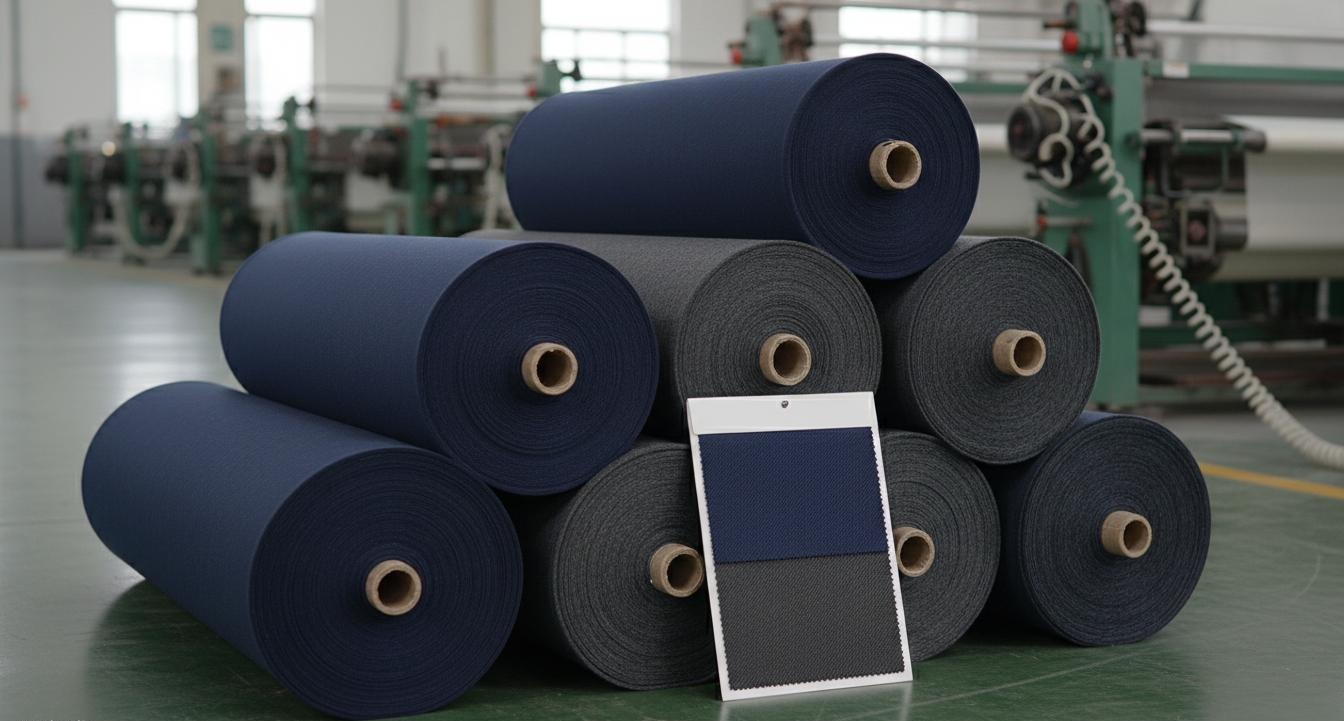
 The Pricing Reality of Lightweight Twill for the European Market
With 30 years of experience in cross-border procurement across China’s manufacturing base, I have watched the polyester viscose twill segment evolve from a commodity fabric with thin margins to a specialized product category where procurement strategy determines whether a European apparel mill hits its target COGS or misses by 15-20 percent.
Let me be direct about the USD 0.32/meter price point. It is achievable for 100gsm polyester viscose twill at a 70/30 blend ratio with standard 145cm width and piece-dyed finishing, but it requires specific conditions. The price assumes an order volume of 10,000-50,000 meters per colour per SKU, FOB Ningbo or Shanghai, excluding sample development charges and testing fees. At smaller volumes — 1,000-5,000 meters — the unit price typically ranges from USD 0.38-0.48/meter because the dye lot reproducibility cost is proportionally higher.
In this guide, I walk through the procurement parameters that European apparel mills should verify when sourcing 100gsm polyester viscose twill at competitive pricing — covering fabric specifications, certification requirements, supplier qualification, lead time planning, and the logistics strategies that make the USD 0.32/meter price point achievable without compromising quality.
Fabric Specification: What “100gsm Polyester Viscose Twill” Actually Means
The specification sheet for 100gsm polyester viscose twill is not uniform across Chinese mills. The differences in construction parameters affect both the finished garment quality and the price.
Blend Ratio: The 70/30 Sweet Spot
The standard 70 percent polyester to 30 percent viscose blend ratio gives the fabric its characteristic combination of wrinkle resistance (from the polyester) and soft hand feel (from the viscose). Mills that deviate from this ratio — using 65/35 or 75/25 — typically do so to manage raw material cost volatility. Polyester staple fiber prices fluctuate with crude oil; viscose staple fiber prices with dissolving wood pulp. In 2024, polyester prices ranged from USD 0.85-1.05/kg FOB China while viscose ranged from USD 1.80-2.20/kg. A mill that shifts the blend toward 75/25 polyester reduces raw material cost by approximately 3-5 percent but alters the fabric’s drape and moisture absorption characteristics. European apparel mills designing blouses, dresses, and lightweight trousers from 100gsm twill should specify 70/30 as the confirmed blend ratio on the purchase order and require a third-party fibre composition test on the finished fabric.
Weave Construction and Thread Count
The twill weave for 100gsm fabric typically uses a 2/1 right-hand twill construction with a warp count of 50-60 Ne (cotton count system) and a weft count of 30-40 Ne. The thread density should be approximately 160-180 threads per inch (warp plus weft). Fabric that falls below 150 threads per inch begins to show visible weave gaps on close inspection — a quality threshold that European apparel buyers in the mid-to-premium segment consistently reject. Above 190 threads per inch, the fabric weight increases toward 120-130gsm, moving it out of the 100gsm lightweight category. I recommend specifying the thread count range on the purchase order and inspecting the greige fabric before dyeing.
Width and Shrinkage Specifications
European apparel mills typically require a finished width of 145cm (+/- 2cm) after relaxation, with a maximum shrinkage of 3 percent in warp and 2 percent in weft after three home-laundering cycles at 40°C. Mills that dye the fabric under tension and then relax it on a Sanforizing machine achieve shrinkage within these limits. Mills that skip the Sanforizing step produce fabric with 5-8 percent residual shrinkage — a defect that European garment manufacturers, particularly those supplying Italian and French ready-to-wear brands, routinely reject.
Certification Requirements for European Market Access
Three certification documents are expected by European apparel mills when sourcing polyester viscose twill from China.
Oeko-Tex Standard 100 — Class II Certification
The Oeko-Tex Standard 100 certification is the most frequently required compliance document for European fabric imports. Class II (skin-contact) certification tests for restricted substances including azo dyes, formaldehyde, heavy metals (lead, cadmium, mercury, chromium VI), chlorinated phenols (PCP, TeCP), and phthalates. The test must be conducted by an Oeko-Tex-accredited laboratory — typically TESTEX, Hohenstein, or an equivalent institution with a valid license agreement. I recommend asking the mill for their current Oeko-Tex certificate (renewed annually) and verifying that the certificate covers both the polyester and viscose components, not just the finished fabric. Some mills certify only the polyester yarn and assume the viscose component passes by extension — this is not a valid compliance claim and will be rejected during a European brand’s supplier audit.
REACH Compliance Declaration
While Oeko-Tex covers the consumer safety aspect, REACH (Registration, Evaluation, Authorization and Restriction of Chemicals) compliance addresses the chemical safety of the manufacturing process. The mill should provide a REACH compliance declaration listing all chemicals used in the fabric production chain — spinning, weaving, dyeing, and finishing — and confirming that none exceed the REACH SVHC (Substances of Very High Concern) concentration limits. CBNB maintains REACH compliance documentation for all fabric suppliers in our network, verified through annual third-party audits.
BSCI or Sedex Social Compliance Audit
European apparel brands increasingly require evidence of social compliance in their supply chain. Amfori BSCI (Business Social Compliance Initiative) or Sedex (Supplier Ethical Data Exchange) audits are the most commonly accepted frameworks. A valid BSCI or Sedex audit report — conducted within the last 12 months — confirms that the mill’s working conditions, wages, and health and safety practices meet the standards expected by European importers. I have seen European fashion brands reject otherwise acceptable fabric because the mill could not produce a current BSCI audit report.
Lead Time Planning for European Fabric Orders
A typical order for 100gsm polyester viscose twill from a Chinese mill follows this timeline.
| Milestone | Week | Notes |
|---|---|---|
| Sample development and colour matching | Week 1-2 | 10-14 working days for Pantone matching |
| Bulk greige fabric production | Week 3-5 | 3 weeks for 10,000-30,000m |
| Dyeing and finishing | Week 6-7 | 2 weeks including relaxation |
| Final quality inspection | Week 8 | AQL 2.5 standard, 10% roll inspection |
| Container loading and shipping | Week 8 | Departure from Ningbo/Shanghai |
| Sea freight — Shanghai to Rotterdam | Week 9-12 | 28-32 days transit |
| Customs clearance and delivery | Week 13 | 2-5 days clearance |
The 13-week total lead time means that a European mill sourcing for the spring/summer collection (typically requiring fabric delivery by October-November for January retail arrival) must place the order by July at the latest. I have seen mills who waited until September for a spring order end up air-freighting fabric at USD 1.80-2.50/kg instead of the sea freight cost of USD 0.15-0.25/kg — erasing the USD 0.32/meter pricing advantage entirely.
Container Consolidation: The Key to Unlocking the $0.32 Price Point
The USD 0.32/meter FOB price assumes that the fabric order is part of a larger container consolidation, not a single-product full container load. Here is why.
A full 40-foot container holds approximately 30,000-35,000 linear metres of 100gsm twill on standard 1.5m-diameter rolls. For a single mill producing at USD 0.32/meter, the FOB value of a full container is approximately USD 9,600-11,200. The ocean freight from Shanghai to Rotterdam for a 40-foot container was approximately USD 2,800-3,800 in 2025 — an additional USD 0.09-0.11/meter in logistics cost. The total landed cost is USD 0.41-0.43/meter — still competitive, but the freight surcharge raises the effective unit cost by 28-34 percent.
CBNB’s advantage here is our 36,000+ factory supplier network spanning multiple product categories. We consolidate fabric orders with other non-competing textile products — finished garments, home textiles, industrial fabrics — into single containers that ship on a weekly schedule from Ningbo to Rotterdam. The consolidation reduces the per-product freight allocation by 40-55 percent because the container space and customs documentation costs are shared across multiple products. For a European mill ordering 5,000-10,000 metres of twill as part of a consolidated shipment, the allocated freight cost drops to USD 0.03-0.05/meter — making the landed cost approximately USD 0.35-0.37/meter, directly competitive with Eastern European fabric sources.
Quality Inspection Protocol for European Buyers
I recommend a four-point quality inspection process that I have refined through three decades of international trade.
Point 1: Greige Inspection Before Dyeing
Before the fabric enters the dyeing process, the greige (unbleached, undyed) fabric should be inspected for weaving defects — missing warp ends, double picks, slubs, and reed marks. The standard acceptable defect rate for export-quality greige is 2-3 defects per 100 linear metres. Defects identified at this stage can be cut out before dyeing, preventing the waste of dye chemicals on defective fabric.
Point 2: Dye Lot Shade Verification
Each dye lot — typically 1,000-2,000 metres per shade in a production run — must be checked against the approved Pantone standard under D65 daylight illumination (standard north-sky daylight at 6,500K colour temperature). A Delta E (colour difference) value of 1.0 or less is the acceptance standard for European apparel. I recommend the mill provides a spectral photometer reading with each dye lot shipment so the European buyer can verify conformity upon receipt.
Point 3: Finished Fabric Inspection per AQL 2.5
The finished fabric inspection follows the Acceptable Quality Level (AQL) 2.5 standard — meaning that no more than 2.5 percent of the inspected rolls may contain major defects. The inspection covers shade variation across the roll width, bowing of the twill line (maximum permissible: 2 percent of fabric width), weft straightness, and point defects. CBNB offers third-party inspection through SGS or Bureau Veritas at the mill before container loading, with the inspection report issued within 48 hours.
Point 4: Pre-Shipment Verification of Documentation
Before the container leaves the mill, I confirm that all documentation is complete: the Oeko-Tex certificate, REACH compliance declaration, BSCI/Sedex audit report, the packing list, the commercial invoice, and the bill of lading. I have seen European fabric buyers accept a shipment at their warehouse only to discover that the Oeko-Tex certificate expired during transit — requiring the fabric to be quarantined until a renewed certificate is issued. We verify the validity dates of all compliance documents at the time of container loading.
Frequently Asked Questions
Can the 100gsm polyester viscose twill be piece-dyed or yarn-dyed?
The standard production method for this fabric is piece-dyeing — the greige fabric is woven from undyed polyester and viscose yarns, then dyed in the finished piece form. Piece-dyeing is the most cost-effective method at USD 0.28-0.32/meter for solid colours. Yarn-dyeing — where the polyester and viscose yarns are dyed separately before weaving — is significantly more expensive at USD 0.55-0.75/meter and is used for stripe, check, or other multicolour pattern effects. Yarn-dyed twill is also heavier because the dyeing process increases yarn stiffness, requiring a higher twist per inch to achieve the same fabric hand feel.
What is the minimum order quantity for custom-colour 100gsm twill?
The typical MOQ for custom Pantone-matched colour is 3,000-5,000 metres per colour per SKU. Below 3,000 metres, the dye house must produce a smaller dye batch and the unit cost increases to USD 0.45-0.55/meter because the dye chemistry balancing is proportionally more expensive per metre. If your requirement is 1,000-2,000 metres, I recommend selecting from the mill’s standard colour range — typically 15-25 stock colours — which can be shipped immediately at the standard USD 0.32-0.35/meter price point with no colour matching lead time.
How does the fabric perform in garment washing tests?
100gsm polyester viscose twill (70/30 blend) typically shows 2.5-3.5 percent warp shrinkage and 1.5-2.5 percent weft shrinkage after five home-laundering cycles at 40°C. The fabric reaches dimensional stability after the third wash, with no further measurable shrinkage beyond cycle five. Colour fastness to washing is typically Grade 4-5 (grey scale) for disperse dyes on polyester and Grade 4 for reactive dyes on viscose. Colour fastness to light (ISO 105-B02) is Grade 4-5, suitable for garments that are not exposed to prolonged direct sunlight in retail display windows.
Can this fabric be used for printed garment designs?
Yes, but with a limitation. The 70/30 polyester/viscose blend presents a challenge for digital printing because the polyester and viscose fibres absorb ink at different rates. For best results, I recommend a fabric that has been pre-treated with a dispersing agent specifically formulated for polyester-viscose blended fabrics. The print sharpness on 100gsm twill is excellent for geometric and abstract designs but may show slight blurring on fine text or micro-detailed motifs below 0.5mm line width due to the twill weave texture. For printed fabric orders, CBNB can coordinate with mills that have dedicated polyester-viscose digital printing lines with pre-treatment application — a specific capability that not all weaving mills in China have in-house.
What is the packaging standard for fabric rolls shipped to Europe?
Standard export packaging for 100gsm twill destined for Europe is: the fabric is wound onto 7.5cm (3-inch) inner-diameter cardboard tubes with a minimum wall thickness of 5mm to prevent collapse during ocean transit. Each roll is individually wrapped in polyethylene film to protect against moisture, with desiccant gel packs placed inside the poly wrap. Maximum roll weight is 50 kg for manual handling or 200 kg for forklift-compatible palletized rolls. The textile export carton label must include the material composition (70% polyester, 30% viscose), the GSM weight (100 g/m²), the colour reference, the roll number, the metre length, and the mill’s batch number. For container stowage, fabric rolls should be loaded in a moisture-free container with silica gel desiccant (minimum 2 kg per 20-foot container) and a container humidity logger if the transit crosses the Suez Canal or other high-humidity zones during the European winter.