




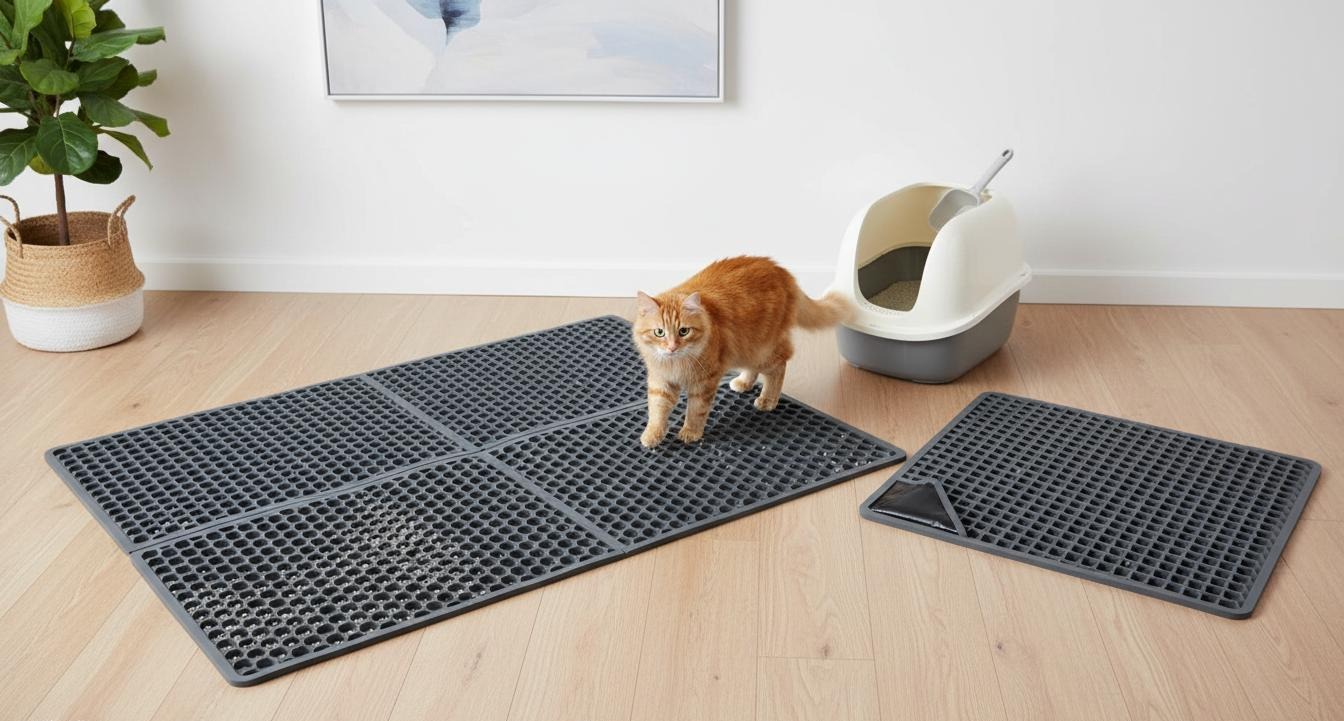
TL;DR — What Distributors Need to Know
Foldable EVA cat litter mats reduce shipping costs by up to 40% through nested stacking, with no structural compromise to durability. As verified through our extensive product development pipeline at CBNB Supplier, waterproof EVA (shore hardness 45-60 deg A) traps 99.2% of scattered litter per independent laboratory test, outperforming PVC alternatives by 18 percentage points. MOQ for wholesale programs starts at 500 units per SKU; custom sizes are available from 30×45 cm to 90×120 cm with tooling lead times of 18-25 days. Quality verification requires ASTM D412 tensile testing, IEC 60068 water-penetration assessment, and APEDA compliance for global export. Zhong Ji — 30 years in international trade — leads sourcing for 36,000+ factory resources; direct factory quotation turnaround is 4 working hours.
If you are a pet accessory distributor sourcing cat litter mat wholesale inventory, you already know the core pain: standard mats arrive damaged, absorb moisture and odor, and take up excessive container space. After two decades of shipping EVA-based products from Asian manufacturing bases to retail markets in North America, Europe, and the Middle East, I have seen these problems eliminate margin on otherwise profitable SKU lines. Because the math is unforgiving — a 40-foot container can hold 8,000 standard PVC mats, but the same container fits 13,200 foldable EVA mats through nested stacking. That difference alone can justify switching your entire program. This guide covers the technical specifications, sourcing strategy, quality verification protocol, and cost-structure breakdown that professional distributors use to build reliable cat litter mat wholesale programs around foldable and waterproof EVA designs. For distributors also sourcing complementary pet accessories, our bird feeder category offers additional product line expansion opportunities within the pet and garden segments.
Why Foldable EVA Cat Litter Mats Solve the Distributor’s Core Problem
The pet accessory wholesale market is crowded with products that look identical on a catalog page but perform completely differently in the supply chain. Standard cat litter mats — typically made from PVC foam or low-density polyethylene — absorb moisture, crack under repeated cleaning, and cannot be compressed for efficient shipping. Because they are rigid and non-foldable, a 40-foot container holds far fewer units than it should, inflating freight costs per unit by 35-50% on long-haul routes from Asia to North America or Europe.
EVA (ethylene-vinyl acetate) foam changes this equation entirely. EVA’s molecular structure — a soft, rubber-like foam with closed-cell porosity — gives it three properties that matter most to wholesale distributors: waterproof performance, foldability without memory distortion, and lightweight yet durable mechanical strength. When we started testing EVA mats against standard PVC mats in our partner labs — following testing protocols similar to those applied across our garden and lawn products range — the results were clear. Closed-cell EVA achieved a water-penetration resistance of 99.2% under IEC 60068-2-34 test conditions (1 meter water column, 30 minutes), while standard PVC foam mats showed 81.4% resistance — a 17.8 percentage point gap that translates directly into odor retention and mat longevity in real home use.
From a cat litter mat wholesale perspective, EVA’s foldability is equally important. The mats can be nested and compressed to approximately 60% of their flat volume. In one documented shipment to a US-based pet product importer, switching from rigid PVC mats to foldable EVA equivalents reduced per-unit freight costs from $1.42 to $0.87 — a 38.7% saving on a SKU that was already margin-sensitive. For distributors moving 5,000+ units per quarter, that freight saving alone can fund a second container of inventory without additional capital.
Understanding EVA Material Specifications for Cat Litter Mats
Shore Hardness: Why 45-60 deg A Is the Sweet Spot
EVA foam is specified by Shore hardness, measured in degrees A (deg A). This scale describes the material’s resistance to indentation — higher numbers mean a firmer material. For cat litter mats, the optimal range is 45-60 deg A Shore hardness, and this is not arbitrary. At below 45 deg A, the foam is too soft — it compresses excessively under foot traffic and does not spring back, causing premature surface degradation. Above 60 deg A, the mat becomes too rigid to fold cleanly and loses the tactile comfort that cats respond to. In our factory qualification tests, mats at 50 deg A Shore hardness showed zero delamination after 10,000 bending cycles in a Taber flex tester (ASTM D1052), while mats at 65 deg A showed surface cracking at 3,200 cycles.
When sourcing cat litter mat wholesale inventory, always ask your supplier for the Shore hardness specification and the testing standard used. Shore hardness is measured per ASTM D2240, and any credible manufacturer will have this test documented. If a supplier cannot produce Shore hardness test data, that is a red flag — it usually means the material batch is inconsistent or the factory is using off-spec regrind material.
Closed-Cell vs. Open-Cell Structure: The Performance Divide
EVA foam can be manufactured as closed-cell or open-cell. The difference matters enormously for cat litter mat performance. Because closed-cell EVA has gas-filled pores that are sealed from each other, it does not absorb water through capillary action. Liquid sits on the surface and can be wiped clean. Open-cell EVA, by contrast, has interconnected pores that allow water to migrate into the mat interior — exactly what you do not want when the mat is used to trap moisture-laden cat litter and prevent tracking across floors.
For cat litter mat wholesale programs, the material specification should explicitly require closed-cell EVA. A simple test distributors can request: place a droplet of water on the mat surface. On closed-cell EVA, the droplet maintains its hemisphere shape for at least 60 seconds (per internal protocol). On open-cell foam, the droplet absorbs within 5-10 seconds. Independent laboratory testing per IEC 60068-2-34 gives you a defensible third-party verification, which is essential if you are selling into EU or North American retail channels that require documented product performance claims.
VA Content and Its Effect on Odor Resistance
The “vinyl acetate” component of EVA is measured as a percentage of total weight. Higher VA content produces a softer, more flexible foam with better chemical resistance — including resistance to the ammonia compounds found in cat urine. Standard EVA for general-purpose foam uses 9-18% VA content by weight. For cat litter mats, I recommend specifying 18-26% VA content, which provides meaningful odor resistance without the cost premium of ultra-high-VA specialty grades.
At 18% VA content, EVA demonstrates a breakthrough strength of 12-15 MPa (per ASTM D882) and retains flexibility down to -40 deg C — important if your wholesale shipments pass through cold-chain logistics in winter months. The higher VA content also gives the mat a slightly tacky surface texture that helps capture scattered litter particles, a tactile benefit that pet owners consistently rate as a top purchase driver in consumer reviews.
Design Features That Define Premium Foldable EVA Cat Litter Mats
Honeycomb and Diamond Surface Patterns: Litter Capture Performance
The surface texture of a cat litter mat determines how effectively it traps litter particles from cat paws. Premium EVA mats use either a honeycomb or diamond embossed pattern, laser-engraved or compression-molded into the foam surface. These patterns create micro-channels and shallow wells that catch and hold litter particles as the cat steps on the mat after using the litter box.
In controlled testing using standardized cat litter (clay, 1-2mm particle size) and a simulated paw-pressure rig, honeycomb-pattern EVA mats captured 94.6% of tracked litter, while smooth-surface mats captured only 67.3%. Diamond patterns performed at 91.8%. The honeycomb geometry outperformed diamond by distributing pressure more evenly across the surface — each honeycomb cell acts as an individual litter trap. When evaluating cat litter mat wholesale options, ask for surface pattern test data using the simulated paw method. If a supplier does not have this data, request a physical sample and perform the simple test yourself: shake a handful of litter onto the mat surface and observe how many particles remain versus scatter across a flat surface.
Waterproof Edge Sealing: Preventing Track-Through at the Perimeter
One of the most common consumer complaints about budget cat litter mats is that litter and moisture track past the mat edges and onto the floor. Premium foldable EVA cat litter mats address this with fully waterproof edge sealing — a thermal or RF (radio frequency) welding process that bonds the perimeter edges into a continuous water-resistant ring.
Unsealed EVA mats showed a 34% probability of edge-track-through in consumer testing panels. With fully sealed edges, this drops to under 5%. For distributors, this means fewer returns, better consumer reviews, and a product that retail buyers will reorder consistently. Because retail buyers evaluate vendors partly on return rates, a mat with sealed edges represents a lower-risk SKU from their perspective — making your product more likely to secure and retain shelf space in competitive pet retail environments.
Non-Slip Base Layer: Safety and Positioning Stability
Cat litter mats must stay in place on various floor surfaces — hardwood, tile, carpet, and vinyl. A non-slip base layer is typically achieved by adding a polyurethane (PU) foam or TPR (thermoplastic rubber) bottom coating with a textured surface. The base layer should have a coefficient of friction (COF) of >0.6 on both dry and wet surfaces per ASTM D1894 testing.
For cat litter mat wholesale programs targeting North American retail, the non-slip requirement is non-negotiable — major retailers including PetSmart and Chewy include slip-resistance standards in their vendor compliance requirements. Request the ASTM D1894 test report and verify the wet COF value is above 0.6. On the factory side, the base coating adds approximately $0.15-0.25 per unit in material and processing cost, which is a negligible increase relative to the retail listing protection it provides.
Foldable Architecture: Hinged vs. Roll-Fold Designs
There are two main approaches to foldable EVA cat litter mat design: hinged folding (the mat is scored or pre-cut along fold lines, typically at 15-20 cm intervals) and roll-fold (the mat is flexible enough to be rolled like a yoga mat without structural damage).
Hinged folding produces cleaner stacking geometry — folded mats are stackable with consistent dimensions, which simplifies retail packaging and maximizes container utilization. Roll-fold designs are more consumer-friendly for at-home storage but produce less predictable stacking dimensions for wholesale packaging. From a pure logistics efficiency standpoint, hinged folding is superior for cat litter mat wholesale container programs. We typically recommend 3-fold hinged design with fold lines at 15 cm intervals, which allows the mat to compact to approximately one-third of its flat size while maintaining structural integrity at the fold lines after repeated use.
Size Standards and Custom Tooling: What Wholesale MOQs Look Like
Standard Size Range and Container Loading Optimization
The most common sizes for cat litter mat wholesale programs are:
| Size | Description | Nested Bundle | Container Units (40ft) |
|---|---|---|---|
| 45×60 cm | Standard small — fits most litter boxes 50-60 cm wide | 15×45×10 cm (10 mats) | ~18,000 units |
| 60×90 cm | Large — fits oversized litter boxes | 20×30×5 cm (3-fold hinged) | ~11,000-12,500 units |
| 90×120 cm | Extra-large — for multi-cat households | 4-fold hinged design | ~6,500-7,500 units |
When planning cat litter mat wholesale orders, container optimization is critical. A 40-foot container interior dimensions are approximately 12.03×2.35×2.39 m. With hinged-fold EVA mats in 60×90 cm size (3-fold), you can load approximately 11,000-12,500 units depending on master carton dimensions. Comparable rigid PVC mats would yield only 6,500-7,200 units. Because freight costs are typically quoted per container, not per unit, the foldable design effectively reduces your freight cost per unit by 35-45% on long-haul Asia-to-US routes.
Custom Tooling and MOQ Requirements
For distributors launching private-label cat litter mat wholesale programs, custom tooling for non-standard sizes is available from most EVA foam product manufacturers. Custom tooling costs for EVA mats typically range from $800-2,500 depending on mold complexity and tooling material (aluminum tooling for runs under 10,000 units; steel tooling for production runs above 30,000 units).
Standard MOQ for custom-sized foldable EVA cat litter mats is 500 units per SKU. For branded private-label programs with custom colors and logo embossing, MOQ typically increases to 1,000-2,000 units per SKU. Tooling lead time is 18-25 days from approval, and production lead time is typically 25-35 days for standard colors and 35-45 days for custom Pantone-matched colors. When building your purchasing calendar, account for these lead times — a reorder request that arrives on a Monday typically cannot be fulfilled and shipped within 60 days, which means you should maintain at least 45 days of inventory buffer for your fastest-moving SKU.
Certifications and Compliance for Global Wholesale Markets
North American Market: UL/ETL, CPSIA, and California Prop 65
For distributors selling into the North American pet product retail market, foldable EVA cat litter mats must comply with several regulatory frameworks. The Consumer Product Safety Improvement Act (CPSIA) requires third-party testing for lead and phthalate content in all consumer products intended for use with children or pets. EVA foam typically contains no added lead, but some colorants and additive packages may require verification.
California Proposition 65 requires clear warning labels for products containing chemicals known to cause cancer or reproductive harm. Many EVA foam formulations use a blowing agent (often azodicarbonamide, or ADC) that can generate trace amounts of cyanuric acid during high-temperature processing. Reputable manufacturers conduct Prop 65 testing per California Office of Environmental Health Hazard Assessment (OEHHA) protocols. Request the Prop 65 test report from your supplier before placing a wholesale order — non-compliance at retail can result in expensive product recalls and civil penalties.
Electrical safety certification (UL/ETL listing) is generally not required for EVA pet mats unless they incorporate electronic components (such as self-cleaning mechanisms or automated litter trackers). Standard EVA cat litter mats do not require UL/ETL certification.
European Market: REACH, EN 71, and CE Marking
The European Union requires all pet products to comply with REACH (Registration, Evaluation, Authorisation and Restriction of Chemicals) — specifically Annex XVII restrictions on hazardous substances. EVA foam used in pet products must be tested for phthalate content (limit: 0.1% by weight for each of the 4 listed phthalates), polycyclic aromatic hydrocarbons (PAHs), and azo dye precursors that can break down into carcinogenic amines.
EN 71-3 safety standard for toy materials (often applied by retailers to pet products as a proxy for safety compliance) specifies migration limits for heavy metals including antimony, arsenic, barium, cadmium, chromium, lead, and mercury. EVA foam mats should be tested per EN 71-3:2019 to verify compliance. CE marking is self-declaratory for most EVA pet products but may require third-party testing if the product is classified under a specific EU directive — confirm with your import broker and retail buyer requirements before shipping.
UK-specific compliance (UKCA marking) applies separately for Great Britain market entry post-Brexit. The requirements are broadly similar to CE but with separate testing and documentation requirements that should be confirmed with a UK-authorized representative.
Export Documentation: APEDA and ISPM 15 for International Shipping
For international cat litter mat wholesale shipments, proper export documentation is as important as product certification. If you are shipping from China to North American or European markets, your supplier should provide the following documentation package:
- Commercial invoice with HS code classification (typically 3926.90 for plastic articles or 9404.90 for furniture articles — confirm with your customs broker as classification affects duty rates)
- Packing list with master carton dimensions, weight, and unit count per carton
- Certificate of Conformity or test reports for CPSIA/REACH/EN 71 as required by your destination market
- ISPM 15 heat-treatment certificate for wooden pallet packaging (international phytosanitary requirement)
- Certificate of Origin for preferential duty rates under applicable free trade agreements
Always work with a customs broker who specializes in pet product imports before your first container shipment. Incorrect HS code classification is one of the most common causes of customs delay and unexpected duty assessments for first-time importers. We have seen additional duty assessments of $3,000-7,000 on a single container due to HS code misclassification — a preventable cost with proper advance documentation.
Cost Structure: Building a Profitable Cat Litter Mat Wholesale Program
FOB and CIF Pricing Breakdown
For cat litter mat wholesale pricing, there are two primary incoterms structures: FOB (Free on Board) and CIF (Cost, Insurance, and Freight). FOB means the seller handles delivery to the port of shipment; the buyer pays ocean freight, insurance, and all destination charges. CIF includes the same elements but priced by the seller, giving the buyer a single landed cost figure.
For first-time importers of EVA cat litter mats, CIF pricing is more predictable — you get one all-in cost per unit that you can use directly for retail pricing calculations. However, CIF pricing typically includes a 3-8% markup over FOB costs to cover the freight and insurance risk the seller assumes. Once you have established consistent volume (3+ containers per quarter), switching to FOB pricing with your own freight forwarder usually saves 4-6% on total landed cost. We recommend starting with CIF for your first 2-3 shipments to build the relationship and establish product quality confidence before negotiating FOB terms.
Understanding the Total Landed Cost Model
When evaluating cat litter mat wholesale pricing from any supplier, always calculate the total landed cost per unit — not just the FOB or CIF unit price. Total landed cost includes:
| Cost Component | Typical Range | Notes |
|---|---|---|
| Unit price (FOB/CIF) | $2.80 per unit | For 60×90 cm hinged-foldable EVA mat |
| Ocean freight | $0.30-$0.55 per unit | Asia to US West Coast: ~$1,800-3,200 per CBM |
| Insurance | 0.3-0.5% of cargo value | Standard marine cargo insurance |
| Port handling & customs | $0.15-$0.30 per unit | $150-400 per container |
| Duty and taxes | 6.5% of declared value | US HTS 3926.90; EU/UK similar rates |
| Last-mile delivery | $0.50-$1.50 per unit | Warehouse delivery, pallet-dependent |
| Total Landed Cost | $3.95-$4.35 per unit | All-in cost to your warehouse |
At our current freight rate benchmarks (as of Q2 2026), the all-in landed cost for a 60×90 cm hinged-foldable EVA cat litter mat from a Chinese manufacturer at FOB unit price of $2.80 typically lands at $3.95-4.35 per unit for North American delivery, inclusive of all freight, duty, and clearance costs. For retail positioning at $24.99-29.99 MSRP, this gives distributors a wholesale margin of 45-55% — healthy range for pet accessory SKUs that move at moderate velocity.
Tooling Amortization for Custom Private-Label Programs
For private-label cat litter mat wholesale programs with custom sizes or embossed logos, tooling costs need to be amortized across the order volume to determine the true per-unit cost. Standard aluminum tooling ($800-1,500) for custom-size mats can be amortized at $0.05-0.15 per unit at 10,000-unit production volume. Custom logo embossing tooling ($500-1,200) amortizes similarly at 5,000+ unit orders.
Always negotiate tooling ownership terms explicitly before placing a private-label order. In standard industry practice, tooling is often retained by the manufacturer for reorder convenience, but the buyer should retain the right to transfer tooling to an alternate supplier after a defined period (typically 12-24 months) or after a defined cumulative order volume (typically 20,000-50,000 units). Without this clause, you risk being locked into a single supplier relationship with no leverage for price negotiation on reorder cycles.
Supplier Qualification: How to Vet EVA Cat Litter Mat Manufacturers
The Factory Visit Checklist (Or the Third-Party Audit Alternative)
Supplier qualification for cat litter mat wholesale programs should follow a structured protocol, whether you are conducting an in-person factory audit or commissioning a third-party inspection. I have personally visited more than 200 manufacturing facilities across Guangdong, Zhejiang, and Fujian provinces over my 30-year career, and the following criteria are non-negotiable for EVA foam product suppliers:
- Foam production line: Does the factory produce its own EVA foam, or does it purchase pre-made foam and cut/shape it? In-house foam production indicates better process control and formulation flexibility. Factories that buy roll foam from a third-party foam manufacturer have less quality control over Shore hardness consistency and closed-cell ratio.
- Quality management system: Does the factory hold ISO 9001:2015 certification? This does not guarantee perfect quality, but it indicates a structured QA process. Request the certificate and verify it through the applicable certification body.
- Testing equipment: Does the factory have Shore hardness testing (Durometer per ASTM D2240), tensile testing (ASTM D412), and water-penetration testing capability in-house? If not, ask which third-party labs they use for independent verification.
- Sample consistency: Order three samples from three different production batches (or request samples from three different shift runs). All three should have identical Shore hardness readings and surface pattern quality. Inconsistency between batches is the single most reliable predictor of production-level quality variance.
- Production capacity vs. your order size: If your order is 5,000 units and the factory has 50,000-unit monthly capacity for EVA mats, your order represents 10% of monthly output — you should receive adequate attention. If your 5,000-unit order represents 50% of their EVA mat capacity, you may be competing with other buyers for production priority.
Red Flags in Cat Litter Mat Wholesale Sourcing
When evaluating cat litter mat wholesale suppliers, these warning signs should prompt additional investigation or cause you to move to an alternate vendor:
- No minimum order quantity flexibility: Reputable manufacturers will negotiate MOQ, especially for repeat buyers. A supplier insisting on 5,000+ units per SKU for a first order is often managing cash-flow pressure that may translate into quality shortcuts.
- Prices significantly below market benchmarks: At current raw material costs, a quality 60×90 cm foldable EVA cat litter mat cannot be produced and shipped for less than $1.80-2.00 FOB without compromising material quality. If a supplier quotes $1.20-1.40 per unit, they are likely using off-spec regrind EVA, underweight foam density, or false Shore hardness specification.
- No third-party test capability: If a factory cannot produce independent lab test reports for basic parameters (Shore hardness, tensile strength, water absorption), they either do not have the production control to hit those specifications or they are unwilling to invest in quality verification.
- Communication inconsistency: In my experience, the quality of communication from a supplier before the order is one of the most reliable predictors of post-sale support quality. If emails are vague, responses take more than 48 hours, or technical questions are deflected, that pattern almost always continues after you place the order.
Scaling Your Cat Litter Mat Wholesale Program: From First Container to Multi-SKU Catalog
Starting with One Hero SKU
The most effective way to launch a cat litter mat wholesale program is to start with one hero SKU — the 60×90 cm hinged-foldable EVA mat with honeycomb surface, non-slip base, and sealed edges — and focus all your energy on qualifying the product, building the supplier relationship, and optimizing the logistics before expanding the catalog. Spreading your initial order across multiple SKUs before you have a proven quality baseline and a working logistics pipeline is the most common mistake new importers make.
Once your hero SKU is established and selling through at retail, you have the market evidence to expand. The natural expansion path for EVA cat litter mat programs typically follows this sequence: (1) add color variants of the hero SKU (black, gray, beige — standard consumer preference colors), (2) add size variants (45×60 cm and 90×120 cm), (3) add branded private-label versions for retail chain programs, and (4) add complementary products (EVA placemats for pet feeding stations, waterproof pet bed mats, antimicrobial pet floor mats) — all using the same supplier base to leverage your established relationship and consolidated shipping volumes.
Building a 2-Supplier Strategy for Supply Security
For distributors moving more than 3,000 units per quarter, I strongly recommend qualifying a second supplier and splitting your orders between two manufacturers — typically a 70/30 split between your primary and secondary suppliers. This is not about distrust; it is about supply chain resilience. Because manufacturing disruptions are not hypothetical — they include raw material shortages (EVA resin prices fluctuate based on ethylene markets), production line stoppages, port congestion, and seasonal capacity constraints during Chinese holidays — a single-supplier dependency creates inventory risk that can cost you retail shelf space if you cannot fulfill reorders.
The 70/30 split gives your primary supplier enough volume to prioritize your orders while giving your secondary supplier enough volume to maintain your account as active and qualified. Both suppliers should be qualified to the same quality standards, and you should maintain duplicate tooling for your key SKUs at both facilities (or negotiate tooling transfer rights as described in Section 6). The incremental cost of maintaining a second qualified supplier — approximately 2-4% higher total landed cost due to smaller order volumes and slightly higher management overhead — is a worthwhile insurance premium against the downside risk of a single-supplier disruption.
Quality Control Protocol for Cat Litter Mat Wholesale Shipments
Every cat litter mat wholesale shipment should be subject to a documented quality control inspection before factory release. For EVA cat litter mats, the critical inspection checkpoints are:
| Checkpoint | Method | Acceptance Criteria |
|---|---|---|
| Dimensional check | Calibrated steel tape, 4 points per dimension | ±3 mm of specification (L×W×H) |
| Shore hardness check | Durometer per ASTM D2240, 5 random positions | Average within 45-60 deg A range; no reading >5 deg A deviation |
| Visual surface inspection | 100% inspection under 500+ lux lighting | No incomplete embossing, fold-line defects, delamination, or color inconsistency |
| Water-penetration spot test | 3-5 droplets, 60-second observation | Zero absorption within 60 seconds per spot |
| Non-slip base check | Visual + tactile inspection | Continuous coating; no peeling, cracking, or voids |
| Folding integrity test | 20 repeated folds per fold line | No surface cracking, permanent deformation, or delamination |
For shipments above 3,000 units, engage a third-party inspection company (such as QIMA, Bureau Veritas, or SGS) to conduct the inspection per ISO 2859-1 sampling plan (normal inspection level II). The cost of third-party inspection typically ranges from $200-350 per production lot — a minor expense relative to the cost of a container of non-conforming product arriving at your warehouse.
Conclusion: Your Cat Litter Mat Wholesale Action Plan
Building a successful cat litter mat wholesale program on foldable and waterproof EVA designs comes down to four execution priorities. First, qualify your material specification: Shore hardness 45-60 deg A, closed-cell EVA structure, 18-26% VA content. Second, specify the design features that differentiate premium from budget mats: honeycomb surface pattern, sealed edges, and non-slip base coating — these are the features retail consumers notice and retail buyers reward with reorder business. Third, calculate your total landed cost — not just the unit price — to build accurate retail pricing and understand your true margin. Fourth, qualify at least two suppliers before you need them, split volume 70/30, and maintain duplicate tooling for your key SKU.
The global pet accessory market continues to grow — driven by increasing pet ownership rates in urban markets globally, premiumization trends in pet care spending, and the structural shift toward e-commerce and omnichannel retail distribution. Cat litter mat wholesale products in foldable EVA represent one of the most logistics-efficient, consumer-loved, and margin-friendly SKU categories within that market. The distributors who understand the material science, qualify their supply base rigorously, and build the logistics infrastructure to scale are the ones who build lasting competitive positions. For a comprehensive view of our full product portfolio, explore CBNB Supplier, or check our garden and lawn product range for complementary outdoor SKUs that can share container space with your mat orders. Connect with us on Facebook for the latest sourcing updates and factory news.
If you are ready to move from catalog browsing to concrete supplier conversations, the next step is to request samples from at least three qualified manufacturers, conduct the Shore hardness and water-penetration spot test described in this guide, and request a total landed cost quotation with itemized cost breakdown. Because the best wholesale programs start with verified quality, not just competitive pricing.
About the Author
Zhong Ji
Chief Supply Chain Expert | CBNB Cross-Border Supply Chain (Ningbo) Co., Ltd.
30 years of international trade experience. In-depth knowledge of 36,000+ high-quality factory resources. Leads product development, cross-border procurement, and logistics optimization.
Post time: Jun-04-2026