




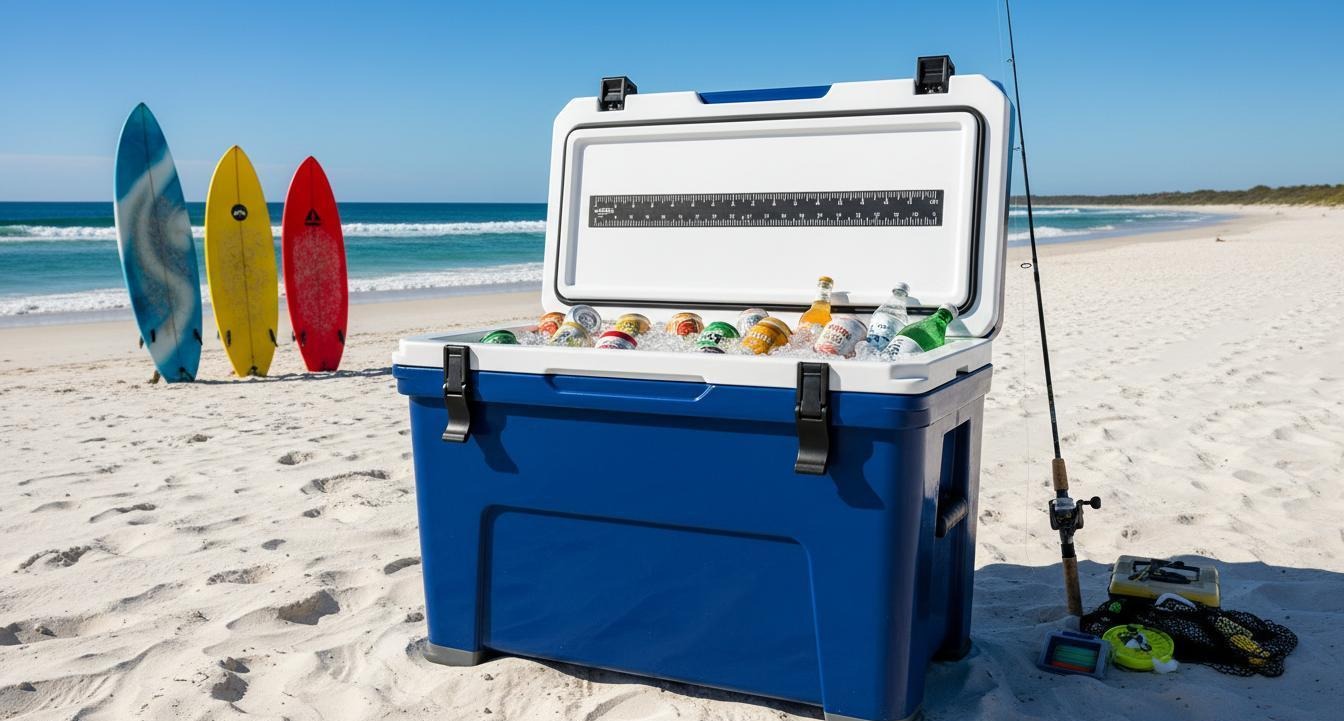
When I walk into a marine supply store in Fremantle or a fishing co-op on the Great Australian Bight, I see the same problem over and over: cheap injection-molded coolers that quit after 48 hours, leaving bait rotting and drinks warm before the boat even clears the harbor. That’s a solvable problem, and it starts with rotomolded construction. If you’re an Australian importer or marine store buyer evaluating cooler box wholesale options, understanding the difference between manufacturing processes could be the single most profitable insight in your inventory decision.
In this guide, I break down exactly why rotomolded cooler boxes outperform other types in marine environments, what specifications matter most for Australian coastal conditions, how to vet Chinese manufacturers without flying to Ningbo, and what pricing to expect at genuine wholesale MOQs.
What Is Rotomolding — and Why It Changes Everything for Marine Coolers
Rotational molding (rotomolding) is a production process where powdered polyethylene is heated inside a closed mold that rotates on two axes simultaneously. Because the plastic flows evenly across every surface, the wall thickness is completely uniform — there are no weld lines, no weak points, and no thin walls that crack under impact. Compare this to injection molding, where molten plastic is shot into a mold at high pressure; that process creates gate scars, uneven wall sections, and stress concentrations that are exactly where marine coolers fail first.
For Australian marine stores, this matters enormously. A fishing vessel bouncing through a 2-meter swell needs a cooler that can take a hard corner-drop onto a fibreglass deck without cracking. A charter boat operator needs a cooler that sits in35°C cockpit heat for8 hours and still keeps the catch at 4°C. Because rotomolded coolers are one seamless piece of plastic, they are fundamentally more resistant to impact damage, UV degradation, and water ingress than any cooler built from multiple welded sections.
The rotomolding process also allows manufacturers to embed thick insulation directly into the mold wall. A quality marine rotomolded cooler typically features 40–60 mm of closed-cell polyurethane foam filling the entire cavity between the inner and outer plastic shells. That foam is the ice retention engine — and its density and distribution are determined by the mold design, not added in a secondary step.
The 5-Day Ice Retention Claim: What It Really Means
You’ll see “5-day ice retention” printed on cooler boxes from nearly every Chinese manufacturer. Not all of those claims are created equal, and understanding the test conditions behind the number is critical for Australian buyers.
Industry-standard ice retention testing fills the cooler with pre-frozen ice (typically2 kg blocks at -18°C) and places it in a controlled environment at 23°C ambient temperature with no lid openings. Under those conditions, a properly rotomolded marine cooler with 50 mm foam insulation will typically hold usable ice for 4–6 days. But Australian marine conditions are nothing like a23°C lab.
On a summer afternoon in the Pilbara or the Top End, cockpit temperatures can exceed 50°C. Direct sunlight hammers a cooler sitting on a boat deck for hours. Every time someone opens the lid — and on a working boat, that’s dozens of times a day — cold air escapes and warm ambient air rushes in. Because of this, I recommend treating manufacturer ice retention claims as baseline performance under ideal conditions, then applying a 30–40% discount for real-world Australian marine use.
That still means a quality rotomolded marine cooler will deliver 3–4 full days of ice retention in active commercial use — far better than the 18–36 hours you’ll get from a typical retail-grade injection-molded cooler. For charter fishing operators running full-day or multi-day trips, that difference is the entire value proposition.
When evaluating Chinese manufacturers, ask for the actual test report (not just a marketing spec sheet). Look for tests conducted at ambient temperatures of 30°C or higher, with simulated lid openings, to get a realistic performance picture. Because the foam density and wall thickness are the two primary drivers of ice retention, I push buyers to request physical samples before committing to full container orders.
Load Capacity: Why 330LB (150KG) Matters for Commercial Marine Use
Australian marine stores serve a wide range of commercial customers: recreational fishers, charter boat operators, commercial fishing vessels, dive tour companies, and research institutions. Many of these customers are loading their coolers with far more than just drinks and ice.
Commercial catch coolers routinely hold 30–80 kg of iced fish on a single trip. Dive operators pack heavy dive gear on top of ice chests. Research vessels use coolers as temporary cold storage for samples that need to stay at specific temperatures. A 330 LB (150 KG) rated cooler isn’t overbuilt — for many commercial marine applications, it’s the minimum you should consider.
Rotomolded construction achieves this load capacity through a combination of factors. The seamless one-piece shell distributes load stress evenly rather than concentrating it at weld points. The base of a quality marine cooler is typically reinforced with additional wall thickness and ribbing patterns molded into the outer shell. And the lid is usually a separate rotomolded component with a robust hinge system — not a snap-fit lid that can deform under load.
When sourcing from China, I always ask manufacturers for the specific load test documentation, not just the rated capacity number. Because the rotomolding process is highly mold-dependent, manufacturers who cut corners on mold steel or use recycled polyethylene will show load ratings that don’t hold up in the field. Reputable manufacturers in Ningbo and Qingdao typically use virgin LLDPE (Linear Low-Density Polyethylene) with UV stabilizer additives specifically formulated for outdoor marine exposure.
Marine-Grade Features That Australian Buyers Should Specify
Beyond ice retention and load capacity, there are several construction details that separate a genuine marine rotomolded cooler from a general-purpose outdoor cooler that happens to be sold through marine retailers:
UV-stable outer shell: Australian UV ratings are among the highest in the world — UV Index11+ is common in Queensland and Northern Territory summer. Inferior coolers will become brittle and chalk within 12–18 months of constant sun exposure. Request UV8 or UV10 stabilizer additives in the outer shell formulation.
Non-slip base pad: A molded rubber or silicone base pad prevents the cooler from sliding on wet boat decks. This is a safety issue on working vessels, and it’s one of the first things commercial boat operators notice when evaluating coolers.
Integrated tie-down slots: Many Australian marine vessels operate in conditions where securing every loose item is a regulatory requirement, not just a best practice. Molded tie-down slots in the cooler body allow users to use cam straps or rope through the cooler without additional hardware.
Heavy-duty hinge system: Avoid coolers with piano hinges or snap-hinge designs. Marine hinges should be rotomolded as part of the shell or use stainless steel pin hinges with molded bearing surfaces. Because a failed hinge in a commercial marine environment can dump an entire catch, this is not a place to accept compromises.
Drain plug location and design: The drain plug should be low on the cooler body (not the base) to allow complete drainage without tilting. Marine-rated silicone gasket seals on the drain plug are essential to prevent weeping in rough conditions.
Understanding Wholesale Pricing from Chinese Manufacturers
The FOB Ningbo pricing for quality rotomolded marine coolers typically falls into the following range, based on capacity and specification level:
Entry-level rotomolded coolers (20–30L capacity, basic foam) start around USD $18–25 per unit at 50-piece MOQ. Mid-range marine-grade coolers (40–60L with enhanced foam density, UV stabilization, and reinforced base) run USD $35–55 per unit. Premium commercial marine coolers (80–100L with 5+ day ice retention, 150KG load rating, and full marine hardware) land in the USD $65–120 per unit range.
Because shipping from Ningbo to Australian ports (Sydney, Melbourne, Fremantle) adds significant landed cost, most Australian marine store buyers work at 100–200 unit MOQ to achieve meaningful per-unit freight economics. Container loading (20ft FCL = approximately 400–600 units depending on cooler size) is typically the most cost-effective approach for established retailers.
Payment terms from Chinese manufacturers typically range from 30% deposit / 70% balance against copy of Bill of Lading to irrevocable Letter of Credit for first-order buyers. I recommend establishing credit terms with manufacturers over 2–3 repeat orders before requesting open credit terms.
Certifications and Compliance for Australian Market Entry
For marine-grade cooler boxes sold into Australian commercial marine use, there are no specific mandatory certifications required — but for retail sales through marine supply stores, buyers increasingly expect compliance with the following:
Food-grade materials: The inner liner of any cooler intended to store fish, bait, or food products should be manufactured from FDA-compliant food-grade polyethylene. Request the manufacturer’s food contact material declaration.
UV stabilization testing: Ask for ASTM D4329 ( Xenon arc lamp exposure) or equivalent testing demonstrating UV resistance at Australian UV Index levels. This protects both your customers and your reputation.
BPA-free certification: Increasingly expected by Australian consumers. Reputable manufacturers can provide test reports from SGS or similar third-party laboratories confirming no BPA migration.
ISO9001 manufacturer certification: This indicates the manufacturer has a documented quality management system, which correlates strongly with production consistency — essential when you’re importing container loads where inspection at source isn’t practical.
How to Vet Chinese Manufacturers Without Visiting the Factory
I understand that most Australian marine store buyers can’t fly to Ningbo for every container order. Here’s the practical due diligence process I use with my clients:
Step 1 — Online factory verification: Use Google Maps satellite view and company registration databases (tianyancha.com or qichacha.com) to verify the factory address matches the legal business registration. Be wary of trading companies posing as manufacturers. A genuine factory will have a consistent operational footprint, not a virtual office address.
Step 2 — Sample evaluation: Order 2–3 samples before committing to full MOQ. Test ice retention yourself under ambient Australian conditions. Evaluate hinge feel, lid seal, and base pad grip. Because a bad container decision costs far more than the sample shipping, I never skip this step.
Step 3 — Video factory tour: Request a live video call with the factory floor. Ask to see the rotomolding machine in operation, the foam injection process, and the quality control station. Manufacturers who refuse video calls are a red flag — walk away. Ask specifically to see the foam density certification for the batch of raw material they plan to use for your order.
Step 4 — Third-party inspection: For orders over USD $10,000, engage a QC inspection company (AsiaInspection, QIMA, or similar) to conduct pre-shipment inspection. A typical marine cooler inspection covers: dimensions, wall thickness (ultrasonic gauge), hinge operation, seal integrity, UV surface condition, and packaging verification.
Why Australian Marine Store Buyers Are Moving Away from Domestic Suppliers
For decades, Australian marine stores sourced coolers primarily from domestic distributors or established international brands. That model worked when the price gap between domestic and imported product was small and the quality gap was manageable. But that gap has narrowed dramatically in the past five years as Chinese rotomolded cooler manufacturing has matured.
The domestic Australian retail market for marine coolers has seen significant price compression. Imported rotomolded marine coolers from China now compete at price points that make the domestic distribution model economically unviable for most retailers. The result is that Australian marine stores that haven’t yet established direct manufacturing relationships in China are paying 40–70% more per unit than stores with direct supply agreements.
For a marine store ordering 200 units per quarter, that price gap represents USD $6,000–12,000 in quarterly margin compression. Over a 12-month period, the difference between direct factory sourcing and distributor-based purchasing can easily exceed USD $30,000–40,000 in lost margin. Because that margin difference can fund an additional staff member, better retail display infrastructure, or expanded product range, the sourcing decision is not just a product decision — it’s a business strategy decision.
The key is finding a manufacturer who treats Australian marine retailers as a priority market, not a secondary export destination. Manufacturers who already supply the Australian market understand the UV requirements, the retail packaging expectations, and the seasonal demand patterns that drive your inventory cycles. Building that relationship early, before your order volume is large enough to be attractive to the factory, gives you better negotiating leverage than waiting until you’re ordering full containers.
Sizing Guide: Matching Cooler Capacity to Australian Marine Applications
Getting the right size cooler is one of the most common mistakes Australian marine store buyers make when stocking rotomolded cooler inventory. Here’s my practical sizing guide based on end-user application:
20–30L: Ideal for personal watercraft (jet ski, small dinghy), kayak fishing, and short half-day trips. Handles approximately 10–15 kg of catch with ice.
40–50L: The best-selling marine retail size. Fits in most boat rod lockers, handles a full day’s fishing catch (20–40 kg), and suits charter boat crew use. This is the sweet spot for Australian marine store inventory — carry at least 2–3 color options.
60–75L: Commercial fishing and charter boat primary cooler. Holds 50–80 kg of catch with ice. Consider this as the recommended upgrade path for customers who own the 40–50L and want to move up.
80–100L: Research vessel, commercial dive operation, and remote area tourism operator territory. The 150KG load rating becomes critical at this capacity range for heavy commercial applications.
Building Your Marine Cooler Product Page for Australian Retail
For marine stores selling online or through catalog, the product page needs to communicate the specific Australian marine use case, not generic outdoor cooler copy. Buyers searching for “cooler box wholesale Australia” are typically trade buyers or serious recreational users — they want technical specificity, not lifestyle photography.
Key spec fields to display prominently: actual ice retention days (with test temperature stated), load capacity in both KG and LB, internal dimensions (for fitting into specific boat storage spaces), weight when empty, and UV stabilization level. Include a comparison table showing the rotomolded option versus injection-molded alternatives — this is often the conversion trigger for price-comparison shoppers.
Internal links to your broader cooler box category and hiking and camping gear range help buyers discover complementary products. Cross-selling rotomolded coolers with camping awnings, waterproof storage, and marine hardware creates higher average order values.
Conclusion
Rotomolded cooler boxes represent the strongest margin opportunity in the Australian marine cooler market — and the reason is simple: they outperform alternatives so dramatically in real marine conditions that customers who try them once rarely go back to cheaper alternatives. Because the rotomolding process creates a fundamentally superior product, the key sourcing decision is not whether to carry rotomolded coolers, but how to source them at the right quality level and price point from a Chinese manufacturer you can trust.
Focus on manufacturers who can provide food-grade material declarations, UV stabilization test reports, and physical samples for ice retention testing under Australian conditions. Build your inventory mix around the 40–75L range that serves90% of your commercial and serious recreational customers. And invest in the sample evaluation step — that USD $80–150 spent on samples before a container order is the cheapest insurance against a bad inventory decision you’ll ever make.
For Australian marine store buyers ready to move from sampling to full wholesale orders, CBNB Supplier’s rotomolded cooler box range starts at 50-piece MOQ with FOB Ningbo delivery.Browse the full range on cbnbsupplier.com or explore the hiking and camping category for complementary marine and outdoor products.
Post time: Jun-08-2026