




- 1. What is the factory FMVSS/SAE compliance documentation process? Without it, your goods risk customs rejection and liability exposure.
- 2. Can I tour the production facility or conduct a live video inspection? A supplier who refuses is hiding something.
- 3. What is your AQL sampling standard and which inspection phases do you cover? “We inspect at the end” is not a QC system.
- 4. Do you provide HS code classification before the order? Wrong codes cause penalty fees, delays, and unexpected duty costs.
- 5. What are your payment terms for first orders vs. repeat orders? Cash in advance on first orders is a red flag.
- 6. How do you handle pre-shipment inspection failures? The answer reveals their accountability culture.
- 7. What is your lead time from PO to EXW, and what causes delays? Padding in quoted lead times masks factory instability.
- 8. What certifications do you hold, and can I verify them independently? Self-issued certificates are worthless.
- 9. Do you offer consolidated shipping across product categories? Separate shipments multiply logistics costs.
- 10. What is your incoterms structure, and who controls the freight forwarding? Hidden freight markups erode your landed cost model.
Every vehicle accessories importer has at least one story of a supplier that seemed professional until the shipment arrived. Wrong HS codes, missing FMVSS documentation, a sample that looked nothing like the production run, a factory that went dark for 3 weeks mid-production — these are not edge cases. They are the most common sourcing failures in the industry, and they are almost entirely preventable if you ask the right questions before you place an order. Because most buyers do not ask — they assume the supplier sales deck tells the full story — the ones who do ask stand apart. Therefore, these 10 questions are not negotiable. They are the baseline due diligence that separates professional importers from first-timers who absorb the learning curve on their own budget.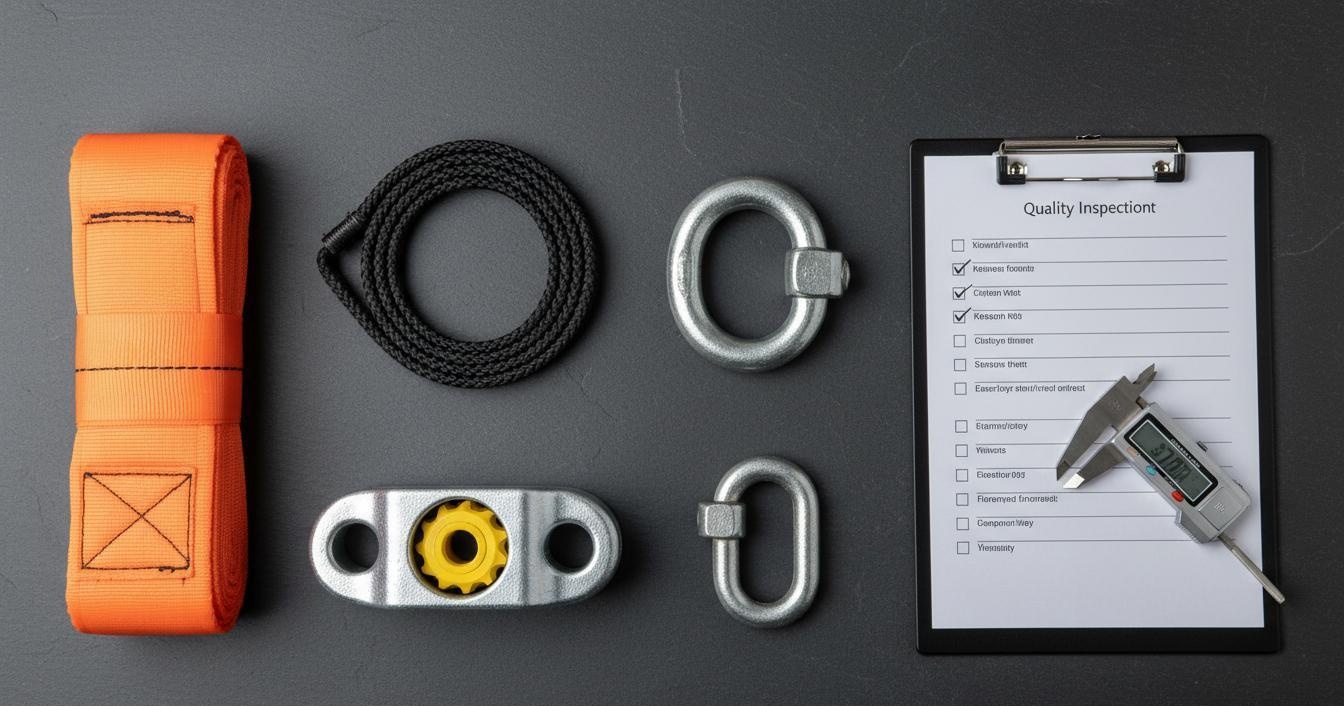
The 10-Question Red-Flag Checklist
Question 1: What is your FMVSS compliance documentation process for products sold in the US market?
Why This Matters
The Federal Motor Vehicle Safety Standards (FMVSS) are legally mandatory for vehicle safety equipment sold in the US — recovery straps, winches, shackles, and towing accessories are not exempt. If a supplier cannot produce FMVSS-compliant documentation, your goods can be seized at customs, fined post-delivery, or become the subject of a product liability claim if they fail in use.
Good Answer
“We have a dedicated compliance team that maintains FMVSS documentation for all vehicle safety products. For each product category, we hold current test reports from SAE-accredited labs, and we can provide the documentation package — including material certifications and batch-level traceability — before your goods leave the port. We flag any FMVSS updates that affect our product line within 30 days of publication.”
Red Flag
“We do not handle FMVSS — our buyers take care of that themselves.” or “Our CE marking covers the EU and the US uses the same standard.” Both are false. CE does not equal FMVSS, and no supplier who says this has actually tested their products to the US standard.
Consequence
Importing non-FMVSS-compliant recovery gear into the US exposes your company to civil liability, CBP seizure of the shipment at the port of entry, and potential NHTSA enforcement action including mandatory recall. The cost of a recall — product retrieval, customer compensation, regulatory filing — can exceed the total revenue of the order.
Question 2: Can I tour your production facility or conduct a live video inspection before I place my first order?
Why This Matters
A factory that refuses on-site or video inspections is either too small to absorb the logistics overhead of a buyer visit, hiding working condition violations, or misrepresenting its production capability. Any legitimate manufacturer with capacity to fulfill B2B orders should be able to accommodate a facility tour.
Good Answer
“We regularly host buyer visits at our Ningbo facility. We can arrange a video walkthrough with our production manager within 7 days, or schedule an in-person visit with 2 weeks notice. We have a dedicated buyer liaison team that handles logistics coordination, translator services, and a written tour report with photos of current production runs.”
Red Flag
“Our factory is currently at capacity and not accepting visitor appointments.” or “We have NDAs with our other buyers that prevent us from showing the facility.” Both are deflection. A factory at full capacity will schedule a visit 4–6 weeks out, not refuse entirely.
Consequence
Ordering from a factory you have never seen and that refuses to show you its operation means you are sourcing on faith. Production delays, quality inconsistencies, and capacity shortfalls discovered mid-order are expensive to resolve from a distance.
Question 3: What is your AQL sampling standard, and at which production phases do you conduct inspections?
Why This Matters
Single-point final inspection is not a quality control system — it is a quality detection mechanism that tells you what is already wrong. A real QC system catches deviations at the pre-production and during-production phases, when correction is still cheap.
Good Answer
“We use ISO 2859-1 AQL 2.5 with three inspection phases: pre-production (first-shot samples against specs), during production (at 30% and 70% completion), and pre-shipment (full inspection before release). For orders above 5,000 units, we conduct DPI at both milestones. You receive a full inspection report with photos before goods are released.”
Red Flag
“We inspect every unit before shipping — 100% check.” While this sounds good, 100% inspection without reference to a statistical sampling standard is unverified. Also a red flag: “We only do final inspection, but our defect rate is very low.” Low defect rates without during-production checkpoints are luck, not process.
Consequence
Final-only inspection means defective goods are already packed and containerized before you know there is a problem. Correction requires unpacking, reworking, and potentially re-shipping — a cost that falls on you, not the factory.
Question 4: Can you provide HS code classification for each product in my order before I confirm the PO?
Why This Matters
Incorrect HS code classification causes customs penalty fees (typically 10–30% of the shipment value), port storage fees while customs resolves the discrepancy, and in extreme cases, seizure of non-compliant goods.
Good Answer
“We maintain a proprietary HS code database covering all SKUs in our vehicle accessories catalog, with classification confirmed by licensed customs brokers in the US, EU, UK, and Australia. For any new SKU not yet in our database, we engage a third-party broker for classification confirmation before the order is placed. You will receive an HS code sheet with your order confirmation including applicable duty rates for your destination market.”
Red Flag
“HS codes are the importer responsibility — you handle customs clearance.” While technically correct, a supplier with no HS code knowledge is either new to export or not handling documentation seriously.
Consequence
Entering an order without HS code confirmation means your freight forwarder estimate may not reflect actual duty costs. A 10% duty miscalculation on a $50,000 shipment is a $5,000 unexpected cost — absorbed by your margin, not the supplier.
Question 5: What are your standard payment terms for first orders, and how do they change for established relationships?
Why This Matters
Payment terms reveal how much risk the supplier is willing to share. A supplier demanding 100% cash in advance on a first order is shifting all risk to the buyer — and has no financial incentive to resolve any problems that arise.
Good Answer
“For first orders, we recommend Letter of Credit (LC) at sight or 30% deposit / 70% balance TT terms. For buyers with a 3-order track record and no CARs, we shift to 30% deposit / 70% balance at destination or net-60 terms for accounts below $50,000 annual volume. All payment terms are documented in our standard Terms of Trade.”
Red Flag
“We require 100% payment in advance for first orders.” or “We only accept irrevocable LC confirmed through a Chinese bank of our choice.” Both are problematic. 100% advance payment provides zero leverage if the factory fails to deliver conforming goods. An LC confirmed through the factory own bank eliminates the bank as a neutral arbiter.
Consequence
Paying 100% in advance to a new supplier means your recourse if goods arrive non-conforming is limited to whatever goodwill the supplier decides to extend. Without a payment instrument that releases funds contingent on conforming goods, you have no financial protection.
Question 6: What is your Corrective Action Request (CAR) process when a pre-shipment inspection fails?
Why This Matters
How a supplier handles quality failures reveals their accountability culture. A supplier with a strong quality system treats inspection failures as a process improvement opportunity and has a documented escalation path.
Good Answer
“When a PSI fails, we issue a CAR within 24 hours with a mandatory root cause analysis from the factory within 10 business days. Production is halted until the CAR is resolved. We offer three resolution paths: re-manufacture at the factory cost with free re-inspection; substitution of the defective component from an alternate qualified factory; or a price reduction reflecting the reduced value of non-conforming goods. All CARs are tracked and reviewed quarterly to identify factories with recurring quality patterns.”
Red Flag
“We will discuss the inspection results and see what we can do.” or “A small defect rate of 3–5% is normal in this industry.” Both are deflection. A 3–5% defect rate on a recovery product is not normal and not acceptable — it is a safety issue. And “we will discuss it” has no accountability mechanism behind it.
Consequence
Without a documented CAR process, inspection failures get resolved through email negotiations that can stretch weeks — during which your goods sit in the factory warehouse, accruing storage fees, while your retail inventory timeline deteriorates.
Question 7: What is your typical lead time from PO confirmation to EXW delivery, and what factors most commonly cause delays?
Why This Matters
Lead time accuracy affects your inventory planning. A supplier who quotes 20-day lead time but routinely ships at 35 days forces you to carry excess buffer stock to avoid stockouts — tying up working capital in inventory you should not need to hold.
Good Answer
“Our standard lead time is 25–35 days from PO and artwork approval to EXW Ningbo, excluding transit. The most common delay factors are: material procurement for custom colors (adds 7–10 days), holiday periods (Chinese New Year: add 15–20 days; National Day: add 7–10 days), and peak season (October–November: add 5–7 days). We flag any delay risk at the 15-day mark and provide an updated delivery estimate with expediting options if needed.”
Red Flag
“Our lead time is 15 days — we can ship faster than anyone.” Lead times below 20 days for custom-manufactured goods are almost always optimistic. A 15-day quoted lead time means the factory is either triple-booking its production schedule or willing to sacrifice quality during the inspection phase.
Consequence
Unreliable lead times force you into a safety stock strategy: holding 4–6 weeks of inventory as a buffer against delays. At a 40% gross margin and 15% carrying cost, holding an extra month of safety stock on a $200,000 annual SKU costs approximately $3,000/year in carry costs alone.
Question 8: Can you provide third-party verified certifications, and can I verify them independently through the issuing body?
Why This Matters
Self-issued or factory-generated certifications are worthless in regulated markets. A CE certificate from a factory that is not actually tested is not a CE certificate — it is a document that can be used against you in a liability proceeding to prove you knew the certification was unverified.
Good Answer
“All certifications are issued through SGS, Bureau Veritas (BV), or TUV Rheinland — not self-issued. We provide the test report number, issuing laboratory, and date of issue for every certificate in your order documentation package. You can verify each certificate independently by entering the report number on the issuing laboratory public website.”
Red Flag
“We have all the necessary certifications — we will send you copies after the order is confirmed.” or “We are ISO certified” without a certificate number or issuing body. Both are evasion. A legitimate certification exists before the order, is specific to the product being sold, and can be independently verified.
Consequence
Marketing products as CE-certified or FMVSS-compliant when the underlying test reports are fabricated exposes your company to product liability claims and regulatory enforcement. NHTSA has pursued civil penalties against importers of falsely certified vehicle safety products.
Question 9: Do you offer consolidated shipping across multiple product categories, and what are your consolidation warehouse capabilities?
Why This Matters
If you are sourcing vehicle accessories plus pet supplies plus hiking gear through separate suppliers, you are managing separate shipments, separate customs entries, and separate freight invoices. A supplier who can consolidate across categories reduces your logistics overhead and per-unit freight cost significantly.
Good Answer
“We operate a consolidation hub in Ningbo with bonded warehouse capability. You can place orders across our vehicle, pet, hiking, and garden categories — we aggregate them into a single shipment, issue one Bill of Lading, and provide one customs documentation package. Consolidated LCL shipping typically reduces your ocean freight cost by 40–60% compared to separate factory-direct shipments.”
Red Flag
“We only ship from our own factory — you will need to arrange your own consolidation.” or “We quote FOB only and do not handle freight coordination.” A supplier who quotes FOB without offering freight coordination is saying: “We have completed our obligation when the goods leave our dock — what happens next is your problem.”
Consequence
Managing 4 separate shipments instead of 1 consolidated shipment means 4x the freight forwarding fees, 4x the customs entry costs, 4x the documentation overhead, and 4x the tracking complexity. For a mid-market importer doing $500,000/year, consolidated shipping versus fragmented represents an $8,000–$15,000 annual logistics cost difference.
Question 10: What is your incoterms structure, and do you have visibility into the freight forwarding markup so I can calculate a true landed cost?
Why This Matters
Incoterms define who is responsible for which costs at which point in the shipping chain. A supplier who insists on DDP pricing but will not disclose the freight component is hiding a margin markup that inflates your landed cost unnecessarily.
Good Answer
“We support EXW, FOB, CIF, DDP, and DAP per Incoterms 2020. For FOB and CIF quotes, we provide a separate line-item breakdown of ocean freight, insurance, and port charges so you can calculate your exact landed cost. We do not mark up freight — we pass through the forwarder rate at cost plus a documented 3% administrative fee.”
Red Flag
“We only quote DDP and the price includes everything.” When a supplier will not break out the freight component, the freight margin is embedded in the product price — and you have lost visibility into what you are actually paying for logistics versus product.
Consequence
If a supplier marks up ocean freight by 20–30% and buries it in the DDP price, you are overpaying for logistics by that margin on every shipment. Over 12 months, an importer shipping 10 FCLs per year at $3,000/FCL freight could be paying $6,000–$9,000 in unnecessary freight markup embedded in product prices.
These 10 questions are your minimum viable due diligence checklist for any vehicle accessories supplier — whether you are sourcing a single SKU or building a full catalog. Asking them upfront is not adversarial — it is how professional buyers operate. A supplier who answers confidently and completely has nothing to hide. A supplier who deflects, delays, or demands trust without evidence is telling you who they are before you have placed the order. Our CBNB Vehicle Parts & Accessories — Wholesale with Strict QC & Flexible Shipping team answers all 10 of these questions in our initial sourcing consultation. Explore our certified recovery gear range — including the Synthetic Soft Shackle Recovery Kit — 41,000 LBS Breaking Strength, CE Certified and the Snatch Block 15,000 lb — Heavy-Duty Winch Accessory — to see what a fully documented, third-party verified sourcing process looks like in practice.
Frequently Asked Questions
1. Is it realistic to expect a supplier to answer all 10 questions in an initial inquiry?
Yes — for any supplier with more than 2 years of experience exporting to regulated markets. A professional supplier sales team should be able to answer all 10 questions from their standard documentation package within 24–48 hours of your inquiry. If you are working with a supplier who cannot answer these questions in week one, they will not be easier to work with in week eight. Suppliers who say “our lawyers review information requests before we respond” are using process overhead as a red tape barrier to prevent you from getting the answers you need.
2. Should I share this checklist directly with a supplier, or use it as a mental framework?
Use it as a mental framework first. Share the checklist only if you are doing due diligence on a supplier you have already vetted and are seriously considering as a long-term partner. Sharing it with a supplier during initial outreach signals that you are a sophisticated buyer — which filters out low-quality suppliers who would rather work with buyers who do not ask these questions. However, be aware that some suppliers will prepare answers specifically for the checklist without actually having the underlying systems in place. Use the interview to probe deeper: ask for specific inspection reports, specific HS code confirmations, specific root cause analysis documents from prior failures. The specificity of your follow-up questions will reveal whether the initial answers were rehearsed or real.
3. How do these questions apply if I am sourcing from a trading company rather than a direct factory?
Trading companies can be legitimate sourcing partners — and in many cases, they provide value that direct factories cannot (consolidation, QC management, documentation handling, payment risk mitigation). However, the questions become more important when working with a trading company because the factory relationship is one step removed. Ask specifically: which specific factory will produce my goods? Can I inspect that factory? Who conducts the QC inspection — you or the factory? Who holds the liability if goods fail to conform? A trading company that can answer these questions and provide documentation linking specific factories to your specific order is operating professionally. A trading company that says “we work with several factories and we manage the QC ourselves” without being able to name the factory or show you its audit report is operating as a black box — and you do not want to be inside a black box when something goes wrong.
4. What is the single most important question on this list?
Question 8 — third-party verification of certifications. Everything else can be resolved through negotiation, process improvement, or relationship management. But a supplier who cannot produce independently verifiable test reports is selling you documentation that may not correspond to actual product performance. In vehicle safety accessories, a fabric strap that fails under load because the breaking strength was overstated in an unverified test report kills people and bankrupts companies. The certification question is not about compliance bureaucracy — it is about whether the product you are selling does what the supplier says it does. Everything else follows from that foundation.
5. Should I use this checklist with CBNB as a supplier?
Please do. We published this checklist because we believe buyers who ask these questions end up as long-term customers — and buyers who do not ask them sometimes end up as costly cautionary tales. Every question on this list is one we can answer with documentation, not reassurance. Ask for the FMVSS test reports, ask for the factory audit, ask for the CAR history, ask for the HS code breakdown. If a supplier cannot provide these on request, that is your answer before you place the order. Our sourcing team responds to these questions in the initial consultation, not after you have signed a supplier agreement.
6. What should I do if a supplier gives me great answers to all 10 questions but the first shipment is still problematic?
Document everything immediately: take photos of the non-conforming goods, note the specific specification deviations, and send a formal written complaint to the supplier within 48 hours of discovery — not 2 weeks later. Invoke the CAR process if the supplier has one (Question 6), and escalate to the supplier management if the factory does not respond within the agreed timeline. If you do not have a CAR process, establish one now: demand a root cause analysis, a corrective action plan with a timeline, and a commitment to either re-manufacture or compensate. If the supplier refuses to engage on a corrective action path, you have your answer about whether this is a partnership worth continuing. First-shipment problems with a supplier who has good processes are recoverable. First-shipment problems with a supplier who deflects or minimizes are a preview of every future order.
Dave Zheng (郑达维)
International Procurement Director at CBNB Supplier | 12 years in global supply chain management | Helped 400+ overseas brands source from China 36,000-factory network | Let me put my sourcing expertise to work for your next product line.
Connect on LinkedIn · Contact Dave Directly · Explore Vehicle Accessories
Start Your Vetted Sourcing Journey
Skip the 10-question interview process — CBNB supply chain system answers every question on this checklist before you ask. Pre-vetted factories, three-phase QC, verified certifications, and transparent logistics. Place your first order with confidence.
Post time: May-19-2026